A16270. One-X
编程题
普及/提高-
知识点
题目描述
In this sad world full of imperfections, ugly segment trees exist.
A segment tree is a tree where each node represents a segment and has its number. A segment tree for an array of $n$ elements can be built in a recursive manner. Let's say function $\operatorname{build}(v,l,r)$ builds the segment tree rooted in the node with number $v$ and it corresponds to the segment $[l,r]$ .
Now let's define $\operatorname{build}(v,l,r)$ :
- If $l=r$ , this node $v$ is a leaf so we stop adding more edges
- Else, we add the edges $(v, 2v)$ and $(v, 2v+1)$ . Let $m=\lfloor \frac{l+r}{2} \rfloor$ . Then we call $\operatorname{build}(2v,l,m)$ and $\operatorname{build}(2v+1,m+1,r)$ .
So, the whole tree is built by calling $\operatorname{build}(1,1,n)$ .
Now Ibti will construct a segment tree for an array with $n$ elements. He wants to find the sum of $\operatorname{lca}^\dagger(S)$ , where $S$ is a non-empty subset of leaves. Notice that there are exactly $2^n - 1$ possible subsets. Since this sum can be very large, output it modulo $998\,244\,353$ .
$^\dagger\operatorname{lca}(S)$ is the number of the least common ancestor for the nodes that are in $S$ .
A segment tree is a tree where each node represents a segment and has its number. A segment tree for an array of $n$ elements can be built in a recursive manner. Let's say function $\operatorname{build}(v,l,r)$ builds the segment tree rooted in the node with number $v$ and it corresponds to the segment $[l,r]$ .
Now let's define $\operatorname{build}(v,l,r)$ :
- If $l=r$ , this node $v$ is a leaf so we stop adding more edges
- Else, we add the edges $(v, 2v)$ and $(v, 2v+1)$ . Let $m=\lfloor \frac{l+r}{2} \rfloor$ . Then we call $\operatorname{build}(2v,l,m)$ and $\operatorname{build}(2v+1,m+1,r)$ .
So, the whole tree is built by calling $\operatorname{build}(1,1,n)$ .
Now Ibti will construct a segment tree for an array with $n$ elements. He wants to find the sum of $\operatorname{lca}^\dagger(S)$ , where $S$ is a non-empty subset of leaves. Notice that there are exactly $2^n - 1$ possible subsets. Since this sum can be very large, output it modulo $998\,244\,353$ .
$^\dagger\operatorname{lca}(S)$ is the number of the least common ancestor for the nodes that are in $S$ .
输入格式
Each test consists of multiple test cases. The first line contains a single integer $t$ ( $1 \le t \le 10^3$ ) — the number of test cases. The description of the test cases follows.
The first line of each test case contains a single integer $n$ ( $2 \le n \le 10^{18}$ ) — the length of the array for which the segment tree is built.
The first line of each test case contains a single integer $n$ ( $2 \le n \le 10^{18}$ ) — the length of the array for which the segment tree is built.
输出格式
For each test case, output a single integer — the required sum modulo $998\,244\,353$ .
输入输出样例
输入 #1
5
2
3
4
5
53278
输出 #1
6
17
36
69
593324855
说明/提示
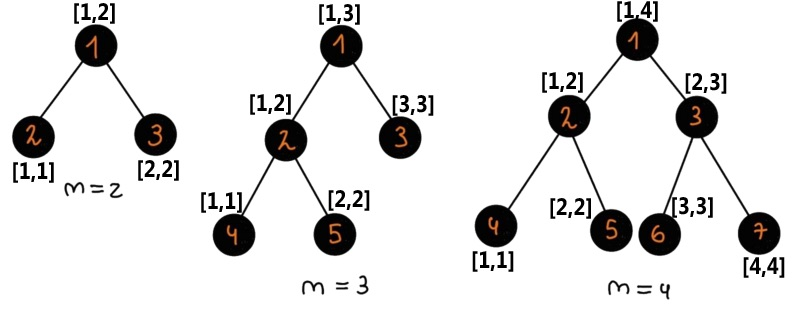In the first test case:
Let's look at all subsets of leaves.
- $\operatorname{lca}(\{2\})=2$ ;
- $\operatorname{lca}(\{3\})=3$ ;
- $\operatorname{lca}(\{2,3\})=1$ .
Thus, the answer is $2+3+1=6$ .
In the second test case:
Let's look at all subsets of leaves.
- $\operatorname{lca}(\{4\})=4$ ;
- $\operatorname{lca}(\{5\})=5$ ;
- $\operatorname{lca}(\{3\})=3$ ;
- $\operatorname{lca}(\{4,5\})=2$ ;
- $\operatorname{lca}(\{4,3\})=1$ ;
- $\operatorname{lca}(\{5,3\})=1$ ;
- $\operatorname{lca}(\{4,5,3\})=1$ ;
Thus, the answer is $4+5+3+2+1+1+1=17$ .
Let's look at all subsets of leaves.
- $\operatorname{lca}(\{2\})=2$ ;
- $\operatorname{lca}(\{3\})=3$ ;
- $\operatorname{lca}(\{2,3\})=1$ .
Thus, the answer is $2+3+1=6$ .
In the second test case:
Let's look at all subsets of leaves.
- $\operatorname{lca}(\{4\})=4$ ;
- $\operatorname{lca}(\{5\})=5$ ;
- $\operatorname{lca}(\{3\})=3$ ;
- $\operatorname{lca}(\{4,5\})=2$ ;
- $\operatorname{lca}(\{4,3\})=1$ ;
- $\operatorname{lca}(\{5,3\})=1$ ;
- $\operatorname{lca}(\{4,5,3\})=1$ ;
Thus, the answer is $4+5+3+2+1+1+1=17$ .