A10324. Bear and Two Paths
编程题
普及/提高-
知识点
题目描述
Bearland has $n$ cities, numbered $1$ through $n$ . Cities are connected via bidirectional roads. Each road connects two distinct cities. No two roads connect the same pair of cities.
Bear Limak was once in a city $a$ and he wanted to go to a city $b$ . There was no direct connection so he decided to take a long walk, visiting each city exactly once. Formally:
- There is no road between $a$ and $b$ .
- There exists a sequence (path) of $n$ distinct cities $v_{1},v_{2},...,v_{n}$ that $v_{1}=a$ , $v_{n}=b$ and there is a road between $v_{i}$ and $v_{i+1}$ for .
On the other day, the similar thing happened. Limak wanted to travel between a city $c$ and a city $d$ . There is no road between them but there exists a sequence of $n$ distinct cities $u_{1},u_{2},...,u_{n}$ that $u_{1}=c$ , $u_{n}=d$ and there is a road between $u_{i}$ and $u_{i+1}$ for .
Also, Limak thinks that there are at most $k$ roads in Bearland. He wonders whether he remembers everything correctly.
Given $n$ , $k$ and four distinct cities $a$ , $b$ , $c$ , $d$ , can you find possible paths $(v_{1},...,v_{n})$ and $(u_{1},...,u_{n})$ to satisfy all the given conditions? Find any solution or print -1 if it's impossible.
Bear Limak was once in a city $a$ and he wanted to go to a city $b$ . There was no direct connection so he decided to take a long walk, visiting each city exactly once. Formally:
- There is no road between $a$ and $b$ .
- There exists a sequence (path) of $n$ distinct cities $v_{1},v_{2},...,v_{n}$ that $v_{1}=a$ , $v_{n}=b$ and there is a road between $v_{i}$ and $v_{i+1}$ for .
On the other day, the similar thing happened. Limak wanted to travel between a city $c$ and a city $d$ . There is no road between them but there exists a sequence of $n$ distinct cities $u_{1},u_{2},...,u_{n}$ that $u_{1}=c$ , $u_{n}=d$ and there is a road between $u_{i}$ and $u_{i+1}$ for .
Also, Limak thinks that there are at most $k$ roads in Bearland. He wonders whether he remembers everything correctly.
Given $n$ , $k$ and four distinct cities $a$ , $b$ , $c$ , $d$ , can you find possible paths $(v_{1},...,v_{n})$ and $(u_{1},...,u_{n})$ to satisfy all the given conditions? Find any solution or print -1 if it's impossible.
输入格式
The first line of the input contains two integers $n$ and $k$ ( $4<=n<=1000$ , $n-1<=k<=2n-2$ ) — the number of cities and the maximum allowed number of roads, respectively.
The second line contains four distinct integers $a$ , $b$ , $c$ and $d$ ( $1<=a,b,c,d<=n$ ).
The second line contains four distinct integers $a$ , $b$ , $c$ and $d$ ( $1<=a,b,c,d<=n$ ).
输出格式
Print -1 if it's impossible to satisfy all the given conditions. Otherwise, print two lines with paths descriptions. The first of these two lines should contain $n$ distinct integers $v_{1},v_{2},...,v_{n}$ where $v_{1}=a$ and $v_{n}=b$ . The second line should contain $n$ distinct integers $u_{1},u_{2},...,u_{n}$ where $u_{1}=c$ and $u_{n}=d$ .
Two paths generate at most $2n-2$ roads: $(v_{1},v_{2}),(v_{2},v_{3}),...,(v_{n-1},v_{n}),(u_{1},u_{2}),(u_{2},u_{3}),...,(u_{n-1},u_{n})$ . Your answer will be considered wrong if contains more than $k$ distinct roads or any other condition breaks. Note that $(x,y)$ and $(y,x)$ are the same road.
Two paths generate at most $2n-2$ roads: $(v_{1},v_{2}),(v_{2},v_{3}),...,(v_{n-1},v_{n}),(u_{1},u_{2}),(u_{2},u_{3}),...,(u_{n-1},u_{n})$ . Your answer will be considered wrong if contains more than $k$ distinct roads or any other condition breaks. Note that $(x,y)$ and $(y,x)$ are the same road.
输入输出样例
输入 #1
7 11
2 4 7 3
输出 #1
2 7 1 3 6 5 4
7 1 5 4 6 2 3
输入 #2
1000 999
10 20 30 40
输出 #2
-1
说明/提示
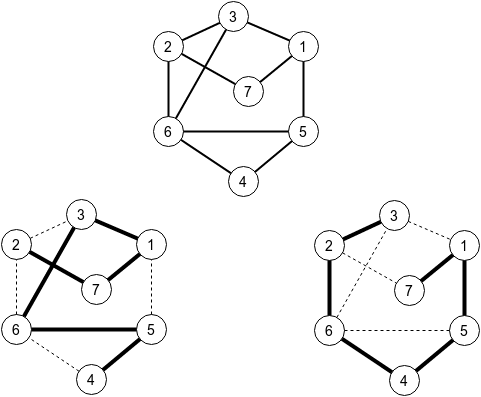
In the first sample test, there should be $7$ cities and at most $11$ roads. The provided sample solution generates $10$ roads, as in the drawing. You can also see a simple path of length $n$ between $2$ and $4$ , and a path between $7$ and $3$ .