A12572. Prime Graph
编程题
普及/提高-
知识点
题目描述
Every person likes prime numbers. Alice is a person, thus she also shares the love for them. Bob wanted to give her an affectionate gift but couldn't think of anything inventive. Hence, he will be giving her a graph. How original, Bob! Alice will surely be thrilled!
When building the graph, he needs four conditions to be satisfied:
- It must be a simple undirected graph, i.e. without multiple (parallel) edges and self-loops.
- The number of vertices must be exactly $n$ — a number he selected. This number is not necessarily prime.
- The total number of edges must be prime.
- The degree (i.e. the number of edges connected to the vertex) of each vertex must be prime.
Below is an example for $n = 4$ . The first graph (left one) is invalid as the degree of vertex $2$ (and $4$ ) equals to $1$ , which is not prime. The second graph (middle one) is invalid as the total number of edges is $4$ , which is not a prime number. The third graph (right one) is a valid answer for $n = 4$ .
Note that the graph can be disconnected.
Please help Bob to find any such graph!
When building the graph, he needs four conditions to be satisfied:
- It must be a simple undirected graph, i.e. without multiple (parallel) edges and self-loops.
- The number of vertices must be exactly $n$ — a number he selected. This number is not necessarily prime.
- The total number of edges must be prime.
- The degree (i.e. the number of edges connected to the vertex) of each vertex must be prime.
Below is an example for $n = 4$ . The first graph (left one) is invalid as the degree of vertex $2$ (and $4$ ) equals to $1$ , which is not prime. The second graph (middle one) is invalid as the total number of edges is $4$ , which is not a prime number. The third graph (right one) is a valid answer for $n = 4$ .
Note that the graph can be disconnected.
Please help Bob to find any such graph!
输入格式
The input consists of a single integer $n$ ( $3 \leq n \leq 1\,000$ ) — the number of vertices.
输出格式
If there is no graph satisfying the conditions, print a single line containing the integer $-1$ .
Otherwise, first print a line containing a prime number $m$ ( $2 \leq m \leq \frac{n(n-1)}{2}$ ) — the number of edges in the graph. Then, print $m$ lines, the $i$ -th of which containing two integers $u_i$ , $v_i$ ( $1 \leq u_i, v_i \leq n$ ) — meaning that there is an edge between vertices $u_i$ and $v_i$ . The degree of each vertex must be prime. There must be no multiple (parallel) edges or self-loops.
If there are multiple solutions, you may print any of them.
Note that the graph can be disconnected.
Otherwise, first print a line containing a prime number $m$ ( $2 \leq m \leq \frac{n(n-1)}{2}$ ) — the number of edges in the graph. Then, print $m$ lines, the $i$ -th of which containing two integers $u_i$ , $v_i$ ( $1 \leq u_i, v_i \leq n$ ) — meaning that there is an edge between vertices $u_i$ and $v_i$ . The degree of each vertex must be prime. There must be no multiple (parallel) edges or self-loops.
If there are multiple solutions, you may print any of them.
Note that the graph can be disconnected.
输入输出样例
输入 #1
4
输出 #1
5
1 2
1 3
2 3
2 4
3 4
输入 #2
8
输出 #2
13
1 2
1 3
2 3
1 4
2 4
1 5
2 5
1 6
2 6
1 7
1 8
5 8
7 8
说明/提示
The first example was described in the statement.
In the second example, the degrees of vertices are $[7, 5, 2, 2, 3, 2, 2, 3]$ . Each of these numbers is prime. Additionally, the number of edges, $13$ , is also a prime number, hence both conditions are satisfied.
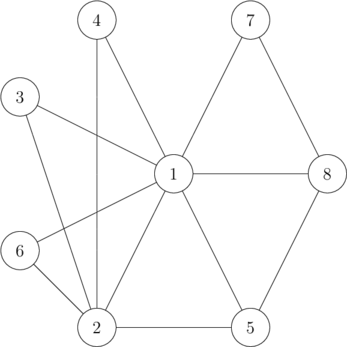
In the second example, the degrees of vertices are $[7, 5, 2, 2, 3, 2, 2, 3]$ . Each of these numbers is prime. Additionally, the number of edges, $13$ , is also a prime number, hence both conditions are satisfied.
