A10272. Seating On Bus
编程题
普及/提高-
知识点
题目描述
Consider $2n$ rows of the seats in a bus. $n$ rows of the seats on the left and $n$ rows of the seats on the right. Each row can be filled by two people. So the total capacity of the bus is $4n$ .
Consider that $m$ ( $m<=4n$ ) people occupy the seats in the bus. The passengers entering the bus are numbered from $1$ to $m$ (in the order of their entering the bus). The pattern of the seat occupation is as below:
$1$ -st row left window seat, $1$ -st row right window seat, $2$ -nd row left window seat, $2$ -nd row right window seat, ... , $n$ -th row left window seat, $n$ -th row right window seat.
After occupying all the window seats (for $m>2n$ ) the non-window seats are occupied:
$1$ -st row left non-window seat, $1$ -st row right non-window seat, ... , $n$ -th row left non-window seat, $n$ -th row right non-window seat.
All the passengers go to a single final destination. In the final destination, the passengers get off in the given order.
$1$ -st row left non-window seat, $1$ -st row left window seat, $1$ -st row right non-window seat, $1$ -st row right window seat, ... , $n$ -th row left non-window seat, $n$ -th row left window seat, $n$ -th row right non-window seat, $n$ -th row right window seat.
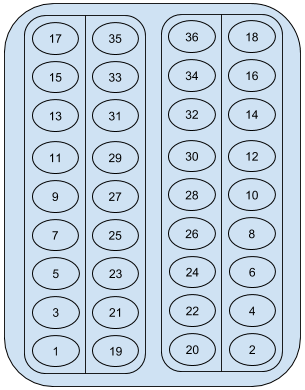The seating for $n=9$ and $m=36$ .You are given the values $n$ and $m$ . Output $m$ numbers from $1$ to $m$ , the order in which the passengers will get off the bus.
Consider that $m$ ( $m<=4n$ ) people occupy the seats in the bus. The passengers entering the bus are numbered from $1$ to $m$ (in the order of their entering the bus). The pattern of the seat occupation is as below:
$1$ -st row left window seat, $1$ -st row right window seat, $2$ -nd row left window seat, $2$ -nd row right window seat, ... , $n$ -th row left window seat, $n$ -th row right window seat.
After occupying all the window seats (for $m>2n$ ) the non-window seats are occupied:
$1$ -st row left non-window seat, $1$ -st row right non-window seat, ... , $n$ -th row left non-window seat, $n$ -th row right non-window seat.
All the passengers go to a single final destination. In the final destination, the passengers get off in the given order.
$1$ -st row left non-window seat, $1$ -st row left window seat, $1$ -st row right non-window seat, $1$ -st row right window seat, ... , $n$ -th row left non-window seat, $n$ -th row left window seat, $n$ -th row right non-window seat, $n$ -th row right window seat.
The seating for $n=9$ and $m=36$ .You are given the values $n$ and $m$ . Output $m$ numbers from $1$ to $m$ , the order in which the passengers will get off the bus.
输入格式
The only line contains two integers, $n$ and $m$ ( $1<=n<=100,1<=m<=4n$ ) — the number of pairs of rows and the number of passengers.
输出格式
Print $m$ distinct integers from $1$ to $m$ — the order in which the passengers will get off the bus.
输入输出样例
输入 #1
2 7
输出 #1
5 1 6 2 7 3 4
输入 #2
9 36
输出 #2
19 1 20 2 21 3 22 4 23 5 24 6 25 7 26 8 27 9 28 10 29 11 30 12 31 13 32 14 33 15 34 16 35 17 36 18