A10119. Acyclic Organic Compounds
编程题
普及/提高-
知识点
题目描述
You are given a tree $T$ with $n$ vertices (numbered $1$ through $n$ ) and a letter in each vertex. The tree is rooted at vertex $1$ .
Let's look at the subtree $T_{v}$ of some vertex $v$ . It is possible to read a string along each simple path starting at $v$ and ending at some vertex in $T_{v}$ (possibly $v$ itself). Let's denote the number of distinct strings which can be read this way as .
Also, there's a number $c_{v}$ assigned to each vertex $v$ . We are interested in vertices with the maximum value of .
You should compute two statistics: the maximum value of  and the number of vertices $v$ with the maximum .
Let's look at the subtree $T_{v}$ of some vertex $v$ . It is possible to read a string along each simple path starting at $v$ and ending at some vertex in $T_{v}$ (possibly $v$ itself). Let's denote the number of distinct strings which can be read this way as .
Also, there's a number $c_{v}$ assigned to each vertex $v$ . We are interested in vertices with the maximum value of .
You should compute two statistics: the maximum value of  and the number of vertices $v$ with the maximum .
输入格式
The first line of the input contains one integer $n$ ( $1<=n<=300000$ ) — the number of vertices of the tree.
The second line contains $n$ space-separated integers $c_{i}$ ( $0<=c_{i}<=10^{9}$ ).
The third line contains a string $s$ consisting of $n$ lowercase English letters — the $i$ -th character of this string is the letter in vertex $i$ .
The following $n-1$ lines describe the tree $T$ . Each of them contains two space-separated integers $u$ and $v$ ( $1<=u,v<=n$ ) indicating an edge between vertices $u$ and $v$ .
It's guaranteed that the input will describe a tree.
The second line contains $n$ space-separated integers $c_{i}$ ( $0<=c_{i}<=10^{9}$ ).
The third line contains a string $s$ consisting of $n$ lowercase English letters — the $i$ -th character of this string is the letter in vertex $i$ .
The following $n-1$ lines describe the tree $T$ . Each of them contains two space-separated integers $u$ and $v$ ( $1<=u,v<=n$ ) indicating an edge between vertices $u$ and $v$ .
It's guaranteed that the input will describe a tree.
输出格式
Print two lines.
On the first line, print  over all $1<=i<=n$ .
On the second line, print the number of vertices $v$ for which .
On the first line, print  over all $1<=i<=n$ .
On the second line, print the number of vertices $v$ for which .
输入输出样例
输入 #1
10
1 2 7 20 20 30 40 50 50 50
cacabbcddd
1 2
6 8
7 2
6 2
5 4
5 9
3 10
2 5
2 3
输出 #1
51
3
输入 #2
6
0 2 4 1 1 1
raaaba
1 2
2 3
2 4
2 5
3 6
输出 #2
6
2
说明/提示
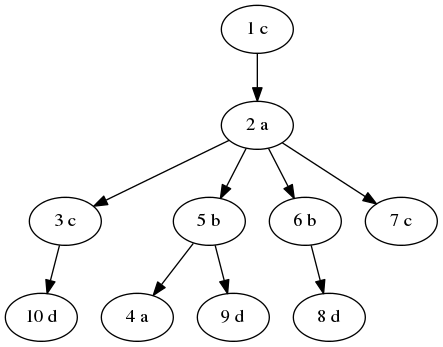
In the first sample, the tree looks like this:
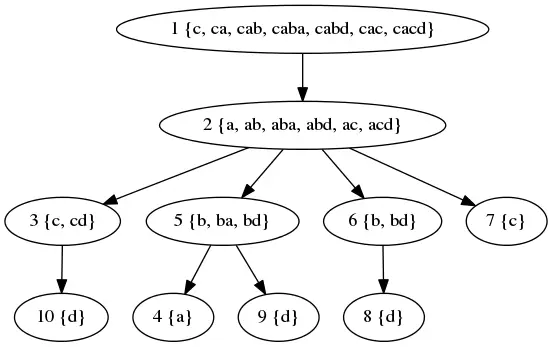
The sets of strings that can be read from individual vertices are:
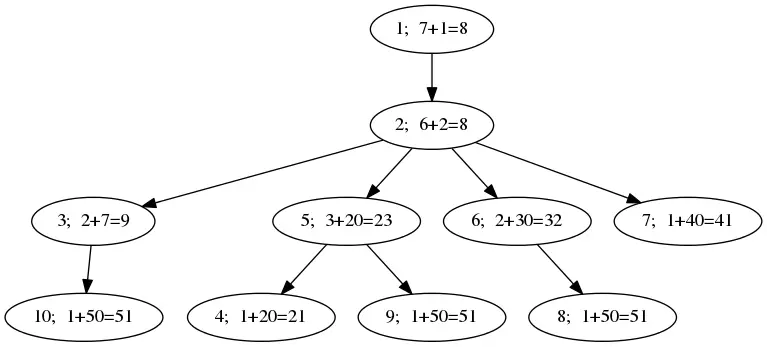
Finally, the values of  are:
In the second sample, the values of  are $(5,4,2,1,1,1)$ . The distinct strings read in $T_{2}$ are ; note that  can be read down to vertices $3$ or $4$ .
The sets of strings that can be read from individual vertices are:
Finally, the values of  are:
In the second sample, the values of  are $(5,4,2,1,1,1)$ . The distinct strings read in $T_{2}$ are ; note that  can be read down to vertices $3$ or $4$ .