A15862. Candy Store
编程题
普及/提高-
知识点
题目描述
The store sells $n$ types of candies with numbers from $1$ to $n$ . One candy of type $i$ costs $b_i$ coins. In total, there are $a_i$ candies of type $i$ in the store.
You need to pack all available candies in packs, each pack should contain only one type of candies. Formally, for each type of candy $i$ you need to choose the integer $d_i$ , denoting the number of type $i$ candies in one pack, so that $a_i$ is divided without remainder by $d_i$ .
Then the cost of one pack of candies of type $i$ will be equal to $b_i \cdot d_i$ . Let's denote this cost by $c_i$ , that is, $c_i = b_i \cdot d_i$ .
After packaging, packs will be placed on the shelf. Consider the cost of the packs placed on the shelf, in order $c_1, c_2, \ldots, c_n$ . Price tags will be used to describe costs of the packs. One price tag can describe the cost of all packs from $l$ to $r$ inclusive if $c_l = c_{l+1} = \ldots = c_r$ . Each of the packs from $1$ to $n$ must be described by at least one price tag. For example, if $c_1, \ldots, c_n = [4, 4, 2, 4, 4]$ , to describe all the packs, a $3$ price tags will be enough, the first price tag describes the packs $1, 2$ , the second: $3$ , the third: $4, 5$ .
You are given the integers $a_1, b_1, a_2, b_2, \ldots, a_n, b_n$ . Your task is to choose integers $d_i$ so that $a_i$ is divisible by $d_i$ for all $i$ , and the required number of price tags to describe the values of $c_1, c_2, \ldots, c_n$ is the minimum possible.
For a better understanding of the statement, look at the illustration of the first test case of the first test:
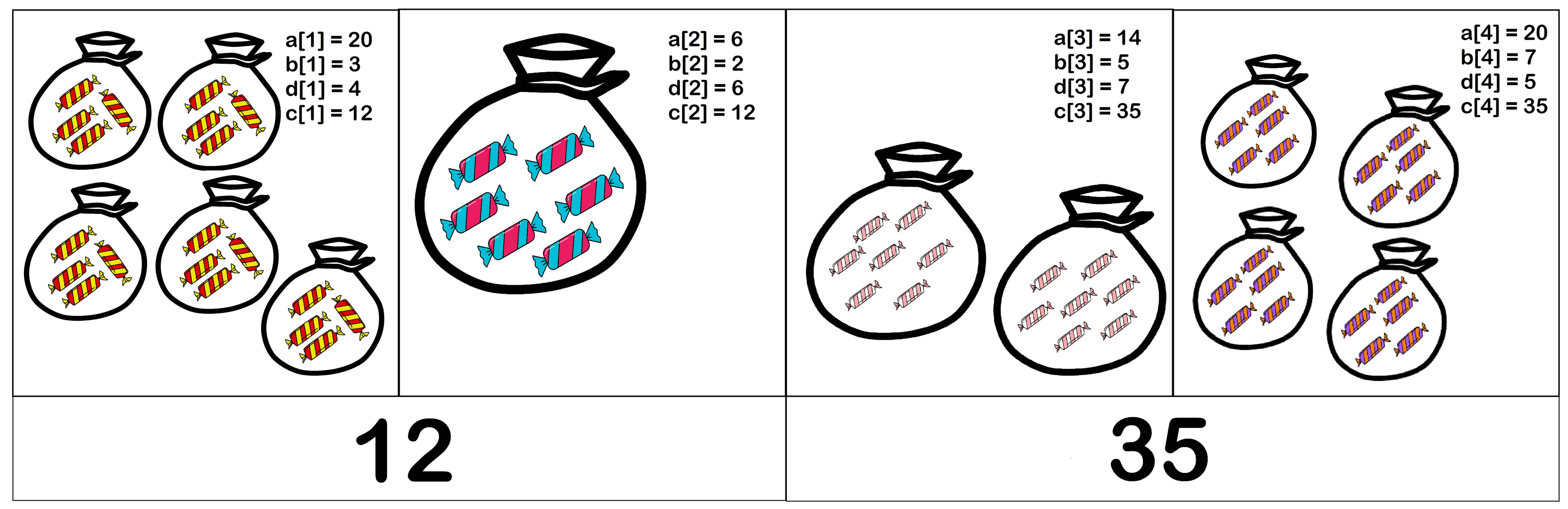Let's repeat the meaning of the notation used in the problem:
$a_i$ — the number of candies of type $i$ available in the store.
$b_i$ — the cost of one candy of type $i$ .
$d_i$ — the number of candies of type $i$ in one pack.
$c_i$ — the cost of one pack of candies of type $i$ is expressed by the formula $c_i = b_i \cdot d_i$ .
You need to pack all available candies in packs, each pack should contain only one type of candies. Formally, for each type of candy $i$ you need to choose the integer $d_i$ , denoting the number of type $i$ candies in one pack, so that $a_i$ is divided without remainder by $d_i$ .
Then the cost of one pack of candies of type $i$ will be equal to $b_i \cdot d_i$ . Let's denote this cost by $c_i$ , that is, $c_i = b_i \cdot d_i$ .
After packaging, packs will be placed on the shelf. Consider the cost of the packs placed on the shelf, in order $c_1, c_2, \ldots, c_n$ . Price tags will be used to describe costs of the packs. One price tag can describe the cost of all packs from $l$ to $r$ inclusive if $c_l = c_{l+1} = \ldots = c_r$ . Each of the packs from $1$ to $n$ must be described by at least one price tag. For example, if $c_1, \ldots, c_n = [4, 4, 2, 4, 4]$ , to describe all the packs, a $3$ price tags will be enough, the first price tag describes the packs $1, 2$ , the second: $3$ , the third: $4, 5$ .
You are given the integers $a_1, b_1, a_2, b_2, \ldots, a_n, b_n$ . Your task is to choose integers $d_i$ so that $a_i$ is divisible by $d_i$ for all $i$ , and the required number of price tags to describe the values of $c_1, c_2, \ldots, c_n$ is the minimum possible.
For a better understanding of the statement, look at the illustration of the first test case of the first test:
Let's repeat the meaning of the notation used in the problem:
$a_i$ — the number of candies of type $i$ available in the store.
$b_i$ — the cost of one candy of type $i$ .
$d_i$ — the number of candies of type $i$ in one pack.
$c_i$ — the cost of one pack of candies of type $i$ is expressed by the formula $c_i = b_i \cdot d_i$ .
输入格式
Each test contains multiple test cases. The first line contains the number of test cases $t$ ( $1 \le t \le 100\,000$ ). Description of the test cases follows.
The first line of each test case contains a single integer $n$ ( $2 \le n \le 200\,000$ ) — the number of types of candies.
Each of the next $n$ lines of each test case contains two integers $a_i$ and $b_i$ ( $1 \le a_i \le 10^9$ , $1 \le b_i \le 10\,000$ ) — the number of candies and the cost of one candy of type $i$ , respectively.
It is guaranteed that the sum of $n$ over all test cases does not exceed $200\,000$ .
The first line of each test case contains a single integer $n$ ( $2 \le n \le 200\,000$ ) — the number of types of candies.
Each of the next $n$ lines of each test case contains two integers $a_i$ and $b_i$ ( $1 \le a_i \le 10^9$ , $1 \le b_i \le 10\,000$ ) — the number of candies and the cost of one candy of type $i$ , respectively.
It is guaranteed that the sum of $n$ over all test cases does not exceed $200\,000$ .
输出格式
For each test case, output the minimum number of price tags required to describe the costs of all packs of candies in the store.
输入输出样例
输入 #1
5
4
20 3
6 2
14 5
20 7
3
444 5
2002 10
2020 2
5
7 7
6 5
15 2
10 3
7 7
5
10 1
11 5
5 1
2 2
8 2
6
7 12
12 3
5 3
9 12
9 3
1000000000 10000
输出 #1
2
1
3
2
5
说明/提示
In the first test case, you can choose $d_1 = 4$ , $d_2 = 6$ , $d_3 = 7$ , $d_4 = 5$ . Then the cost of packs will be equal to $[12, 12, 35, 35]$ . $2$ price tags are enough to describe them, the first price tag for $c_1, c_2$ and the second price tag for $c_3, c_4$ . It can be shown that with any correct choice of $d_i$ , at least $2$ of the price tag will be needed to describe all the packs. Also note that this example is illustrated by a picture in the statement.
In the second test case, with $d_1 = 4$ , $d_2 = 2$ , $d_3 = 10$ , the costs of all packs will be equal to $20$ . Thus, $1$ price tag is enough to describe all the packs. Note that $a_i$ is divisible by $d_i$ for all $i$ , which is necessary condition.
In the third test case, it is not difficult to understand that one price tag can be used to describe $2$ nd, $3$ rd and $4$ th packs. And additionally a price tag for pack $1$ and pack $5$ . Total: $3$ price tags.
In the second test case, with $d_1 = 4$ , $d_2 = 2$ , $d_3 = 10$ , the costs of all packs will be equal to $20$ . Thus, $1$ price tag is enough to describe all the packs. Note that $a_i$ is divisible by $d_i$ for all $i$ , which is necessary condition.
In the third test case, it is not difficult to understand that one price tag can be used to describe $2$ nd, $3$ rd and $4$ th packs. And additionally a price tag for pack $1$ and pack $5$ . Total: $3$ price tags.