A15747. Weighed Tree Radius
编程题
普及/提高-
知识点
题目描述
You are given a tree of $n$ vertices and $n - 1$ edges. The $i$ -th vertex has an initial weight $a_i$ .
Let the distance $d_v(u)$ from vertex $v$ to vertex $u$ be the number of edges on the path from $v$ to $u$ . Note that $d_v(u) = d_u(v)$ and $d_v(v) = 0$ .
Let the weighted distance $w_v(u)$ from $v$ to $u$ be $w_v(u) = d_v(u) + a_u$ . Note that $w_v(v) = a_v$ and $w_v(u) \neq w_u(v)$ if $a_u \neq a_v$ .
Analogically to usual distance, let's define the eccentricity $e(v)$ of vertex $v$ as the greatest weighted distance from $v$ to any other vertex (including $v$ itself), or $e(v) = \max\limits_{1 \le u \le n}{w_v(u)}$ .
Finally, let's define the radius $r$ of the tree as the minimum eccentricity of any vertex, or $r = \min\limits_{1 \le v \le n}{e(v)}$ .
You need to perform $m$ queries of the following form:
- $v_j$ $x_j$ — assign $a_{v_j} = x_j$ .
After performing each query, print the radius $r$ of the current tree.
Let the distance $d_v(u)$ from vertex $v$ to vertex $u$ be the number of edges on the path from $v$ to $u$ . Note that $d_v(u) = d_u(v)$ and $d_v(v) = 0$ .
Let the weighted distance $w_v(u)$ from $v$ to $u$ be $w_v(u) = d_v(u) + a_u$ . Note that $w_v(v) = a_v$ and $w_v(u) \neq w_u(v)$ if $a_u \neq a_v$ .
Analogically to usual distance, let's define the eccentricity $e(v)$ of vertex $v$ as the greatest weighted distance from $v$ to any other vertex (including $v$ itself), or $e(v) = \max\limits_{1 \le u \le n}{w_v(u)}$ .
Finally, let's define the radius $r$ of the tree as the minimum eccentricity of any vertex, or $r = \min\limits_{1 \le v \le n}{e(v)}$ .
You need to perform $m$ queries of the following form:
- $v_j$ $x_j$ — assign $a_{v_j} = x_j$ .
After performing each query, print the radius $r$ of the current tree.
输入格式
The first line contains the single integer $n$ ( $2 \le n \le 2 \cdot 10^5$ ) — the number of vertices in the tree.
The second line contains $n$ integers $a_1, \dots, a_n$ ( $0 \le a_i \le 10^6$ ) — the initial weights of vertices.
Next $n - 1$ lines contain edges of tree. The $i$ -th line contains two integers $u_i$ and $v_i$ ( $1 \le u_i, v_i \le n$ ; $u_i \neq v_i$ ) — the corresponding edge. The given edges form a tree.
The next line contains the single integer $m$ ( $1 \le m \le 10^5$ ) — the number of queries.
Next $m$ lines contain queries — one query per line. The $j$ -th query contains two integers $v_j$ and $x_j$ ( $1 \le v_j \le n$ ; $0 \le x_j \le 10^6$ ) — a vertex and it's new weight.
The second line contains $n$ integers $a_1, \dots, a_n$ ( $0 \le a_i \le 10^6$ ) — the initial weights of vertices.
Next $n - 1$ lines contain edges of tree. The $i$ -th line contains two integers $u_i$ and $v_i$ ( $1 \le u_i, v_i \le n$ ; $u_i \neq v_i$ ) — the corresponding edge. The given edges form a tree.
The next line contains the single integer $m$ ( $1 \le m \le 10^5$ ) — the number of queries.
Next $m$ lines contain queries — one query per line. The $j$ -th query contains two integers $v_j$ and $x_j$ ( $1 \le v_j \le n$ ; $0 \le x_j \le 10^6$ ) — a vertex and it's new weight.
输出格式
Print $m$ integers — the radius $r$ of the tree after performing each query.
输入输出样例
输入 #1
6
1 3 3 7 0 1
2 1
1 3
1 4
5 4
4 6
5
4 7
4 0
2 5
5 10
5 5
输出 #1
7
4
5
10
7
说明/提示
After the first query, you have the following tree:
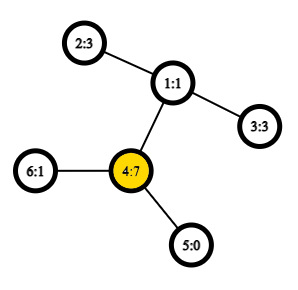 The marked vertex in the picture is the vertex with minimum $e(v)$ , or $r = e(4) = 7$ . The eccentricities of the other vertices are the following: $e(1) = 8$ , $e(2) = 9$ , $e(3) = 9$ , $e(5) = 8$ , $e(6) = 8$ .The tree after the second query:
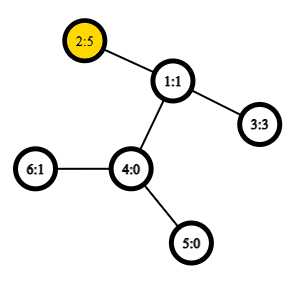
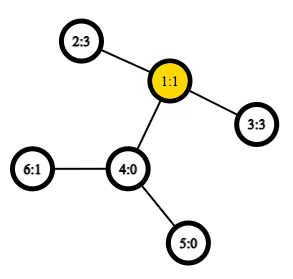 The radius $r = e(1) = 4$ .After the third query, the radius $r = e(2) = 5$ :
 The marked vertex in the picture is the vertex with minimum $e(v)$ , or $r = e(4) = 7$ . The eccentricities of the other vertices are the following: $e(1) = 8$ , $e(2) = 9$ , $e(3) = 9$ , $e(5) = 8$ , $e(6) = 8$ .The tree after the second query:
 The radius $r = e(1) = 4$ .After the third query, the radius $r = e(2) = 5$ :
