A15196. Making Towers
编程题
普及/提高-
知识点
题目描述
You have a sequence of $n$ colored blocks. The color of the $i$ -th block is $c_i$ , an integer between $1$ and $n$ .
You will place the blocks down in sequence on an infinite coordinate grid in the following way.
1. Initially, you place block $1$ at $(0, 0)$ .
2. For $2 \le i \le n$ , if the $(i - 1)$ -th block is placed at position $(x, y)$ , then the $i$ -th block can be placed at one of positions $(x + 1, y)$ , $(x - 1, y)$ , $(x, y + 1)$ (but not at position $(x, y - 1)$ ), as long no previous block was placed at that position.
A tower is formed by $s$ blocks such that they are placed at positions $(x, y), (x, y + 1), \ldots, (x, y + s - 1)$ for some position $(x, y)$ and integer $s$ . The size of the tower is $s$ , the number of blocks in it. A tower of color $r$ is a tower such that all blocks in it have the color $r$ .
For each color $r$ from $1$ to $n$ , solve the following problem independently:
- Find the maximum size of a tower of color $r$ that you can form by placing down the blocks according to the rules.
You will place the blocks down in sequence on an infinite coordinate grid in the following way.
1. Initially, you place block $1$ at $(0, 0)$ .
2. For $2 \le i \le n$ , if the $(i - 1)$ -th block is placed at position $(x, y)$ , then the $i$ -th block can be placed at one of positions $(x + 1, y)$ , $(x - 1, y)$ , $(x, y + 1)$ (but not at position $(x, y - 1)$ ), as long no previous block was placed at that position.
A tower is formed by $s$ blocks such that they are placed at positions $(x, y), (x, y + 1), \ldots, (x, y + s - 1)$ for some position $(x, y)$ and integer $s$ . The size of the tower is $s$ , the number of blocks in it. A tower of color $r$ is a tower such that all blocks in it have the color $r$ .
For each color $r$ from $1$ to $n$ , solve the following problem independently:
- Find the maximum size of a tower of color $r$ that you can form by placing down the blocks according to the rules.
输入格式
The first line contains a single integer $t$ ( $1 \le t \le 10^4$ ) — the number of test cases.
The first line of each test case contains a single integer $n$ ( $1 \le n \le 10^5$ ).
The second line of each test case contains $n$ integers $c_1, c_2, \ldots, c_n$ ( $1 \le c_i \le n$ ).
It is guaranteed that the sum of $n$ over all test cases does not exceed $2 \cdot 10^5$ .
The first line of each test case contains a single integer $n$ ( $1 \le n \le 10^5$ ).
The second line of each test case contains $n$ integers $c_1, c_2, \ldots, c_n$ ( $1 \le c_i \le n$ ).
It is guaranteed that the sum of $n$ over all test cases does not exceed $2 \cdot 10^5$ .
输出格式
For each test case, output $n$ integers. The $r$ -th of them should be the maximum size of an tower of color $r$ you can form by following the given rules. If you cannot form any tower of color $r$ , the $r$ -th integer should be $0$ .
输入输出样例
输入 #1
6
7
1 2 3 1 2 3 1
6
4 2 2 2 4 4
1
1
5
5 4 5 3 5
6
3 3 3 1 3 3
8
1 2 3 4 4 3 2 1
输出 #1
3 2 2 0 0 0 0
0 3 0 2 0 0
1
0 0 1 1 1
1 0 4 0 0 0
2 2 2 2 0 0 0 0
说明/提示
In the first test case, one of the possible ways to form a tower of color $1$ and size $3$ is:
- place block $1$ at position $(0, 0)$ ;
- place block $2$ to the right of block $1$ , at position $(1, 0)$ ;
- place block $3$ above block $2$ , at position $(1, 1)$ ;
- place block $4$ to the left of block $3$ , at position $(0, 1)$ ;
- place block $5$ to the left of block $4$ , at position $(-1, 1)$ ;
- place block $6$ above block $5$ , at position $(-1, 2)$ ;
- place block $7$ to the right of block $6$ , at position $(0, 2)$ .
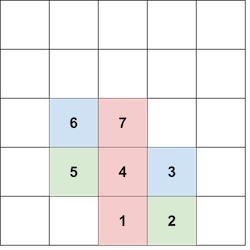The blocks at positions $(0, 0)$ , $(0, 1)$ , and $(0, 2)$ all have color $1$ , forming an tower of size $3$ .
In the second test case, note that the following placement is not valid, since you are not allowed to place block $6$ under block $5$ :
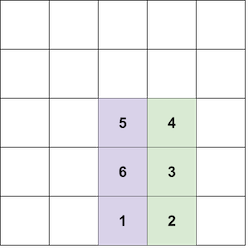It can be shown that it is impossible to form a tower of color $4$ and size $3$ .
- place block $1$ at position $(0, 0)$ ;
- place block $2$ to the right of block $1$ , at position $(1, 0)$ ;
- place block $3$ above block $2$ , at position $(1, 1)$ ;
- place block $4$ to the left of block $3$ , at position $(0, 1)$ ;
- place block $5$ to the left of block $4$ , at position $(-1, 1)$ ;
- place block $6$ above block $5$ , at position $(-1, 2)$ ;
- place block $7$ to the right of block $6$ , at position $(0, 2)$ .
The blocks at positions $(0, 0)$ , $(0, 1)$ , and $(0, 2)$ all have color $1$ , forming an tower of size $3$ .
In the second test case, note that the following placement is not valid, since you are not allowed to place block $6$ under block $5$ :
It can be shown that it is impossible to form a tower of color $4$ and size $3$ .