A15162. Tokitsukaze and Meeting
编程题
普及/提高-
知识点
题目描述
Tokitsukaze is arranging a meeting. There are $n$ rows and $m$ columns of seats in the meeting hall.
There are exactly $n \cdot m$ students attending the meeting, including several naughty students and several serious students. The students are numerated from $1$ to $n\cdot m$ . The students will enter the meeting hall in order. When the $i$ -th student enters the meeting hall, he will sit in the $1$ -st column of the $1$ -st row, and the students who are already seated will move back one seat. Specifically, the student sitting in the $j$ -th ( $1\leq j \leq m-1$ ) column of the $i$ -th row will move to the $(j+1)$ -th column of the $i$ -th row, and the student sitting in $m$ -th column of the $i$ -th row will move to the $1$ -st column of the $(i+1)$ -th row.
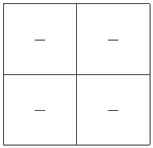
For example, there is a meeting hall with $2$ rows and $2$ columns of seats shown as below:
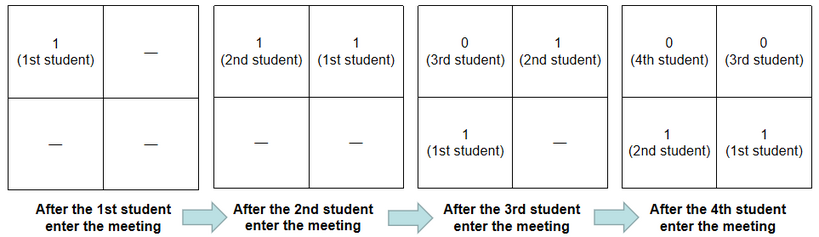
There will be $4$ students entering the meeting hall in order, represented as a binary string "1100", of which '0' represents naughty students and '1' represents serious students. The changes of seats in the meeting hall are as follows:
Denote a row or a column good if and only if there is at least one serious student in this row or column. Please predict the number of good rows and columns just after the $i$ -th student enters the meeting hall, for all $i$ .
There are exactly $n \cdot m$ students attending the meeting, including several naughty students and several serious students. The students are numerated from $1$ to $n\cdot m$ . The students will enter the meeting hall in order. When the $i$ -th student enters the meeting hall, he will sit in the $1$ -st column of the $1$ -st row, and the students who are already seated will move back one seat. Specifically, the student sitting in the $j$ -th ( $1\leq j \leq m-1$ ) column of the $i$ -th row will move to the $(j+1)$ -th column of the $i$ -th row, and the student sitting in $m$ -th column of the $i$ -th row will move to the $1$ -st column of the $(i+1)$ -th row.
For example, there is a meeting hall with $2$ rows and $2$ columns of seats shown as below:
There will be $4$ students entering the meeting hall in order, represented as a binary string "1100", of which '0' represents naughty students and '1' represents serious students. The changes of seats in the meeting hall are as follows:
Denote a row or a column good if and only if there is at least one serious student in this row or column. Please predict the number of good rows and columns just after the $i$ -th student enters the meeting hall, for all $i$ .
输入格式
The first contains a single positive integer $t$ ( $1 \leq t \leq 10\,000$ ) — the number of test cases.
For each test case, the first line contains two integers $n$ , $m$ ( $1 \leq n,m \leq 10^6$ ; $1 \leq n \cdot m \leq 10^6$ ), denoting there are $n$ rows and $m$ columns of seats in the meeting hall.
The second line contains a binary string $s$ of length $n \cdot m$ , consisting only of zeros and ones. If $s_i$ equal to '0' represents the $i$ -th student is a naughty student, and $s_i$ equal to '1' represents the $i$ -th student is a serious student.
It is guaranteed that the sum of $n \cdot m$ over all test cases does not exceed $10^6$ .
For each test case, the first line contains two integers $n$ , $m$ ( $1 \leq n,m \leq 10^6$ ; $1 \leq n \cdot m \leq 10^6$ ), denoting there are $n$ rows and $m$ columns of seats in the meeting hall.
The second line contains a binary string $s$ of length $n \cdot m$ , consisting only of zeros and ones. If $s_i$ equal to '0' represents the $i$ -th student is a naughty student, and $s_i$ equal to '1' represents the $i$ -th student is a serious student.
It is guaranteed that the sum of $n \cdot m$ over all test cases does not exceed $10^6$ .
输出格式
For each test case, print a single line with $n \cdot m$ integers — the number of good rows and columns just after the $i$ -th student enters the meeting hall.
输入输出样例
输入 #1
3
2 2
1100
4 2
11001101
2 4
11001101
输出 #1
2 3 4 3
2 3 4 3 5 4 6 5
2 3 3 3 4 4 4 5
说明/提示
The first test case is shown in the statement.
After the $1$ -st student enters the meeting hall, there are $2$ good rows and columns: the $1$ -st row and the $1$ -st column.
After the $2$ -nd student enters the meeting hall, there are $3$ good rows and columns: the $1$ -st row, the $1$ -st column and the $2$ -nd column.
After the $3$ -rd student enters the meeting hall, the $4$ rows and columns are all good.
After the $4$ -th student enters the meeting hall, there are $3$ good rows and columns: the $2$ -nd row, the $1$ -st column and the $2$ -nd column.
After the $1$ -st student enters the meeting hall, there are $2$ good rows and columns: the $1$ -st row and the $1$ -st column.
After the $2$ -nd student enters the meeting hall, there are $3$ good rows and columns: the $1$ -st row, the $1$ -st column and the $2$ -nd column.
After the $3$ -rd student enters the meeting hall, the $4$ rows and columns are all good.
After the $4$ -th student enters the meeting hall, there are $3$ good rows and columns: the $2$ -nd row, the $1$ -st column and the $2$ -nd column.