A14492. Jeopardy of Dropped Balls
编程题
普及/提高-
知识点
题目描述
Mr. Chanek has a new game called Dropping Balls. Initially, Mr. Chanek has a grid $a$ of size $n \times m$
Each cell $(x,y)$ contains an integer $a_{x,y}$ denoting the direction of how the ball will move.
- $a_{x,y}=1$ — the ball will move to the right (the next cell is $(x, y + 1)$ );
- $a_{x,y}=2$ — the ball will move to the bottom (the next cell is $(x + 1, y)$ );
- $a_{x,y}=3$ — the ball will move to the left (the next cell is $(x, y - 1)$ ).
Every time a ball leaves a cell $(x,y)$ , the integer $a_{x,y}$ will change to $2$ . Mr. Chanek will drop $k$ balls sequentially, each starting from the first row, and on the $c_1, c_2, \dots, c_k$ -th ( $1 \leq c_i \leq m$ ) columns.
Determine in which column each ball will end up in (position of the ball after leaving the grid).
Each cell $(x,y)$ contains an integer $a_{x,y}$ denoting the direction of how the ball will move.
- $a_{x,y}=1$ — the ball will move to the right (the next cell is $(x, y + 1)$ );
- $a_{x,y}=2$ — the ball will move to the bottom (the next cell is $(x + 1, y)$ );
- $a_{x,y}=3$ — the ball will move to the left (the next cell is $(x, y - 1)$ ).
Every time a ball leaves a cell $(x,y)$ , the integer $a_{x,y}$ will change to $2$ . Mr. Chanek will drop $k$ balls sequentially, each starting from the first row, and on the $c_1, c_2, \dots, c_k$ -th ( $1 \leq c_i \leq m$ ) columns.
Determine in which column each ball will end up in (position of the ball after leaving the grid).
输入格式
The first line contains three integers $n$ , $m$ , and $k$ ( $1 \leq n, m \leq 1000$ , $1 \leq k \leq 10^5$ ) — the size of the grid and the number of balls dropped by Mr. Chanek.
The $i$ -th of the next $n$ lines contains $m$ integers $a_{i,1},a_{i,2},\ldots,a_{i,m}$ ( $1 \leq a_{i,j} \leq 3$ ). It will satisfy $a_{i, 1} \ne 3$ and $a_{i, m} \ne 1$ .
The next line contains $k$ integers $c_1, c_2, \ldots, c_k$ ( $1 \leq c_i \leq m$ ) — the balls' column positions dropped by Mr. Chanek sequentially.
The $i$ -th of the next $n$ lines contains $m$ integers $a_{i,1},a_{i,2},\ldots,a_{i,m}$ ( $1 \leq a_{i,j} \leq 3$ ). It will satisfy $a_{i, 1} \ne 3$ and $a_{i, m} \ne 1$ .
The next line contains $k$ integers $c_1, c_2, \ldots, c_k$ ( $1 \leq c_i \leq m$ ) — the balls' column positions dropped by Mr. Chanek sequentially.
输出格式
Output $k$ integers — the $i$ -th integer denoting the column where the $i$ -th ball will end.
输入输出样例
输入 #1
5 5 3
1 2 3 3 3
2 2 2 2 2
2 2 2 2 2
2 2 2 2 2
2 2 2 2 2
1 2 1
输出 #1
2 2 1
输入 #2
1 2 2
1 3
1 2
输出 #2
1 2
说明/提示
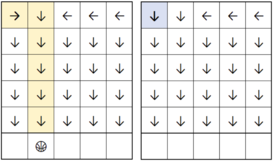
In the first example, the first ball will drop as follows. Note that the cell $(1, 1)$ will change direction to the bottom direction.
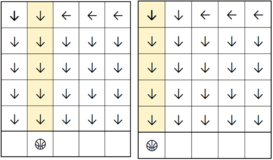
The second and third balls will drop as follows.
All balls will be dropped from the first row and on the $c_1, c_2, \dots, c_k$ -th columns respectively. A ball will stop dropping once it leaves the grid.
The second and third balls will drop as follows.
All balls will be dropped from the first row and on the $c_1, c_2, \dots, c_k$ -th columns respectively. A ball will stop dropping once it leaves the grid.