A14437. How Many Paths?
编程题
普及/提高-
知识点
题目描述
You are given a directed graph $G$ which can contain loops (edges from a vertex to itself). Multi-edges are absent in $G$ which means that for all ordered pairs $(u, v)$ exists at most one edge from $u$ to $v$ . Vertices are numbered from $1$ to $n$ .
A path from $u$ to $v$ is a sequence of edges such that:
- vertex $u$ is the start of the first edge in the path;
- vertex $v$ is the end of the last edge in the path;
- for all pairs of adjacent edges next edge starts at the vertex that the previous edge ends on.
We will assume that the empty sequence of edges is a path from $u$ to $u$ .
For each vertex $v$ output one of four values:
- $0$ , if there are no paths from $1$ to $v$ ;
- $1$ , if there is only one path from $1$ to $v$ ;
- $2$ , if there is more than one path from $1$ to $v$ and the number of paths is finite;
- $-1$ , if the number of paths from $1$ to $v$ is infinite.
Let's look at the example shown in the figure.
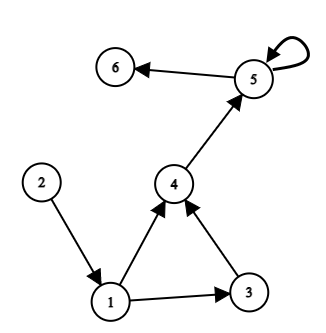Then:
- the answer for vertex $1$ is $1$ : there is only one path from $1$ to $1$ (path with length $0$ );
- the answer for vertex $2$ is $0$ : there are no paths from $1$ to $2$ ;
- the answer for vertex $3$ is $1$ : there is only one path from $1$ to $3$ (it is the edge $(1, 3)$ );
- the answer for vertex $4$ is $2$ : there are more than one paths from $1$ to $4$ and the number of paths are finite (two paths: $[(1, 3), (3, 4)]$ and $[(1, 4)]$ );
- the answer for vertex $5$ is $-1$ : the number of paths from $1$ to $5$ is infinite (the loop can be used in a path many times);
- the answer for vertex $6$ is $-1$ : the number of paths from $1$ to $6$ is infinite (the loop can be used in a path many times).
A path from $u$ to $v$ is a sequence of edges such that:
- vertex $u$ is the start of the first edge in the path;
- vertex $v$ is the end of the last edge in the path;
- for all pairs of adjacent edges next edge starts at the vertex that the previous edge ends on.
We will assume that the empty sequence of edges is a path from $u$ to $u$ .
For each vertex $v$ output one of four values:
- $0$ , if there are no paths from $1$ to $v$ ;
- $1$ , if there is only one path from $1$ to $v$ ;
- $2$ , if there is more than one path from $1$ to $v$ and the number of paths is finite;
- $-1$ , if the number of paths from $1$ to $v$ is infinite.
Let's look at the example shown in the figure.
Then:
- the answer for vertex $1$ is $1$ : there is only one path from $1$ to $1$ (path with length $0$ );
- the answer for vertex $2$ is $0$ : there are no paths from $1$ to $2$ ;
- the answer for vertex $3$ is $1$ : there is only one path from $1$ to $3$ (it is the edge $(1, 3)$ );
- the answer for vertex $4$ is $2$ : there are more than one paths from $1$ to $4$ and the number of paths are finite (two paths: $[(1, 3), (3, 4)]$ and $[(1, 4)]$ );
- the answer for vertex $5$ is $-1$ : the number of paths from $1$ to $5$ is infinite (the loop can be used in a path many times);
- the answer for vertex $6$ is $-1$ : the number of paths from $1$ to $6$ is infinite (the loop can be used in a path many times).
输入格式
The first contains an integer $t$ ( $1 \le t \le 10^4$ ) — the number of test cases in the input. Then $t$ test cases follow. Before each test case, there is an empty line.
The first line of the test case contains two integers $n$ and $m$ ( $1 \le n \le 4 \cdot 10^5, 0 \le m \le 4 \cdot 10^5$ ) — numbers of vertices and edges in graph respectively. The next $m$ lines contain edges descriptions. Each line contains two integers $a_i$ , $b_i$ ( $1 \le a_i, b_i \le n$ ) — the start and the end of the $i$ -th edge. The vertices of the graph are numbered from $1$ to $n$ . The given graph can contain loops (it is possible that $a_i = b_i$ ), but cannot contain multi-edges (it is not possible that $a_i = a_j$ and $b_i = b_j$ for $i \ne j$ ).
The sum of $n$ over all test cases does not exceed $4 \cdot 10^5$ . Similarly, the sum of $m$ over all test cases does not exceed $4 \cdot 10^5$ .
The first line of the test case contains two integers $n$ and $m$ ( $1 \le n \le 4 \cdot 10^5, 0 \le m \le 4 \cdot 10^5$ ) — numbers of vertices and edges in graph respectively. The next $m$ lines contain edges descriptions. Each line contains two integers $a_i$ , $b_i$ ( $1 \le a_i, b_i \le n$ ) — the start and the end of the $i$ -th edge. The vertices of the graph are numbered from $1$ to $n$ . The given graph can contain loops (it is possible that $a_i = b_i$ ), but cannot contain multi-edges (it is not possible that $a_i = a_j$ and $b_i = b_j$ for $i \ne j$ ).
The sum of $n$ over all test cases does not exceed $4 \cdot 10^5$ . Similarly, the sum of $m$ over all test cases does not exceed $4 \cdot 10^5$ .
输出格式
Output $t$ lines. The $i$ -th line should contain an answer for the $i$ -th test case: a sequence of $n$ integers from $-1$ to $2$ .
输入输出样例
输入 #1
5

6 7
1 4
1 3
3 4
4 5
2 1
5 5
5 6

1 0

3 3
1 2
2 3
3 1

5 0

4 4
1 2
2 3
1 4
4 3
输出 #1
1 0 1 2 -1 -1
1
-1 -1 -1
1 0 0 0 0
1 1 2 1