A14366. Nastia Plays with a Tree
编程题
普及/提高-
知识点
题目描述
Nastia has an unweighted tree with $n$ vertices and wants to play with it!
The girl will perform the following operation with her tree, as long as she needs:
1. Remove any existing edge.
2. Add an edge between any pair of vertices.
What is the minimum number of operations Nastia needs to get a bamboo from a tree? A bamboo is a tree in which no node has a degree greater than $2$ .
The girl will perform the following operation with her tree, as long as she needs:
1. Remove any existing edge.
2. Add an edge between any pair of vertices.
What is the minimum number of operations Nastia needs to get a bamboo from a tree? A bamboo is a tree in which no node has a degree greater than $2$ .
输入格式
The first line contains a single integer $t$ ( $1 \le t \le 10\,000$ ) — the number of test cases.
The first line of each test case contains a single integer $n$ ( $2 \le n \le 10^5$ ) — the number of vertices in the tree.
Next $n - 1$ lines of each test cases describe the edges of the tree in form $a_i$ , $b_i$ ( $1 \le a_i, b_i \le n$ , $a_i \neq b_i$ ).
It's guaranteed the given graph is a tree and the sum of $n$ in one test doesn't exceed $2 \cdot 10^5$ .
The first line of each test case contains a single integer $n$ ( $2 \le n \le 10^5$ ) — the number of vertices in the tree.
Next $n - 1$ lines of each test cases describe the edges of the tree in form $a_i$ , $b_i$ ( $1 \le a_i, b_i \le n$ , $a_i \neq b_i$ ).
It's guaranteed the given graph is a tree and the sum of $n$ in one test doesn't exceed $2 \cdot 10^5$ .
输出格式
For each test case in the first line print a single integer $k$ — the minimum number of operations required to obtain a bamboo from the initial tree.
In the next $k$ lines print $4$ integers $x_1$ , $y_1$ , $x_2$ , $y_2$ ( $1 \le x_1, y_1, x_2, y_{2} \le n$ , $x_1 \neq y_1$ , $x_2 \neq y_2$ ) — this way you remove the edge $(x_1, y_1)$ and add an undirected edge $(x_2, y_2)$ .
Note that the edge $(x_1, y_1)$ must be present in the graph at the moment of removing.
In the next $k$ lines print $4$ integers $x_1$ , $y_1$ , $x_2$ , $y_2$ ( $1 \le x_1, y_1, x_2, y_{2} \le n$ , $x_1 \neq y_1$ , $x_2 \neq y_2$ ) — this way you remove the edge $(x_1, y_1)$ and add an undirected edge $(x_2, y_2)$ .
Note that the edge $(x_1, y_1)$ must be present in the graph at the moment of removing.
输入输出样例
输入 #1
2
7
1 2
1 3
2 4
2 5
3 6
3 7
4
1 2
1 3
3 4
输出 #1
2
2 5 6 7
3 6 4 5
0
说明/提示
Note the graph can be unconnected after a certain operation.
Consider the first test case of the example:
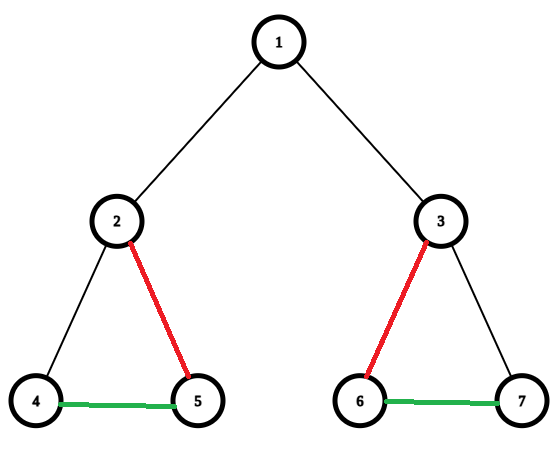 The red edges are removed, and the green ones are added.
Consider the first test case of the example:
 The red edges are removed, and the green ones are added.