A14286. Figure Fixing
编程题
普及/提高-
知识点
题目描述
You have a connected undirected graph made of $n$ nodes and $m$ edges. The $i$ -th node has a value $v_i$ and a target value $t_i$ .
In an operation, you can choose an edge $(i, j)$ and add $k$ to both $v_i$ and $v_j$ , where $k$ can be any integer. In particular, $k$ can be negative.
Your task to determine if it is possible that by doing some finite number of operations (possibly zero), you can achieve for every node $i$ , $v_i = t_i$ .
In an operation, you can choose an edge $(i, j)$ and add $k$ to both $v_i$ and $v_j$ , where $k$ can be any integer. In particular, $k$ can be negative.
Your task to determine if it is possible that by doing some finite number of operations (possibly zero), you can achieve for every node $i$ , $v_i = t_i$ .
输入格式
The first line contains a single integer $t$ ( $1 \leq t \leq 1000$ ), the number of test cases. Then the test cases follow.
The first line of each test case contains two integers $n$ , $m$ ( $2 \leq n \leq 2\cdot 10^5$ , $n-1\leq m\leq \min(2\cdot 10^5, \frac{n(n-1)}{2})$ ) — the number of nodes and edges respectively.
The second line contains $n$ integers $v_1\ldots, v_n$ ( $-10^9 \leq v_i \leq 10^9$ ) — initial values of nodes.
The third line contains $n$ integers $t_1\ldots, t_n$ ( $-10^9 \leq t_i \leq 10^9$ ) — target values of nodes.
Each of the next $m$ lines contains two integers $i$ and $j$ representing an edge between node $i$ and node $j$ ( $1 \leq i, j \leq n$ , $i\ne j$ ).
It is guaranteed that the graph is connected and there is at most one edge between the same pair of nodes.
It is guaranteed that the sum of $n$ over all testcases does not exceed $2 \cdot 10^5$ and the sum of $m$ over all testcases does not exceed $2 \cdot 10^5$ .
The first line of each test case contains two integers $n$ , $m$ ( $2 \leq n \leq 2\cdot 10^5$ , $n-1\leq m\leq \min(2\cdot 10^5, \frac{n(n-1)}{2})$ ) — the number of nodes and edges respectively.
The second line contains $n$ integers $v_1\ldots, v_n$ ( $-10^9 \leq v_i \leq 10^9$ ) — initial values of nodes.
The third line contains $n$ integers $t_1\ldots, t_n$ ( $-10^9 \leq t_i \leq 10^9$ ) — target values of nodes.
Each of the next $m$ lines contains two integers $i$ and $j$ representing an edge between node $i$ and node $j$ ( $1 \leq i, j \leq n$ , $i\ne j$ ).
It is guaranteed that the graph is connected and there is at most one edge between the same pair of nodes.
It is guaranteed that the sum of $n$ over all testcases does not exceed $2 \cdot 10^5$ and the sum of $m$ over all testcases does not exceed $2 \cdot 10^5$ .
输出格式
For each test case, if it is possible for every node to reach its target after some number of operations, print "YES". Otherwise, print "NO".
输入输出样例
输入 #1
2
4 4
5 1 2 -3
3 3 10 1
1 2
1 4
3 2
3 4
4 4
5 8 6 6
-3 1 15 4
1 2
1 4
3 2
3 4
输出 #1
YES
NO
说明/提示
Here is a visualization of the first test case (the orange values denote the initial values and the blue ones the desired values):
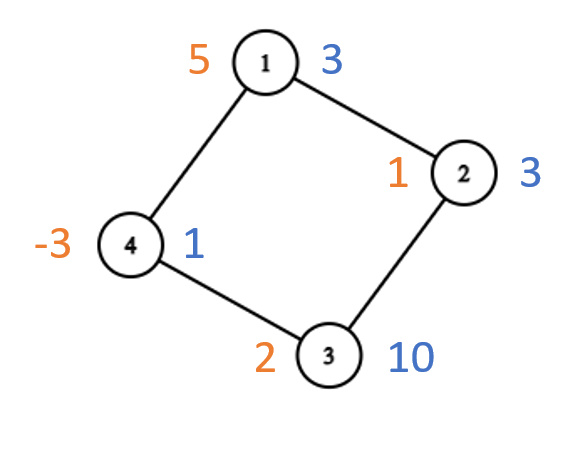One possible order of operations to obtain the desired values for each node is the following:
- Operation $1$ : Add $2$ to nodes $2$ and $3$ .
- Operation $2$ : Add $-2$ to nodes $1$ and $4$ .
- Operation $3$ : Add $6$ to nodes $3$ and $4$ .
Now we can see that in total we added $-2$ to node $1$ , $2$ to node $2$ , $8$ to node $3$ and $4$ to node $4$ which brings each node exactly to it's desired value.
For the graph from the second test case it's impossible to get the target values.
One possible order of operations to obtain the desired values for each node is the following:
- Operation $1$ : Add $2$ to nodes $2$ and $3$ .
- Operation $2$ : Add $-2$ to nodes $1$ and $4$ .
- Operation $3$ : Add $6$ to nodes $3$ and $4$ .
Now we can see that in total we added $-2$ to node $1$ , $2$ to node $2$ , $8$ to node $3$ and $4$ to node $4$ which brings each node exactly to it's desired value.
For the graph from the second test case it's impossible to get the target values.