A13907. Circle Game
编程题
普及/提高-
知识点
题目描述
Utkarsh is forced to play yet another one of Ashish's games. The game progresses turn by turn and as usual, Ashish moves first.
Consider the 2D plane. There is a token which is initially at $(0,0)$ . In one move a player must increase either the $x$ coordinate or the $y$ coordinate of the token by exactly $k$ . In doing so, the player must ensure that the token stays within a (Euclidean) distance $d$ from $(0,0)$ .
In other words, if after a move the coordinates of the token are $(p,q)$ , then $p^2 + q^2 \leq d^2$ must hold.
The game ends when a player is unable to make a move. It can be shown that the game will end in a finite number of moves. If both players play optimally, determine who will win.
Consider the 2D plane. There is a token which is initially at $(0,0)$ . In one move a player must increase either the $x$ coordinate or the $y$ coordinate of the token by exactly $k$ . In doing so, the player must ensure that the token stays within a (Euclidean) distance $d$ from $(0,0)$ .
In other words, if after a move the coordinates of the token are $(p,q)$ , then $p^2 + q^2 \leq d^2$ must hold.
The game ends when a player is unable to make a move. It can be shown that the game will end in a finite number of moves. If both players play optimally, determine who will win.
输入格式
The first line contains a single integer $t$ ( $1 \leq t \leq 100$ ) — the number of test cases.
The only line of each test case contains two space separated integers $d$ ( $1 \leq d \leq 10^5$ ) and $k$ ( $1 \leq k \leq d$ ).
The only line of each test case contains two space separated integers $d$ ( $1 \leq d \leq 10^5$ ) and $k$ ( $1 \leq k \leq d$ ).
输出格式
For each test case, if Ashish wins the game, print "Ashish", otherwise print "Utkarsh" (without the quotes).
输入输出样例
输入 #1
5
2 1
5 2
10 3
25 4
15441 33
输出 #1
Utkarsh
Ashish
Utkarsh
Utkarsh
Ashish
说明/提示
In the first test case, one possible sequence of moves can be
$(0, 0) \xrightarrow{\text{Ashish }} (0, 1) \xrightarrow{\text{Utkarsh }} (0, 2)$ .
Ashish has no moves left, so Utkarsh wins.
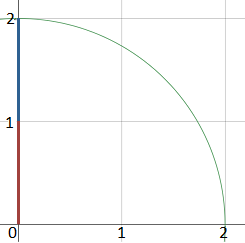
$(0, 0) \xrightarrow{\text{Ashish }} (0, 1) \xrightarrow{\text{Utkarsh }} (0, 2)$ .
Ashish has no moves left, so Utkarsh wins.
