A13880. Four Points
编程题
普及/提高-
知识点
题目描述
You are given four different integer points $p_1$ , $p_2$ , $p_3$ and $p_4$ on $\mathit{XY}$ grid.
In one step you can choose one of the points $p_i$ and move it in one of four directions by one. In other words, if you have chosen point $p_i = (x, y)$ you can move it to $(x, y + 1)$ , $(x, y - 1)$ , $(x + 1, y)$ or $(x - 1, y)$ .
Your goal to move points in such a way that they will form a square with sides parallel to $\mathit{OX}$ and $\mathit{OY}$ axes (a square with side $0$ is allowed).
What is the minimum number of steps you need to make such a square?
In one step you can choose one of the points $p_i$ and move it in one of four directions by one. In other words, if you have chosen point $p_i = (x, y)$ you can move it to $(x, y + 1)$ , $(x, y - 1)$ , $(x + 1, y)$ or $(x - 1, y)$ .
Your goal to move points in such a way that they will form a square with sides parallel to $\mathit{OX}$ and $\mathit{OY}$ axes (a square with side $0$ is allowed).
What is the minimum number of steps you need to make such a square?
输入格式
The first line contains a single integer $t$ ( $1 \le t \le 10^4$ ) — the number of test cases.
Each test case consists of four lines. Each line contains two integers $x$ and $y$ ( $0 \le x, y \le 10^9$ ) — coordinates of one of the points $p_i = (x, y)$ .
All points are different in one test case.
Each test case consists of four lines. Each line contains two integers $x$ and $y$ ( $0 \le x, y \le 10^9$ ) — coordinates of one of the points $p_i = (x, y)$ .
All points are different in one test case.
输出格式
For each test case, print the single integer — the minimum number of steps to make a square.
输入输出样例
输入 #1
3
0 2
4 2
2 0
2 4
1 0
2 0
4 0
6 0
1 6
2 2
2 5
4 1
输出 #1
8
7
5
说明/提示
In the first test case, one of the optimal solutions is shown below:
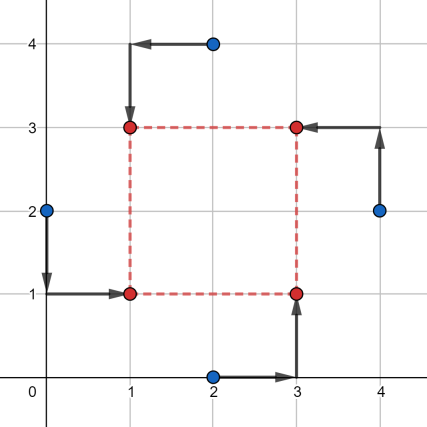 Each point was moved two times, so the answer $2 + 2 + 2 + 2 = 8$ .In the second test case, one of the optimal solutions is shown below:
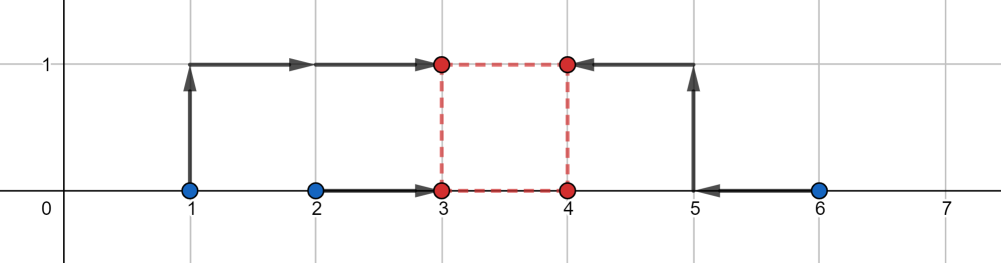 The answer is $3 + 1 + 0 + 3 = 7$ .In the third test case, one of the optimal solutions is shown below:
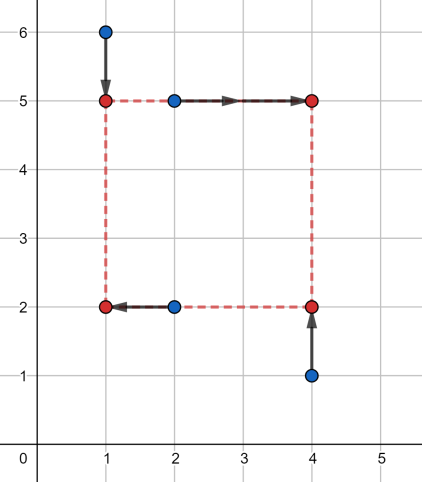 The answer is $1 + 1 + 2 + 1 = 5$ .
 Each point was moved two times, so the answer $2 + 2 + 2 + 2 = 8$ .In the second test case, one of the optimal solutions is shown below:
 The answer is $3 + 1 + 0 + 3 = 7$ .In the third test case, one of the optimal solutions is shown below:
 The answer is $1 + 1 + 2 + 1 = 5$ .