A13722. Maximum Distributed Tree
编程题
普及/提高-
知识点
题目描述
You are given a tree that consists of $n$ nodes. You should label each of its $n-1$ edges with an integer in such way that satisfies the following conditions:
- each integer must be greater than $0$ ;
- the product of all $n-1$ numbers should be equal to $k$ ;
- the number of $1$ -s among all $n-1$ integers must be minimum possible.
Let's define $f(u,v)$ as the sum of the numbers on the simple path from node $u$ to node $v$ . Also, let $\sum\limits_{i=1}^{n-1} \sum\limits_{j=i+1}^n f(i,j)$ be a distribution index of the tree.
Find the maximum possible distribution index you can get. Since answer can be too large, print it modulo $10^9 + 7$ .
In this problem, since the number $k$ can be large, the result of the prime factorization of $k$ is given instead.
- each integer must be greater than $0$ ;
- the product of all $n-1$ numbers should be equal to $k$ ;
- the number of $1$ -s among all $n-1$ integers must be minimum possible.
Let's define $f(u,v)$ as the sum of the numbers on the simple path from node $u$ to node $v$ . Also, let $\sum\limits_{i=1}^{n-1} \sum\limits_{j=i+1}^n f(i,j)$ be a distribution index of the tree.
Find the maximum possible distribution index you can get. Since answer can be too large, print it modulo $10^9 + 7$ .
In this problem, since the number $k$ can be large, the result of the prime factorization of $k$ is given instead.
输入格式
The first line contains one integer $t$ ( $1 \le t \le 100$ ) — the number of test cases.
The first line of each test case contains a single integer $n$ ( $2 \le n \le 10^5$ ) — the number of nodes in the tree.
Each of the next $n-1$ lines describes an edge: the $i$ -th line contains two integers $u_i$ and $v_i$ ( $1 \le u_i, v_i \le n$ ; $u_i \ne v_i$ ) — indices of vertices connected by the $i$ -th edge.
Next line contains a single integer $m$ ( $1 \le m \le 6 \cdot 10^4$ ) — the number of prime factors of $k$ .
Next line contains $m$ prime numbers $p_1, p_2, \ldots, p_m$ ( $2 \le p_i < 6 \cdot 10^4$ ) such that $k = p_1 \cdot p_2 \cdot \ldots \cdot p_m$ .
It is guaranteed that the sum of $n$ over all test cases doesn't exceed $10^5$ , the sum of $m$ over all test cases doesn't exceed $6 \cdot 10^4$ , and the given edges for each test cases form a tree.
The first line of each test case contains a single integer $n$ ( $2 \le n \le 10^5$ ) — the number of nodes in the tree.
Each of the next $n-1$ lines describes an edge: the $i$ -th line contains two integers $u_i$ and $v_i$ ( $1 \le u_i, v_i \le n$ ; $u_i \ne v_i$ ) — indices of vertices connected by the $i$ -th edge.
Next line contains a single integer $m$ ( $1 \le m \le 6 \cdot 10^4$ ) — the number of prime factors of $k$ .
Next line contains $m$ prime numbers $p_1, p_2, \ldots, p_m$ ( $2 \le p_i < 6 \cdot 10^4$ ) such that $k = p_1 \cdot p_2 \cdot \ldots \cdot p_m$ .
It is guaranteed that the sum of $n$ over all test cases doesn't exceed $10^5$ , the sum of $m$ over all test cases doesn't exceed $6 \cdot 10^4$ , and the given edges for each test cases form a tree.
输出格式
Print the maximum distribution index you can get. Since answer can be too large, print it modulo $10^9+7$ .
输入输出样例
输入 #1
3
4
1 2
2 3
3 4
2
2 2
4
3 4
1 3
3 2
2
3 2
7
6 1
2 3
4 6
7 3
5 1
3 6
4
7 5 13 3
输出 #1
17
18
286
说明/提示
In the first test case, one of the optimal ways is on the following image:
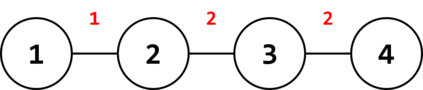 In this case, $f(1,2)=1$ , $f(1,3)=3$ , $f(1,4)=5$ , $f(2,3)=2$ , $f(2,4)=4$ , $f(3,4)=2$ , so the sum of these $6$ numbers is $17$ .
In the second test case, one of the optimal ways is on the following image:
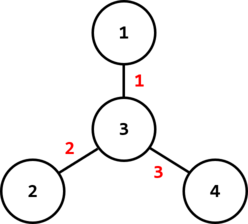 In this case, $f(1,2)=3$ , $f(1,3)=1$ , $f(1,4)=4$ , $f(2,3)=2$ , $f(2,4)=5$ , $f(3,4)=3$ , so the sum of these $6$ numbers is $18$ .
 In this case, $f(1,2)=1$ , $f(1,3)=3$ , $f(1,4)=5$ , $f(2,3)=2$ , $f(2,4)=4$ , $f(3,4)=2$ , so the sum of these $6$ numbers is $17$ .
In the second test case, one of the optimal ways is on the following image:
 In this case, $f(1,2)=3$ , $f(1,3)=1$ , $f(1,4)=4$ , $f(2,3)=2$ , $f(2,4)=5$ , $f(3,4)=3$ , so the sum of these $6$ numbers is $18$ .