A13453. Divisor Paths
编程题
普及/提高-
知识点
题目描述
You are given a positive integer $D$ . Let's build the following graph from it:
- each vertex is a divisor of $D$ (not necessarily prime, $1$ and $D$ itself are also included);
- two vertices $x$ and $y$ ( $x > y$ ) have an undirected edge between them if $x$ is divisible by $y$ and $\frac x y$ is a prime;
- the weight of an edge is the number of divisors of $x$ that are not divisors of $y$ .
For example, here is the graph for $D=12$ :
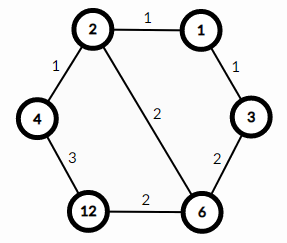Edge $(4,12)$ has weight $3$ because $12$ has divisors $[1,2,3,4,6,12]$ and $4$ has divisors $[1,2,4]$ . Thus, there are $3$ divisors of $12$ that are not divisors of $4$ — $[3,6,12]$ .
There is no edge between $3$ and $2$ because $3$ is not divisible by $2$ . There is no edge between $12$ and $3$ because $\frac{12}{3}=4$ is not a prime.
Let the length of the path between some vertices $v$ and $u$ in the graph be the total weight of edges on it. For example, path $[(1, 2), (2, 6), (6, 12), (12, 4), (4, 2), (2, 6)]$ has length $1+2+2+3+1+2=11$ . The empty path has length $0$ .
So the shortest path between two vertices $v$ and $u$ is the path that has the minimal possible length.
Two paths $a$ and $b$ are different if there is either a different number of edges in them or there is a position $i$ such that $a_i$ and $b_i$ are different edges.
You are given $q$ queries of the following form:
- $v$ $u$ — calculate the number of the shortest paths between vertices $v$ and $u$ .
The answer for each query might be large so print it modulo $998244353$ .
- each vertex is a divisor of $D$ (not necessarily prime, $1$ and $D$ itself are also included);
- two vertices $x$ and $y$ ( $x > y$ ) have an undirected edge between them if $x$ is divisible by $y$ and $\frac x y$ is a prime;
- the weight of an edge is the number of divisors of $x$ that are not divisors of $y$ .
For example, here is the graph for $D=12$ :
Edge $(4,12)$ has weight $3$ because $12$ has divisors $[1,2,3,4,6,12]$ and $4$ has divisors $[1,2,4]$ . Thus, there are $3$ divisors of $12$ that are not divisors of $4$ — $[3,6,12]$ .
There is no edge between $3$ and $2$ because $3$ is not divisible by $2$ . There is no edge between $12$ and $3$ because $\frac{12}{3}=4$ is not a prime.
Let the length of the path between some vertices $v$ and $u$ in the graph be the total weight of edges on it. For example, path $[(1, 2), (2, 6), (6, 12), (12, 4), (4, 2), (2, 6)]$ has length $1+2+2+3+1+2=11$ . The empty path has length $0$ .
So the shortest path between two vertices $v$ and $u$ is the path that has the minimal possible length.
Two paths $a$ and $b$ are different if there is either a different number of edges in them or there is a position $i$ such that $a_i$ and $b_i$ are different edges.
You are given $q$ queries of the following form:
- $v$ $u$ — calculate the number of the shortest paths between vertices $v$ and $u$ .
The answer for each query might be large so print it modulo $998244353$ .
输入格式
The first line contains a single integer $D$ ( $1 \le D \le 10^{15}$ ) — the number the graph is built from.
The second line contains a single integer $q$ ( $1 \le q \le 3 \cdot 10^5$ ) — the number of queries.
Each of the next $q$ lines contains two integers $v$ and $u$ ( $1 \le v, u \le D$ ). It is guaranteed that $D$ is divisible by both $v$ and $u$ (both $v$ and $u$ are divisors of $D$ ).
The second line contains a single integer $q$ ( $1 \le q \le 3 \cdot 10^5$ ) — the number of queries.
Each of the next $q$ lines contains two integers $v$ and $u$ ( $1 \le v, u \le D$ ). It is guaranteed that $D$ is divisible by both $v$ and $u$ (both $v$ and $u$ are divisors of $D$ ).
输出格式
Print $q$ integers — for each query output the number of the shortest paths between the two given vertices modulo $998244353$ .
输入输出样例
输入 #1
12
3
4 4
12 1
3 4
输出 #1
1
3
1
输入 #2
1
1
1 1
输出 #2
1
输入 #3
288807105787200
4
46 482955026400
12556830686400 897
414 12556830686400
4443186242880 325
输出 #3
547558588
277147129
457421435
702277623
说明/提示
In the first example:
- The first query is only the empty path — length $0$ ;
- The second query are paths $[(12, 4), (4, 2), (2, 1)]$ (length $3+1+1=5$ ), $[(12, 6), (6, 2), (2, 1)]$ (length $2+2+1=5$ ) and $[(12, 6), (6, 3), (3, 1)]$ (length $2+2+1=5$ ).
- The third query is only the path $[(3, 1), (1, 2), (2, 4)]$ (length $1+1+1=3$ ).
- The first query is only the empty path — length $0$ ;
- The second query are paths $[(12, 4), (4, 2), (2, 1)]$ (length $3+1+1=5$ ), $[(12, 6), (6, 2), (2, 1)]$ (length $2+2+1=5$ ) and $[(12, 6), (6, 3), (3, 1)]$ (length $2+2+1=5$ ).
- The third query is only the path $[(3, 1), (1, 2), (2, 4)]$ (length $1+1+1=3$ ).