A13199. Around the World
编程题
普及/提高-
知识点
题目描述
Guy-Manuel and Thomas are planning $144$ trips around the world.
You are given a simple weighted undirected connected graph with $n$ vertexes and $m$ edges with the following restriction: there isn't any simple cycle (i. e. a cycle which doesn't pass through any vertex more than once) of length greater than $3$ which passes through the vertex $1$ . The cost of a path (not necessarily simple) in this graph is defined as the [XOR](https://en.wikipedia.org/wiki/Bitwise_operation#XOR) of weights of all edges in that path with each edge being counted as many times as the path passes through it.
But the trips with cost $0$ aren't exciting.
You may choose any subset of edges incident to the vertex $1$ and remove them. How many are there such subsets, that, when removed, there is not any nontrivial cycle with the cost equal to $0$ which passes through the vertex $1$ in the resulting graph? A cycle is called nontrivial if it passes through some edge odd number of times. As the answer can be very big, output it modulo $10^9+7$ .
You are given a simple weighted undirected connected graph with $n$ vertexes and $m$ edges with the following restriction: there isn't any simple cycle (i. e. a cycle which doesn't pass through any vertex more than once) of length greater than $3$ which passes through the vertex $1$ . The cost of a path (not necessarily simple) in this graph is defined as the [XOR](https://en.wikipedia.org/wiki/Bitwise_operation#XOR) of weights of all edges in that path with each edge being counted as many times as the path passes through it.
But the trips with cost $0$ aren't exciting.
You may choose any subset of edges incident to the vertex $1$ and remove them. How many are there such subsets, that, when removed, there is not any nontrivial cycle with the cost equal to $0$ which passes through the vertex $1$ in the resulting graph? A cycle is called nontrivial if it passes through some edge odd number of times. As the answer can be very big, output it modulo $10^9+7$ .
输入格式
The first line contains two integers $n$ and $m$ ( $1 \le n,m \le 10^5$ ) — the number of vertexes and edges in the graph. The $i$ -th of the next $m$ lines contains three integers $a_i$ , $b_i$ and $w_i$ ( $1 \le a_i, b_i \le n, a_i \neq b_i, 0 \le w_i < 32$ ) — the endpoints of the $i$ -th edge and its weight. It's guaranteed there aren't any multiple edges, the graph is connected and there isn't any simple cycle of length greater than $3$ which passes through the vertex $1$ .
输出格式
Output the answer modulo $10^9+7$ .
输入输出样例
输入 #1
6 8
1 2 0
2 3 1
2 4 3
2 6 2
3 4 8
3 5 4
5 4 5
5 6 6
输出 #1
2
输入 #2
7 9
1 2 0
1 3 1
2 3 9
2 4 3
2 5 4
4 5 7
3 6 6
3 7 7
6 7 8
输出 #2
1
输入 #3
4 4
1 2 27
1 3 1
1 4 1
3 4 0
输出 #3
6
说明/提示
The pictures below represent the graphs from examples. 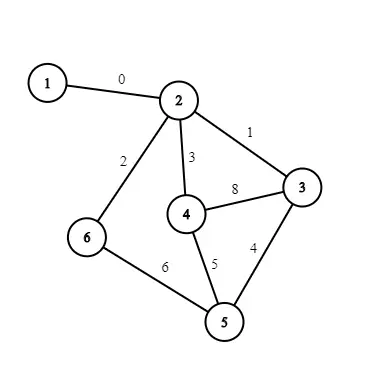 In the first example, there aren't any nontrivial cycles with cost $0$ , so we can either remove or keep the only edge incident to the vertex $1$ . 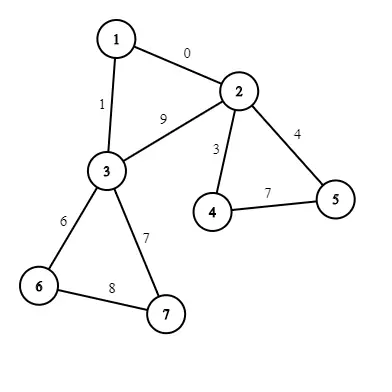 In the second example, if we don't remove the edge $1-2$ , then there is a cycle $1-2-4-5-2-1$ with cost $0$ ; also if we don't remove the edge $1-3$ , then there is a cycle $1-3-2-4-5-2-3-1$ of cost $0$ . The only valid subset consists of both edges. 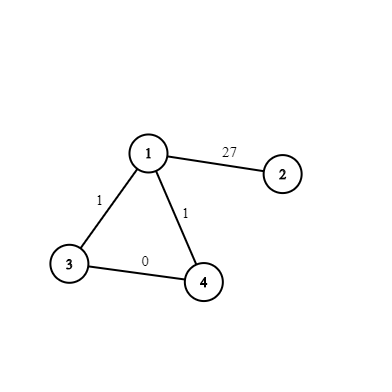 In the third example, all subsets are valid except for those two in which both edges $1-3$ and $1-4$ are kept.