A12818. Almost Equal
编程题
普及/提高-
知识点
题目描述
You are given integer $n$ . You have to arrange numbers from $1$ to $2n$ , using each of them exactly once, on the circle, so that the following condition would be satisfied:
For every $n$ consecutive numbers on the circle write their sum on the blackboard. Then any two of written on the blackboard $2n$ numbers differ not more than by $1$ .
For example, choose $n = 3$ . On the left you can see an example of a valid arrangement: $1 + 4 + 5 = 10$ , $4 + 5 + 2 = 11$ , $5 + 2 + 3 = 10$ , $2 + 3 + 6 = 11$ , $3 + 6 + 1 = 10$ , $6 + 1 + 4 = 11$ , any two numbers differ by at most $1$ . On the right you can see an invalid arrangement: for example, $5 + 1 + 6 = 12$ , and $3 + 2 + 4 = 9$ , $9$ and $12$ differ more than by $1$ .
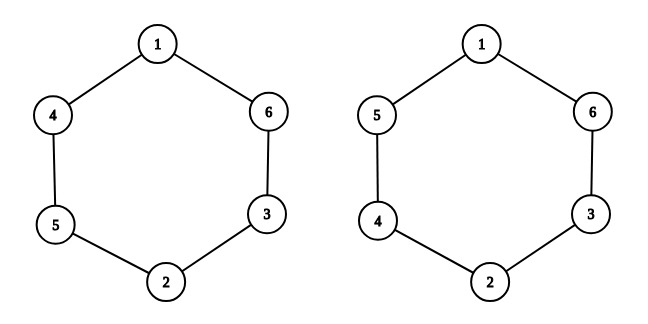
For every $n$ consecutive numbers on the circle write their sum on the blackboard. Then any two of written on the blackboard $2n$ numbers differ not more than by $1$ .
For example, choose $n = 3$ . On the left you can see an example of a valid arrangement: $1 + 4 + 5 = 10$ , $4 + 5 + 2 = 11$ , $5 + 2 + 3 = 10$ , $2 + 3 + 6 = 11$ , $3 + 6 + 1 = 10$ , $6 + 1 + 4 = 11$ , any two numbers differ by at most $1$ . On the right you can see an invalid arrangement: for example, $5 + 1 + 6 = 12$ , and $3 + 2 + 4 = 9$ , $9$ and $12$ differ more than by $1$ .

输入格式
The first and the only line contain one integer $n$ ( $1 \le n \le 10^5$ ).
输出格式
If there is no solution, output "NO" in the first line.
If there is a solution, output "YES" in the first line. In the second line output $2n$ numbers — numbers from $1$ to $2n$ in the order they will stay in the circle. Each number should appear only once. If there are several solutions, you can output any of them.
If there is a solution, output "YES" in the first line. In the second line output $2n$ numbers — numbers from $1$ to $2n$ in the order they will stay in the circle. Each number should appear only once. If there are several solutions, you can output any of them.
输入输出样例
输入 #1
3
输出 #1
YES
1 4 5 2 3 6
输入 #2
4
输出 #2
NO
说明/提示
Example from the statement is shown for the first example.
It can be proved that there is no solution in the second example.
It can be proved that there is no solution in the second example.