A12591. Ehab and the Big Finale
编程题
普及/提高-
知识点
题目描述
This is an interactive problem.
You're given a tree consisting of $n$ nodes, rooted at node $1$ . A tree is a connected graph with no cycles.
We chose a hidden node $x$ . In order to find this node, you can ask queries of two types:
- d $u$ ( $1 \le u \le n$ ). We will answer with the distance between nodes $u$ and $x$ . The distance between two nodes is the number of edges in the shortest path between them.
- s $u$ ( $1 \le u \le n$ ). We will answer with the second node on the path from $u$ to $x$ . However, there's a plot twist. If $u$ is not an ancestor of $x$ , you'll receive "Wrong answer" verdict!
Node $a$ is called an ancestor of node $b$ if $a \ne b$ and the shortest path from node $1$ to node $b$ passes through node $a$ . Note that in this problem a node is not an ancestor of itself.
Can you find $x$ in no more than $36$ queries? The hidden node is fixed in each test beforehand and does not depend on your queries.
You're given a tree consisting of $n$ nodes, rooted at node $1$ . A tree is a connected graph with no cycles.
We chose a hidden node $x$ . In order to find this node, you can ask queries of two types:
- d $u$ ( $1 \le u \le n$ ). We will answer with the distance between nodes $u$ and $x$ . The distance between two nodes is the number of edges in the shortest path between them.
- s $u$ ( $1 \le u \le n$ ). We will answer with the second node on the path from $u$ to $x$ . However, there's a plot twist. If $u$ is not an ancestor of $x$ , you'll receive "Wrong answer" verdict!
Node $a$ is called an ancestor of node $b$ if $a \ne b$ and the shortest path from node $1$ to node $b$ passes through node $a$ . Note that in this problem a node is not an ancestor of itself.
Can you find $x$ in no more than $36$ queries? The hidden node is fixed in each test beforehand and does not depend on your queries.
输入格式
The first line contains the integer $n$ ( $2 \le n \le 2 \cdot 10^5$ ) — the number of nodes in the tree.
Each of the next $n-1$ lines contains two space-separated integers $u$ and $v$ ( $1 \le u,v \le n$ ) that mean there's an edge between nodes $u$ and $v$ . It's guaranteed that the given graph is a tree.
Each of the next $n-1$ lines contains two space-separated integers $u$ and $v$ ( $1 \le u,v \le n$ ) that mean there's an edge between nodes $u$ and $v$ . It's guaranteed that the given graph is a tree.
输出格式
To print the answer, print "! x" (without quotes).
Interaction
To ask a question, print it in one of the formats above:
- d $u$ ( $1 \le u \le n$ ), or
- s $u$ ( $1 \le u \le n$ ).
After each question, you should read the answer: either the distance or the second vertex on the path, as mentioned in the legend.
If we answer with $-1$ instead of a valid answer, that means you exceeded the number of queries, made an invalid query, or violated the condition in the second type of queries. Exit immediately after receiving $-1$ and you will see Wrong answer verdict. Otherwise, you can get an arbitrary verdict because your solution will continue to read from a closed stream.
After printing a query, do not forget to output end of line and flush the output. Otherwise, you will get Idleness limit exceeded. To do this, use:
- fflush(stdout) or cout.flush() in C++;
- System.out.flush() in Java;
- flush(output) in Pascal;
- stdout.flush() in Python;
- See the documentation for other languages.
Hacks:
The first line should contain two integers $n$ and $x$ ( $2 \le n \le 2 \cdot 10^5$ , $1 \le x \le n$ ).
Each of the next $n-1$ lines should contain two integers $u$ and $v$ ( $1 \le u,v \le n$ ) that mean there is an edge between nodes $u$ and $v$ . The edges must form a tree.
Interaction
To ask a question, print it in one of the formats above:
- d $u$ ( $1 \le u \le n$ ), or
- s $u$ ( $1 \le u \le n$ ).
After each question, you should read the answer: either the distance or the second vertex on the path, as mentioned in the legend.
If we answer with $-1$ instead of a valid answer, that means you exceeded the number of queries, made an invalid query, or violated the condition in the second type of queries. Exit immediately after receiving $-1$ and you will see Wrong answer verdict. Otherwise, you can get an arbitrary verdict because your solution will continue to read from a closed stream.
After printing a query, do not forget to output end of line and flush the output. Otherwise, you will get Idleness limit exceeded. To do this, use:
- fflush(stdout) or cout.flush() in C++;
- System.out.flush() in Java;
- flush(output) in Pascal;
- stdout.flush() in Python;
- See the documentation for other languages.
Hacks:
The first line should contain two integers $n$ and $x$ ( $2 \le n \le 2 \cdot 10^5$ , $1 \le x \le n$ ).
Each of the next $n-1$ lines should contain two integers $u$ and $v$ ( $1 \le u,v \le n$ ) that mean there is an edge between nodes $u$ and $v$ . The edges must form a tree.
输入输出样例
输入 #1
5
1 2
1 3
3 4
3 5
3
5
输出 #1
d 2
s 3
! 5
说明/提示
In the first example, the hidden node is node $5$ .
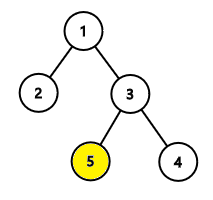We first ask about the distance between node $x$ and node $2$ . The answer is $3$ , so node $x$ is either $4$ or $5$ . We then ask about the second node in the path from node $3$ to node $x$ . Note here that node $3$ is an ancestor of node $5$ . We receive node $5$ as the answer. Finally, we report that the hidden node is node $5$ .
We first ask about the distance between node $x$ and node $2$ . The answer is $3$ , so node $x$ is either $4$ or $5$ . We then ask about the second node in the path from node $3$ to node $x$ . Note here that node $3$ is an ancestor of node $5$ . We receive node $5$ as the answer. Finally, we report that the hidden node is node $5$ .