A11775. Cycles in product
编程题
普及/提高-
知识点
题目描述
Consider a tree (that is, an undirected connected graph without loops) $T_1$ and a tree $T_2$ . Let's define their cartesian product $T_1 \times T_2$ in a following way.
Let $V$ be the set of vertices in $T_1$ and $U$ be the set of vertices in $T_2$ .
Then the set of vertices of graph $T_1 \times T_2$ is $V \times U$ , that is, a set of ordered pairs of vertices, where the first vertex in pair is from $V$ and the second — from $U$ .
Let's draw the following edges:
- Between $(v, u_1)$ and $(v, u_2)$ there is an undirected edge, if $u_1$ and $u_2$ are adjacent in $U$ .
- Similarly, between $(v_1, u)$ and $(v_2, u)$ there is an undirected edge, if $v_1$ and $v_2$ are adjacent in $V$ .
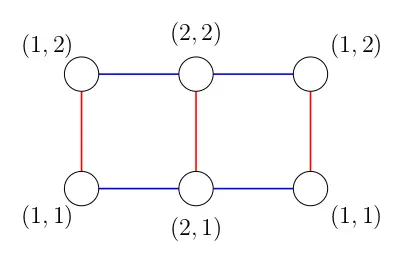
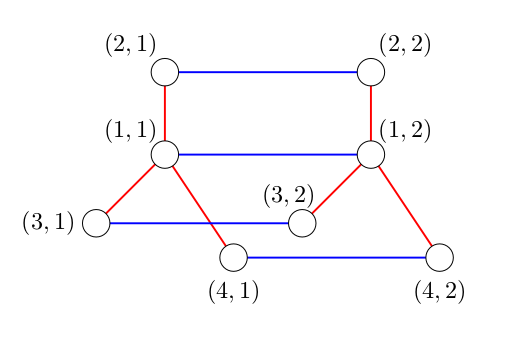
Please see the notes section for the pictures of products of trees in the sample tests.
Let's examine the graph $T_1 \times T_2$ . How much cycles (not necessarily simple) of length $k$ it contains? Since this number can be very large, print it modulo $998244353$ .
The sequence of vertices $w_1$ , $w_2$ , ..., $w_k$ , where $w_i \in V \times U$ called cycle, if any neighboring vertices are adjacent and $w_1$ is adjacent to $w_k$ . Cycles that differ only by the cyclic shift or direction of traversal are still considered different.
Let $V$ be the set of vertices in $T_1$ and $U$ be the set of vertices in $T_2$ .
Then the set of vertices of graph $T_1 \times T_2$ is $V \times U$ , that is, a set of ordered pairs of vertices, where the first vertex in pair is from $V$ and the second — from $U$ .
Let's draw the following edges:
- Between $(v, u_1)$ and $(v, u_2)$ there is an undirected edge, if $u_1$ and $u_2$ are adjacent in $U$ .
- Similarly, between $(v_1, u)$ and $(v_2, u)$ there is an undirected edge, if $v_1$ and $v_2$ are adjacent in $V$ .
Please see the notes section for the pictures of products of trees in the sample tests.
Let's examine the graph $T_1 \times T_2$ . How much cycles (not necessarily simple) of length $k$ it contains? Since this number can be very large, print it modulo $998244353$ .
The sequence of vertices $w_1$ , $w_2$ , ..., $w_k$ , where $w_i \in V \times U$ called cycle, if any neighboring vertices are adjacent and $w_1$ is adjacent to $w_k$ . Cycles that differ only by the cyclic shift or direction of traversal are still considered different.
输入格式
First line of input contains three integers — $n_1$ , $n_2$ and $k$ ( $2 \le n_1, n_2 \le 4000$ , $2 \le k \le 75$ ) — number of vertices in the first tree, number of vertices in the second tree and the cycle length respectively.
Then follow $n_1 - 1$ lines describing the first tree. Each of this lines contains two integers — $v_i, u_i$ ( $1 \le v_i, u_i \le n_1$ ), which define edges of the first tree.
Then follow $n_2 - 1$ lines, which describe the second tree in the same format.
It is guaranteed, that given graphs are trees.
Then follow $n_1 - 1$ lines describing the first tree. Each of this lines contains two integers — $v_i, u_i$ ( $1 \le v_i, u_i \le n_1$ ), which define edges of the first tree.
Then follow $n_2 - 1$ lines, which describe the second tree in the same format.
It is guaranteed, that given graphs are trees.
输出格式
Print one integer — number of cycles modulo $998244353$ .
输入输出样例
输入 #1
2 2 2
1 2
1 2
输出 #1
8
输入 #2
2 2 4
1 2
1 2
输出 #2
32
输入 #3
2 3 4
1 2
1 2
1 3
输出 #3
70
输入 #4
4 2 2
1 2
1 3
1 4
1 2
输出 #4
20
说明/提示
The following three pictures illustrate graph, which are products of the trees from sample tests.
In the first example, the list of cycles of length $2$ is as follows:
- «AB», «BA»
- «BC», «CB»
- «AD», «DA»
- «CD», «DC»
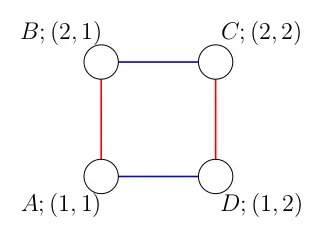
In the first example, the list of cycles of length $2$ is as follows:
- «AB», «BA»
- «BC», «CB»
- «AD», «DA»
- «CD», «DC»
