A11762. Path Counting
编程题
普及/提高-
知识点
题目描述
You are given a rooted tree. Let's denote $d(x)$ as depth of node $x$ : depth of the root is $1$ , depth of any other node $x$ is $d(y)+1$ , where $y$ is a parent of $x$ .
The tree has the following property: every node $x$ with $d(x)=i$ has exactly $a_{i}$ children. Maximum possible depth of a node is $n$ , and $a_{n}=0$ .
We define $f_{k}$ as the number of unordered pairs of vertices in the tree such that the number of edges on the simple path between them is equal to $k$ .
Calculate $f_{k}$ modulo $10^{9}+7$ for every $1<=k<=2n-2$ .
The tree has the following property: every node $x$ with $d(x)=i$ has exactly $a_{i}$ children. Maximum possible depth of a node is $n$ , and $a_{n}=0$ .
We define $f_{k}$ as the number of unordered pairs of vertices in the tree such that the number of edges on the simple path between them is equal to $k$ .
Calculate $f_{k}$ modulo $10^{9}+7$ for every $1<=k<=2n-2$ .
输入格式
The first line of input contains an integer $n$ ( $2<=n<=5000$ ) — the maximum depth of a node.
The second line of input contains $n-1$ integers $a_{1},a_{2},...,a_{n-1}$ ( $2<=a_{i}<=10^{9}$ ), where $a_{i}$ is the number of children of every node $x$ such that $d(x)=i$ . Since $a_{n}=0$ , it is not given in the input.
The second line of input contains $n-1$ integers $a_{1},a_{2},...,a_{n-1}$ ( $2<=a_{i}<=10^{9}$ ), where $a_{i}$ is the number of children of every node $x$ such that $d(x)=i$ . Since $a_{n}=0$ , it is not given in the input.
输出格式
Print $2n-2$ numbers. The $k$ -th of these numbers must be equal to $f_{k}$ modulo $10^{9}+7$ .
输入输出样例
输入 #1
4
2 2 2
输出 #1
14 19 20 20 16 16
输入 #2
3
2 3
输出 #2
8 13 6 9
说明/提示
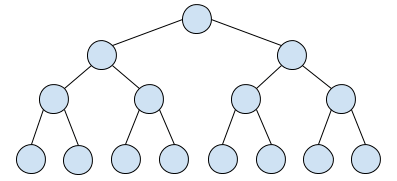
This the tree from the first sample: