A9900 | Kyoya and Train
时间限制1s
内存限制256MB
通过 / 提交0/0
题目描述
Kyoya Ootori wants to take the train to get to school. There are $n$ train stations and $m$ one-way train lines going between various stations. Kyoya is currently at train station $1$ , and the school is at station $n$ . To take a train, he must pay for a ticket, and the train also takes a certain amount of time. However, the trains are not perfect and take random amounts of time to arrive at their destination. If Kyoya arrives at school strictly after $t$ time units, he will have to pay a fine of $x$ .
Each train line is described by a ticket price, and a probability distribution on the time the train takes. More formally, train line $i$ has ticket cost $c_{i}$ , and a probability distribution $p_{i,k}$ which denotes the probability that this train will take $k$ time units for all $1<=k<=t$ . Amounts of time that each of the trains used by Kyouya takes are mutually independent random values (moreover, if Kyoya travels along the same train more than once, it is possible for the train to take different amounts of time and those amounts are also independent one from another).
Kyoya wants to get to school by spending the least amount of money in expectation (for the ticket price plus possible fine for being late). Of course, Kyoya has an optimal plan for how to get to school, and every time he arrives at a train station, he may recalculate his plan based on how much time he has remaining. What is the expected cost that Kyoya will pay to get to school if he moves optimally?
Each train line is described by a ticket price, and a probability distribution on the time the train takes. More formally, train line $i$ has ticket cost $c_{i}$ , and a probability distribution $p_{i,k}$ which denotes the probability that this train will take $k$ time units for all $1<=k<=t$ . Amounts of time that each of the trains used by Kyouya takes are mutually independent random values (moreover, if Kyoya travels along the same train more than once, it is possible for the train to take different amounts of time and those amounts are also independent one from another).
Kyoya wants to get to school by spending the least amount of money in expectation (for the ticket price plus possible fine for being late). Of course, Kyoya has an optimal plan for how to get to school, and every time he arrives at a train station, he may recalculate his plan based on how much time he has remaining. What is the expected cost that Kyoya will pay to get to school if he moves optimally?
输入格式
The first line of input contains four integers $n,m,t,x$ ( $2<=n<=50$ , $1<=m<=100$ , $1<=t<=20000$ , $0<=x<=10^{6}$ ).
The next $2m$ lines contain the description of the trains.
The $2i$ -th line will have $3$ integers $a_{i},b_{i},c_{i}$ , representing a one way train from station $a_{i}$ to $b_{i}$ with ticket cost $c_{i}$ ( $1<=a_{i},b_{i}<=n$ , $a_{i}≠b_{i}$ , $0<=c_{i}<=10^{6}$ ). There will always be at least one path from any station to the school.
The $(2i+1)$ -th line will contain $t$ integers, $p_{i,1},p_{i,2},...,p_{i,t}$ where $p_{i,k}/100000$ is the probability that this train will take $k$ units of time to traverse ( $0<=p_{i,k}<=100000$ for $1<=k<=t$ , 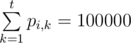).
It is guaranteed that there is no more than one train between each pair of platforms in each of the directions.
The next $2m$ lines contain the description of the trains.
The $2i$ -th line will have $3$ integers $a_{i},b_{i},c_{i}$ , representing a one way train from station $a_{i}$ to $b_{i}$ with ticket cost $c_{i}$ ( $1<=a_{i},b_{i}<=n$ , $a_{i}≠b_{i}$ , $0<=c_{i}<=10^{6}$ ). There will always be at least one path from any station to the school.
The $(2i+1)$ -th line will contain $t$ integers, $p_{i,1},p_{i,2},...,p_{i,t}$ where $p_{i,k}/100000$ is the probability that this train will take $k$ units of time to traverse ( $0<=p_{i,k}<=100000$ for $1<=k<=t$ , ).
It is guaranteed that there is no more than one train between each pair of platforms in each of the directions.
输出格式
Print a single real number that is equal to an optimal expected cost of getting to school. The answer will be considered correct if its relative or absolute error doesn't exceed $10^{-6}$ .
输入输出样例
输入 #1
4 4 5 1
1 2 0
50000 0 50000 0 0
2 3 0
10000 0 0 0 90000
3 4 0
100000 0 0 0 0
2 4 0
0 0 0 50000 50000
输出 #1
0.7000000000
输入 #2
4 4 5 1
1 2 100
50000 0 50000 0 0
2 3 100
10000 0 0 0 90000
3 4 100
100000 0 0 0 0
2 4 100
0 0 0 50000 50000
输出 #2
200.7500000000
The optimal strategy in the first case is as follows:
First, travel along first train line. With probability $1/2$ Kyoya will take $1$ time unit. Otherwise, Kyoya will take $3$ time units.
If the train takes $1$ time unit, travel along the 4th train line. Kyoya will make it to school in time with probability $1/2$ . Otherwise, if the train takes 3 time units, travel along the 2nd train line. Kyoya will make it to school in time with probability $1/10$ .
Since the cost of all train lines are zero, we can just look at the probability that Kyoya will incur the penalty. The probability that Kyoya will have to pay the penalty is $1/2×1/2+1/2×9/10=7/10$ . We can show that no other strategy is strictly better.
The optimal strategy in the second case is to travel along $1→2→4$ no matter what. Kyoya will incur the penalty with probability $3/4$ , and the cost of the trains is $200$ , thus the expected cost is $200.75$ .
First, travel along first train line. With probability $1/2$ Kyoya will take $1$ time unit. Otherwise, Kyoya will take $3$ time units.
If the train takes $1$ time unit, travel along the 4th train line. Kyoya will make it to school in time with probability $1/2$ . Otherwise, if the train takes 3 time units, travel along the 2nd train line. Kyoya will make it to school in time with probability $1/10$ .
Since the cost of all train lines are zero, we can just look at the probability that Kyoya will incur the penalty. The probability that Kyoya will have to pay the penalty is $1/2×1/2+1/2×9/10=7/10$ . We can show that no other strategy is strictly better.
The optimal strategy in the second case is to travel along $1→2→4$ no matter what. Kyoya will incur the penalty with probability $3/4$ , and the cost of the trains is $200$ , thus the expected cost is $200.75$ .
C++ 编辑器
输入
输出
可保存默认模板;新题优先使用已保存模板。
当前快捷键仅展示,暂不支持修改。
- 撤销
Ctrl / ⌘ + Z - 重做
Ctrl / ⌘ + Y - 查找
Ctrl / ⌘ + F - 全选
Ctrl / ⌘ + A - 复制
Ctrl / ⌘ + C - 剪切
Ctrl / ⌘ + X - 粘贴
Ctrl / ⌘ + V - 自动排版
工具栏排版按钮 - 草稿保存
编辑时自动保存到本机
历史
提交记录
状态说明时间源码
AI
作答助手
你好,我是作答助手。可以问思路、复杂度、样例含义或代码报错原因;不会直接给出完整 AC 代码。
确定要清空代码吗?
提交通过
评测结果:Accepted