A9793 | Spiders Evil Plan
时间限制1s
内存限制256MB
通过 / 提交0/0
题目描述
Spiders are Om Nom's old enemies. They love eating candies as much as he does and that's why they keep trying to keep the monster away from his favorite candies. They came up with an evil plan to trap Om Nom.
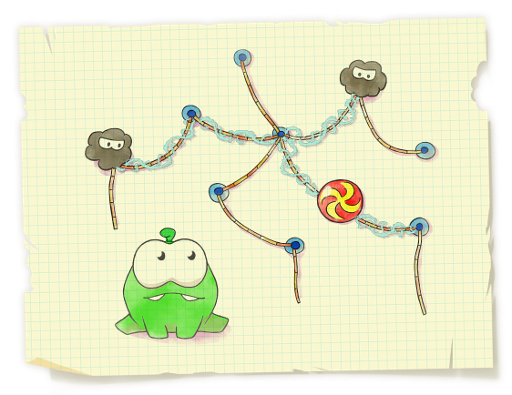Let's consider a rope structure consisting of $n$ nodes and $n-1$ ropes connecting the nodes. The structure is connected, thus, the ropes and the nodes form a tree. Each rope of the formed structure is associated with its length. A candy is tied to node $x$ of the structure. Om Nom really wants to eat this candy.
The $y$ spiders are trying to stop him from doing it. They decided to entangle the candy and some part of the structure into a web, thus attaching the candy to as large as possible part of the rope structure.
Each spider can use his web to cover all ropes on the path between two arbitrary nodes $a$ and $b$ . Thus, $y$ spiders can cover the set of ropes which is a union of $y$ paths in the given tree. These $y$ paths can arbitrarily intersect each other. The spiders want the following conditions to be hold:
- the node containing the candy is adjacent to at least one rope covered with a web
- the ropes covered with the web form a connected structure (what's the idea of covering with a web the ropes that are not connected with the candy?)
- the total length of the ropes covered with web is as large as possible
The spiders haven't yet decided to what node of the structure they will tie the candy and how many spiders will cover the structure with web, so they asked you to help them. Help them calculate the optimal plan for multiple values of $x$ and $y$ .
Let's consider a rope structure consisting of $n$ nodes and $n-1$ ropes connecting the nodes. The structure is connected, thus, the ropes and the nodes form a tree. Each rope of the formed structure is associated with its length. A candy is tied to node $x$ of the structure. Om Nom really wants to eat this candy.
The $y$ spiders are trying to stop him from doing it. They decided to entangle the candy and some part of the structure into a web, thus attaching the candy to as large as possible part of the rope structure.
Each spider can use his web to cover all ropes on the path between two arbitrary nodes $a$ and $b$ . Thus, $y$ spiders can cover the set of ropes which is a union of $y$ paths in the given tree. These $y$ paths can arbitrarily intersect each other. The spiders want the following conditions to be hold:
- the node containing the candy is adjacent to at least one rope covered with a web
- the ropes covered with the web form a connected structure (what's the idea of covering with a web the ropes that are not connected with the candy?)
- the total length of the ropes covered with web is as large as possible
The spiders haven't yet decided to what node of the structure they will tie the candy and how many spiders will cover the structure with web, so they asked you to help them. Help them calculate the optimal plan for multiple values of $x$ and $y$ .
输入格式
The first line contains numbers $n$ and $q$ ( $1<=n,q<=10^{5}$ ) — the number of nodes in the structure and the number of questions that the spiders want to ask you.
The next $n-1$ lines determine the rope structure. The $i$ -th line contains three integers $u_{i},v_{i},l_{i}$ ( $1<=u_{i},v_{i}<=n$ , $u_{i}≠v_{i}$ , $1<=l_{i}<=1000$ ), showing that there is a rope of length $l_{i}$ between nodes $u_{i}$ and $v_{i}$ .
Next $q$ lines describe the spiders' questions. As they want you to answer their question online, they encoded their messages in a special manner.
Each of the next $q$ lines contains two numbers $x_{i},y_{i}$ . In the first question of the spiders $x=x_{1},y=y_{1}$ .
To calculate values $x$ and $y$ in the spiders' $i$ -th ( $2<=i<=q$ ) question, you need to use the following formulas:


where $Ans_{i-1}$ is the total length of the ropes covered by a web in the answer for the $(i-1)$ -th question.
The following inequality holds: $1<=x_{i},y_{i}<=n$ .
The next $n-1$ lines determine the rope structure. The $i$ -th line contains three integers $u_{i},v_{i},l_{i}$ ( $1<=u_{i},v_{i}<=n$ , $u_{i}≠v_{i}$ , $1<=l_{i}<=1000$ ), showing that there is a rope of length $l_{i}$ between nodes $u_{i}$ and $v_{i}$ .
Next $q$ lines describe the spiders' questions. As they want you to answer their question online, they encoded their messages in a special manner.
Each of the next $q$ lines contains two numbers $x_{i},y_{i}$ . In the first question of the spiders $x=x_{1},y=y_{1}$ .
To calculate values $x$ and $y$ in the spiders' $i$ -th ( $2<=i<=q$ ) question, you need to use the following formulas:


where $Ans_{i-1}$ is the total length of the ropes covered by a web in the answer for the $(i-1)$ -th question.
The following inequality holds: $1<=x_{i},y_{i}<=n$ .
输出格式
For each question of the spiders print on a separate line a single integer $Ans_{i}$ — the total length of the ropes covered with web in the optimal plan.
输入输出样例
输入 #1
6 3
1 2 2
2 3 2
3 4 2
4 6 1
3 5 10
3 1
2 5
1 1
输出 #1
14
13
17
暂无题解
C++ 编辑器
输入
输出
可保存默认模板;新题优先使用已保存模板。
当前快捷键仅展示,暂不支持修改。
- 撤销
Ctrl / ⌘ + Z - 重做
Ctrl / ⌘ + Y - 查找
Ctrl / ⌘ + F - 全选
Ctrl / ⌘ + A - 复制
Ctrl / ⌘ + C - 剪切
Ctrl / ⌘ + X - 粘贴
Ctrl / ⌘ + V - 自动排版
工具栏排版按钮 - 草稿保存
编辑时自动保存到本机
历史
提交记录
状态说明时间源码
AI
作答助手
你好,我是作答助手。可以问思路、复杂度、样例含义或代码报错原因;不会直接给出完整 AC 代码。
确定要清空代码吗?
提交通过
评测结果:Accepted