A9529. The Child and Polygon
编程题
普及/提高-
知识点
题目描述
This time our child has a simple polygon. He has to find the number of ways to split the polygon into non-degenerate triangles, each way must satisfy the following requirements:
- each vertex of each triangle is one of the polygon vertex;
- each side of the polygon must be the side of exactly one triangle;
- the area of intersection of every two triangles equals to zero, and the sum of all areas of triangles equals to the area of the polygon;
- each triangle must be completely inside the polygon;
- each side of each triangle must contain exactly two vertices of the polygon.
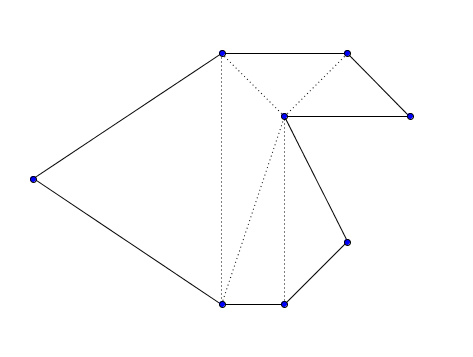
The picture below depicts an example of a correct splitting.
Please, help the child. Calculate the described number of ways modulo $1000000007$ $(10^{9}+7)$ for him.
- each vertex of each triangle is one of the polygon vertex;
- each side of the polygon must be the side of exactly one triangle;
- the area of intersection of every two triangles equals to zero, and the sum of all areas of triangles equals to the area of the polygon;
- each triangle must be completely inside the polygon;
- each side of each triangle must contain exactly two vertices of the polygon.
The picture below depicts an example of a correct splitting.
Please, help the child. Calculate the described number of ways modulo $1000000007$ $(10^{9}+7)$ for him.
输入格式
The first line contains one integer $n$ $(3<=n<=200)$ — the number of vertices of the polygon. Then follow $n$ lines, each line containing two integers. The $i$ -th line contains $x_{i},y_{i}$ $(|x_{i}|,|y_{i}|<=10^{7})$ — the $i$ -th vertex of the polygon in clockwise or counterclockwise order.
It's guaranteed that the polygon is simple.
It's guaranteed that the polygon is simple.
输出格式
Output the number of ways modulo $1000000007$ $(10^{9}+7)$ .
输入输出样例
输入 #1
4
0 0
0 1
1 1
1 0
输出 #1
2
输入 #2
4
0 0
1 0
0 1
-1 0
输出 #2
1
输入 #3
5
0 0
1 0
1 1
0 1
-2 -1
输出 #3
3
说明/提示
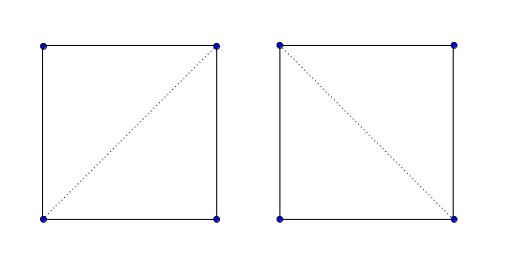
In the first sample, there are two possible splittings:
In the second sample, there are only one possible splitting:
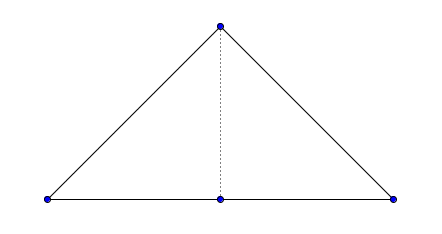
In the second sample, there are only one possible splitting:
