A9506. DZY Loves FFT
编程题
普及/提高-
知识点
题目描述
DZY loves Fast Fourier Transformation, and he enjoys using it.
Fast Fourier Transformation is an algorithm used to calculate convolution. Specifically, if $a$ , $b$ and $c$ are sequences with length $n$ , which are indexed from $0$ to $n-1$ , and
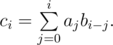We can calculate $c$ fast using Fast Fourier Transformation.
DZY made a little change on this formula. Now
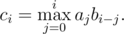To make things easier, $a$ is a permutation of integers from $1$ to $n$ , and $b$ is a sequence only containing $0$ and $1$ . Given $a$ and $b$ , DZY needs your help to calculate $c$ .
Because he is naughty, DZY provides a special way to get $a$ and $b$ . What you need is only three integers $n$ , $d$ , $x$ . After getting them, use the code below to generate $a$ and $b$ .
```
//x is 64-bit variable;
function getNextX() {
x = (x * 37 + 10007) % 1000000007;
return x;
}
function initAB() {
for(i = 0; i < n; i = i + 1){
a[i] = i + 1;
}
for(i = 0; i < n; i = i + 1){
swap(a[i], a[getNextX() % (i + 1)]);
}
for(i = 0; i < n; i = i + 1){
if (i < d)
b[i] = 1;
else
b[i] = 0;
}
for(i = 0; i < n; i = i + 1){
swap(b[i], b[getNextX() % (i + 1)]);
}
}
```
Operation x % y denotes remainder after division $x$ by $y$ . Function swap(x, y) swaps two values $x$ and $y$ .
Fast Fourier Transformation is an algorithm used to calculate convolution. Specifically, if $a$ , $b$ and $c$ are sequences with length $n$ , which are indexed from $0$ to $n-1$ , and
We can calculate $c$ fast using Fast Fourier Transformation.
DZY made a little change on this formula. Now
To make things easier, $a$ is a permutation of integers from $1$ to $n$ , and $b$ is a sequence only containing $0$ and $1$ . Given $a$ and $b$ , DZY needs your help to calculate $c$ .
Because he is naughty, DZY provides a special way to get $a$ and $b$ . What you need is only three integers $n$ , $d$ , $x$ . After getting them, use the code below to generate $a$ and $b$ .
```
//x is 64-bit variable;
function getNextX() {
x = (x * 37 + 10007) % 1000000007;
return x;
}
function initAB() {
for(i = 0; i < n; i = i + 1){
a[i] = i + 1;
}
for(i = 0; i < n; i = i + 1){
swap(a[i], a[getNextX() % (i + 1)]);
}
for(i = 0; i < n; i = i + 1){
if (i < d)
b[i] = 1;
else
b[i] = 0;
}
for(i = 0; i < n; i = i + 1){
swap(b[i], b[getNextX() % (i + 1)]);
}
}
```
Operation x % y denotes remainder after division $x$ by $y$ . Function swap(x, y) swaps two values $x$ and $y$ .
输入格式
The only line of input contains three space-separated integers $n,d,x (1<=d<=n<=100000; 0<=x<=1000000006)$ . Because DZY is naughty, $x$ can't be equal to $27777500$ .
输出格式
Output $n$ lines, the $i$ -th line should contain an integer $c_{i-1}$ .
输入输出样例
输入 #1
3 1 1
输出 #1
1
3
2
输入 #2
5 4 2
输出 #2
2
2
4
5
5
输入 #3
5 4 3
输出 #3
5
5
5
5
4
说明/提示
In the first sample, $a$ is $[1\ 3\ 2]$ , $b$ is $[1\ 0\ 0]$ , so $c_{0}=max(1·1)=1$ , $c_{1}=max(1·0,3·1)=3$ , $c_{2}=max(1·0,3·0,2·1)=2$ .
In the second sample, $a$ is $[2\ 1\ 4\ 5\ 3]$ , $b$ is $[1\ 1\ 1\ 0\ 1]$ .
In the third sample, $a$ is $[5\ 2\ 1\ 4\ 3]$ , $b$ is $[1\ 1\ 1\ 1\ 0]$ .
In the second sample, $a$ is $[2\ 1\ 4\ 5\ 3]$ , $b$ is $[1\ 1\ 1\ 0\ 1]$ .
In the third sample, $a$ is $[5\ 2\ 1\ 4\ 3]$ , $b$ is $[1\ 1\ 1\ 1\ 0]$ .