A9107 | Counting Skyscrapers
时间限制1s
内存限制256MB
通过 / 提交0/0
题目描述
A number of skyscrapers have been built in a line. The number of skyscrapers was chosen uniformly at random between $2$ and $314!$ (314 factorial, a very large number). The height of each skyscraper was chosen randomly and independently, with height $i$ having probability $2^{-i}$ for all positive integers $i$ . The floors of a skyscraper with height $i$ are numbered $0$ through $i-1$ .
To speed up transit times, a number of zip lines were installed between skyscrapers. Specifically, there is a zip line connecting the $i$ -th floor of one skyscraper with the $i$ -th floor of another skyscraper if and only if there are no skyscrapers between them that have an $i$ -th floor.
Alice and Bob decide to count the number of skyscrapers.
Alice is thorough, and wants to know exactly how many skyscrapers there are. She begins at the leftmost skyscraper, with a counter at 1. She then moves to the right, one skyscraper at a time, adding 1 to her counter each time she moves. She continues until she reaches the rightmost skyscraper.
Bob is impatient, and wants to finish as fast as possible. He begins at the leftmost skyscraper, with a counter at 1. He moves from building to building using zip lines. At each stage Bob uses the highest available zip line to the right, but ignores floors with a height greater than $h$ due to fear of heights. When Bob uses a zip line, he travels too fast to count how many skyscrapers he passed. Instead, he just adds $2^{i}$ to his counter, where $i$ is the number of the floor he's currently on. He continues until he reaches the rightmost skyscraper.
Consider the following example. There are $6$ buildings, with heights $1$ , $4$ , $3$ , $4$ , $1$ , $2$ from left to right, and $h=2$ . Alice begins with her counter at $1$ and then adds $1$ five times for a result of $6$ . Bob begins with his counter at $1$ , then he adds $1$ , $4$ , $4$ , and $2$ , in order, for a result of $12$ . Note that Bob ignores the highest zip line because of his fear of heights ( $h=2$ ).
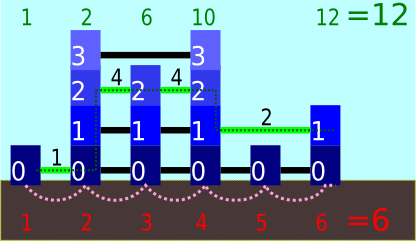Bob's counter is at the top of the image, and Alice's counter at the bottom. All zip lines are shown. Bob's path is shown by the green dashed line and Alice's by the pink dashed line. The floors of the skyscrapers are numbered, and the zip lines Bob uses are marked with the amount he adds to his counter.
When Alice and Bob reach the right-most skyscraper, they compare counters. You will be given either the value of Alice's counter or the value of Bob's counter, and must compute the expected value of the other's counter.
To speed up transit times, a number of zip lines were installed between skyscrapers. Specifically, there is a zip line connecting the $i$ -th floor of one skyscraper with the $i$ -th floor of another skyscraper if and only if there are no skyscrapers between them that have an $i$ -th floor.
Alice and Bob decide to count the number of skyscrapers.
Alice is thorough, and wants to know exactly how many skyscrapers there are. She begins at the leftmost skyscraper, with a counter at 1. She then moves to the right, one skyscraper at a time, adding 1 to her counter each time she moves. She continues until she reaches the rightmost skyscraper.
Bob is impatient, and wants to finish as fast as possible. He begins at the leftmost skyscraper, with a counter at 1. He moves from building to building using zip lines. At each stage Bob uses the highest available zip line to the right, but ignores floors with a height greater than $h$ due to fear of heights. When Bob uses a zip line, he travels too fast to count how many skyscrapers he passed. Instead, he just adds $2^{i}$ to his counter, where $i$ is the number of the floor he's currently on. He continues until he reaches the rightmost skyscraper.
Consider the following example. There are $6$ buildings, with heights $1$ , $4$ , $3$ , $4$ , $1$ , $2$ from left to right, and $h=2$ . Alice begins with her counter at $1$ and then adds $1$ five times for a result of $6$ . Bob begins with his counter at $1$ , then he adds $1$ , $4$ , $4$ , and $2$ , in order, for a result of $12$ . Note that Bob ignores the highest zip line because of his fear of heights ( $h=2$ ).
Bob's counter is at the top of the image, and Alice's counter at the bottom. All zip lines are shown. Bob's path is shown by the green dashed line and Alice's by the pink dashed line. The floors of the skyscrapers are numbered, and the zip lines Bob uses are marked with the amount he adds to his counter.
When Alice and Bob reach the right-most skyscraper, they compare counters. You will be given either the value of Alice's counter or the value of Bob's counter, and must compute the expected value of the other's counter.
输入格式
The first line of input will be a name, either string "Alice" or "Bob". The second line of input contains two integers $n$ and $h$ ( $2<=n<=30000$ , $0<=h<=30$ ). If the name is "Alice", then $n$ represents the value of Alice's counter when she reaches the rightmost skyscraper, otherwise $n$ represents the value of Bob's counter when he reaches the rightmost skyscraper; $h$ represents the highest floor number Bob is willing to use.
输出格式
Output a single real value giving the expected value of the Alice's counter if you were given Bob's counter, or Bob's counter if you were given Alice's counter.
You answer will be considered correct if its absolute or relative error doesn't exceed $10^{-9}$ .
You answer will be considered correct if its absolute or relative error doesn't exceed $10^{-9}$ .
输入输出样例
输入 #1
Alice
3 1
输出 #1
3.500000000
输入 #2
Bob
2 30
输出 #2
2
输入 #3
Alice
2572 10
输出 #3
3439.031415943
In the first example, Bob's counter has a 62.5% chance of being 3, a 25% chance of being 4, and a 12.5% chance of being 5.
C++ 编辑器
输入
输出
可保存默认模板;新题优先使用已保存模板。
当前快捷键仅展示,暂不支持修改。
- 撤销
Ctrl / ⌘ + Z - 重做
Ctrl / ⌘ + Y - 查找
Ctrl / ⌘ + F - 全选
Ctrl / ⌘ + A - 复制
Ctrl / ⌘ + C - 剪切
Ctrl / ⌘ + X - 粘贴
Ctrl / ⌘ + V - 自动排版
工具栏排版按钮 - 草稿保存
编辑时自动保存到本机
历史
提交记录
状态说明时间源码
AI
作答助手
你好,我是作答助手。可以问思路、复杂度、样例含义或代码报错原因;不会直接给出完整 AC 代码。
确定要清空代码吗?
提交通过
评测结果:Accepted