A8666 | Surrounded
时间限制1s
内存限制256MB
通过 / 提交0/0
题目描述
So, the Berland is at war with its eternal enemy Flatland again, and Vasya, an accountant, was assigned to fulfil his duty to the nation.
Right now the situation in Berland is dismal — their both cities are surrounded! The armies of flatlanders stand on the borders of circles, the circles' centers are in the surrounded cities. At any moment all points of the flatland ring can begin to move quickly in the direction of the city — that's the strategy the flatlanders usually follow when they besiege cities.
The berlanders are sure that they can repel the enemy's attack if they learn the exact time the attack starts. For that they need to construct a radar that would register any movement at the distance of at most $r$ from it. Thus, we can install a radar at such point, that at least one point of the enemy ring will be in its detecting range (that is, at a distance of at most $r$ ). Then the radar can immediately inform about the enemy's attack.
Due to the newest technologies, we can place a radar at any point without any problems. But the problem is that the berlanders have the time to make only one radar. Besides, the larger the detection radius $(r)$ is, the more the radar costs.
That's why Vasya's task (that is, your task) is to find the minimum possible detection radius for the radar. In other words, your task is to find the minimum radius $r$ $(r>=0)$ such, that a radar with radius $r$ can be installed at some point and it can register the start of the movements of both flatland rings from that point.
In this problem you can consider the cities as material points, the attacking enemy rings - as circles with centers in the cities, the radar's detection range — as a disk (including the border) with the center at the point where the radar is placed.
Right now the situation in Berland is dismal — their both cities are surrounded! The armies of flatlanders stand on the borders of circles, the circles' centers are in the surrounded cities. At any moment all points of the flatland ring can begin to move quickly in the direction of the city — that's the strategy the flatlanders usually follow when they besiege cities.
The berlanders are sure that they can repel the enemy's attack if they learn the exact time the attack starts. For that they need to construct a radar that would register any movement at the distance of at most $r$ from it. Thus, we can install a radar at such point, that at least one point of the enemy ring will be in its detecting range (that is, at a distance of at most $r$ ). Then the radar can immediately inform about the enemy's attack.
Due to the newest technologies, we can place a radar at any point without any problems. But the problem is that the berlanders have the time to make only one radar. Besides, the larger the detection radius $(r)$ is, the more the radar costs.
That's why Vasya's task (that is, your task) is to find the minimum possible detection radius for the radar. In other words, your task is to find the minimum radius $r$ $(r>=0)$ such, that a radar with radius $r$ can be installed at some point and it can register the start of the movements of both flatland rings from that point.
In this problem you can consider the cities as material points, the attacking enemy rings - as circles with centers in the cities, the radar's detection range — as a disk (including the border) with the center at the point where the radar is placed.
输入格式
The input files consist of two lines. Each line represents the city and the flatland ring that surrounds it as three space-separated integers $x_{i}$ , $y_{i}$ , $r_{i}$ $(|x_{i}|,|y_{i}|<=10^{4}; 1<=r_{i}<=10^{4})$ — the city's coordinates and the distance from the city to the flatlanders, correspondingly.
It is guaranteed that the cities are located at different points.
It is guaranteed that the cities are located at different points.
输出格式
Print a single real number — the minimum detection radius of the described radar. The answer is considered correct if the absolute or relative error does not exceed $10^{-6}$ .
输入输出样例
输入 #1
0 0 1
6 0 3
输出 #1
1.000000000000000
输入 #2
-10 10 3
10 -10 3
输出 #2
11.142135623730951
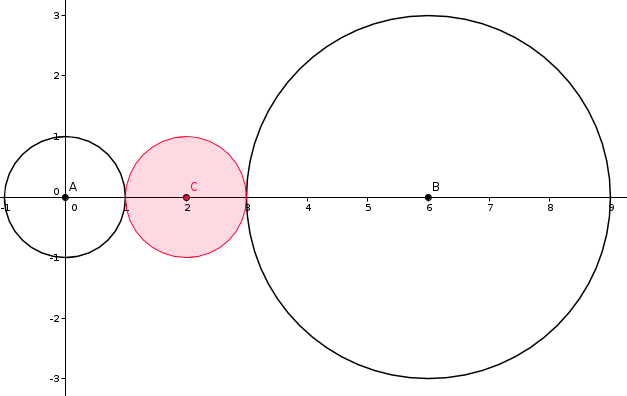
The figure below shows the answer to the first sample. In this sample the best decision is to put the radar at point with coordinates $(2,0)$ .
The figure below shows the answer for the second sample. In this sample the best decision is to put the radar at point with coordinates $(0,0)$ .
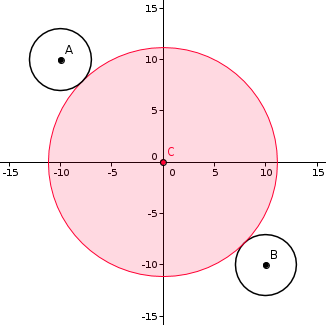
The figure below shows the answer for the second sample. In this sample the best decision is to put the radar at point with coordinates $(0,0)$ .

C++ 编辑器
输入
输出
可保存默认模板;新题优先使用已保存模板。
当前快捷键仅展示,暂不支持修改。
- 撤销
Ctrl / ⌘ + Z - 重做
Ctrl / ⌘ + Y - 查找
Ctrl / ⌘ + F - 全选
Ctrl / ⌘ + A - 复制
Ctrl / ⌘ + C - 剪切
Ctrl / ⌘ + X - 粘贴
Ctrl / ⌘ + V - 自动排版
工具栏排版按钮 - 草稿保存
编辑时自动保存到本机
历史
提交记录
状态说明时间源码
AI
作答助手
你好,我是作答助手。可以问思路、复杂度、样例含义或代码报错原因;不会直接给出完整 AC 代码。
确定要清空代码吗?
提交通过
评测结果:Accepted