A8108 | Colorful Field
时间限制1s
内存限制256MB
通过 / 提交0/0
题目描述
Fox Ciel saw a large field while she was on a bus. The field was a $n×m$ rectangle divided into $1×1$ cells. Some cells were wasteland, and other each cell contained crop plants: either carrots or kiwis or grapes.
After seeing the field carefully, Ciel found that the crop plants of each cell were planted in following procedure:
- Assume that the rows are numbered $1$ to $n$ from top to bottom and the columns are numbered $1$ to $m$ from left to right, and a cell in row $i$ and column $j$ is represented as $(i,j)$ .
- First, each field is either cultivated or waste. Crop plants will be planted in the cultivated cells in the order of $(1,1)→...→(1,m)→(2,1)→...→(2,m)→...→(n,1)→...→(n,m)$ . Waste cells will be ignored.
- Crop plants (either carrots or kiwis or grapes) will be planted in each cell one after another cyclically. Carrots will be planted in the first cell, then kiwis in the second one, grapes in the third one, carrots in the forth one, kiwis in the fifth one, and so on.
The following figure will show you the example of this procedure. Here, a white square represents a cultivated cell, and a black square represents a waste cell.
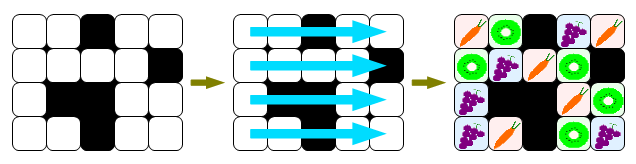Now she is wondering how to determine the crop plants in some certain cells.
After seeing the field carefully, Ciel found that the crop plants of each cell were planted in following procedure:
- Assume that the rows are numbered $1$ to $n$ from top to bottom and the columns are numbered $1$ to $m$ from left to right, and a cell in row $i$ and column $j$ is represented as $(i,j)$ .
- First, each field is either cultivated or waste. Crop plants will be planted in the cultivated cells in the order of $(1,1)→...→(1,m)→(2,1)→...→(2,m)→...→(n,1)→...→(n,m)$ . Waste cells will be ignored.
- Crop plants (either carrots or kiwis or grapes) will be planted in each cell one after another cyclically. Carrots will be planted in the first cell, then kiwis in the second one, grapes in the third one, carrots in the forth one, kiwis in the fifth one, and so on.
The following figure will show you the example of this procedure. Here, a white square represents a cultivated cell, and a black square represents a waste cell.
Now she is wondering how to determine the crop plants in some certain cells.
输入格式
In the first line there are four positive integers $n,m,k,t$ ( $1<=n<=4·10^{4},1<=m<=4·10^{4},1<=k<=10^{3},1<=t<=10^{3}$ ), each of which represents the height of the field, the width of the field, the number of waste cells and the number of queries that ask the kind of crop plants in a certain cell.
Following each $k$ lines contains two integers $a,b$ ( $1<=a<=n,1<=b<=m$ ), which denotes a cell $(a,b)$ is waste. It is guaranteed that the same cell will not appear twice in this section.
Following each $t$ lines contains two integers $i,j$ ( $1<=i<=n,1<=j<=m$ ), which is a query that asks you the kind of crop plants of a cell $(i,j)$ .
Following each $k$ lines contains two integers $a,b$ ( $1<=a<=n,1<=b<=m$ ), which denotes a cell $(a,b)$ is waste. It is guaranteed that the same cell will not appear twice in this section.
Following each $t$ lines contains two integers $i,j$ ( $1<=i<=n,1<=j<=m$ ), which is a query that asks you the kind of crop plants of a cell $(i,j)$ .
输出格式
For each query, if the cell is waste, print Waste. Otherwise, print the name of crop plants in the cell: either Carrots or Kiwis or Grapes.
输入输出样例
输入 #1
4 5 5 6
4 3
1 3
3 3
2 5
3 2
1 3
1 4
2 3
2 4
1 1
1 1
输出 #1
Waste
Grapes
Carrots
Kiwis
Carrots
Carrots
The sample corresponds to the figure in the statement.
C++ 编辑器
输入
输出
可保存默认模板;新题优先使用已保存模板。
当前快捷键仅展示,暂不支持修改。
- 撤销
Ctrl / ⌘ + Z - 重做
Ctrl / ⌘ + Y - 查找
Ctrl / ⌘ + F - 全选
Ctrl / ⌘ + A - 复制
Ctrl / ⌘ + C - 剪切
Ctrl / ⌘ + X - 粘贴
Ctrl / ⌘ + V - 自动排版
工具栏排版按钮 - 草稿保存
编辑时自动保存到本机
历史
提交记录
状态说明时间源码
AI
作答助手
你好,我是作答助手。可以问思路、复杂度、样例含义或代码报错原因;不会直接给出完整 AC 代码。
确定要清空代码吗?
提交通过
评测结果:Accepted