A16409 | Group Division
时间限制1s
内存限制256MB
通过 / 提交0/0
题目描述
In the $31$ st lyceum, there were two groups of olympiad participants: computer science and mathematics. The number of computer scientists was $n_1$ , and the number of mathematicians was $n_2$ . It is not known for certain who belonged to which group, but it is known that there were friendly connections between some pairs of people (these connections could exist between a pair of people from the same group or from different groups).
The connections were so strong that even if one person is removed along with all their friendly connections, any pair of people still remains acquainted either directly or through mutual friends.
$^{\dagger}$ More formally, two people $(x, y)$ are acquainted in the following case: there are people $a_1, a_2, \ldots,a_n$ ( $1 \le a_i \le n_1 + n_2$ ) such that the following conditions are simultaneously met:
$\bullet$ Person $x$ is directly acquainted with $a_1$ .
$\bullet$ Person $a_n$ is directly acquainted with $y$ .
$\bullet$ Person $a_i$ is directly acquainted with $a_{i + 1}$ for any ( $1 \le i \le n - 1$ ).
The teachers were dissatisfied with the fact that computer scientists were friends with mathematicians and vice versa, so they decided to divide the students into two groups in such a way that the following two conditions are met:
$\bullet$ There were $n_1$ people in the computer science group, and $n_2$ people in the mathematics group.
$\bullet$ Any pair of computer scientists should be acquainted (acquaintance involving mutual friends, who must be from the same group as the people in the pair, is allowed), the same should be true for mathematicians.
Help them solve this problem and find out who belongs to which group.
The connections were so strong that even if one person is removed along with all their friendly connections, any pair of people still remains acquainted either directly or through mutual friends.
$^{\dagger}$ More formally, two people $(x, y)$ are acquainted in the following case: there are people $a_1, a_2, \ldots,a_n$ ( $1 \le a_i \le n_1 + n_2$ ) such that the following conditions are simultaneously met:
$\bullet$ Person $x$ is directly acquainted with $a_1$ .
$\bullet$ Person $a_n$ is directly acquainted with $y$ .
$\bullet$ Person $a_i$ is directly acquainted with $a_{i + 1}$ for any ( $1 \le i \le n - 1$ ).
The teachers were dissatisfied with the fact that computer scientists were friends with mathematicians and vice versa, so they decided to divide the students into two groups in such a way that the following two conditions are met:
$\bullet$ There were $n_1$ people in the computer science group, and $n_2$ people in the mathematics group.
$\bullet$ Any pair of computer scientists should be acquainted (acquaintance involving mutual friends, who must be from the same group as the people in the pair, is allowed), the same should be true for mathematicians.
Help them solve this problem and find out who belongs to which group.
输入格式
Each test consists of several test cases. The first line contains a single integer $t$ ( $1 \le t \le 1000$ ) — the number of test cases. Then follows the description of the test cases.
The first line of each test case contains three integers $n_1$ , $n_2$ , and $m$ ( $1 \le n_1, n_2 \le 2000$ , $1 \le m \le 5000$ ). $n_1$ , $n_2$ are the sizes of the two groups described in the problem, and $m$ is the number of friendly connections initially.
The following $m$ lines describe the friendly connections: in the $i$ -th ( $1 \le i \le m$ ) line, a pair of numbers $(a, b)$ is given, which means that the person with number $a$ is friends with the person with number $b$ (and vice versa).
It is guaranteed that for each test case, all friendly connections are distinct.
It is guaranteed that the sum of $n_1 + n_2$ for all test cases does not exceed $2000$ , and the sum of $m$ for all test cases does not exceed $5000$ .
It is also guaranteed that for each test case, a solution exists.
If there are several answers, print any of them.
The first line of each test case contains three integers $n_1$ , $n_2$ , and $m$ ( $1 \le n_1, n_2 \le 2000$ , $1 \le m \le 5000$ ). $n_1$ , $n_2$ are the sizes of the two groups described in the problem, and $m$ is the number of friendly connections initially.
The following $m$ lines describe the friendly connections: in the $i$ -th ( $1 \le i \le m$ ) line, a pair of numbers $(a, b)$ is given, which means that the person with number $a$ is friends with the person with number $b$ (and vice versa).
It is guaranteed that for each test case, all friendly connections are distinct.
It is guaranteed that the sum of $n_1 + n_2$ for all test cases does not exceed $2000$ , and the sum of $m$ for all test cases does not exceed $5000$ .
It is also guaranteed that for each test case, a solution exists.
If there are several answers, print any of them.
输出格式
For each test case, output two lines.
In the first line, output $n_1$ distinct numbers $a_i$ ( $1 \le a_i \le n_1 + n_2$ ) — the people belonging to the first group.
In the second line, output $n_2$ distinct numbers $b_i$ ( $1 \le b_i \le n_1 + n_2$ ) — the people belonging to the second group.
All numbers must be distinct.
If there are several possible answers, print any one.
In the first line, output $n_1$ distinct numbers $a_i$ ( $1 \le a_i \le n_1 + n_2$ ) — the people belonging to the first group.
In the second line, output $n_2$ distinct numbers $b_i$ ( $1 \le b_i \le n_1 + n_2$ ) — the people belonging to the second group.
All numbers must be distinct.
If there are several possible answers, print any one.
输入输出样例
输入 #1
3
1 2 3
2 3
1 3
1 2
1 4 7
2 5
3 4
2 4
1 2
3 5
4 5
1 5
3 3 7
1 2
1 6
2 3
2 5
3 4
4 5
4 6
输出 #1
3
1 2
5
1 2 3 4
4 5 6
1 2 3
Consider the third test case. The division into groups looks as follows:
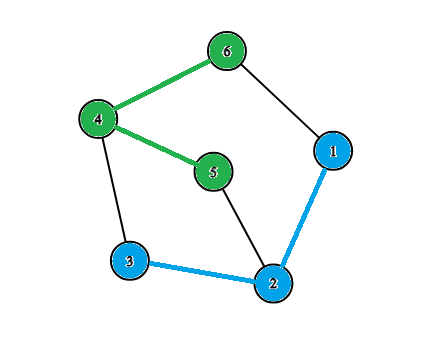 The students selected as computer scientists are colored in green, and those selected as mathematicians are colored in blue.Consider all pairs of computer scientists and how they are acquainted:
Pairs $(4, 5), (4, 6)$ are directly acquainted.
Pair $(5, 6)$ is acquainted through the computer scientist with number $4$ .
Consider all pairs of mathematicians and how they are acquainted:
Pairs $(1, 2), (2, 3)$ are directly acquainted.
Pair $(1, 3)$ is acquainted through the mathematician with number $2$ .
We conclude that any pair of people belonging to the same group is acquainted with each other, thus the division into two groups is correct.
 The students selected as computer scientists are colored in green, and those selected as mathematicians are colored in blue.Consider all pairs of computer scientists and how they are acquainted:
Pairs $(4, 5), (4, 6)$ are directly acquainted.
Pair $(5, 6)$ is acquainted through the computer scientist with number $4$ .
Consider all pairs of mathematicians and how they are acquainted:
Pairs $(1, 2), (2, 3)$ are directly acquainted.
Pair $(1, 3)$ is acquainted through the mathematician with number $2$ .
We conclude that any pair of people belonging to the same group is acquainted with each other, thus the division into two groups is correct.
C++ 编辑器
输入
输出
可保存默认模板;新题优先使用已保存模板。
当前快捷键仅展示,暂不支持修改。
- 撤销
Ctrl / ⌘ + Z - 重做
Ctrl / ⌘ + Y - 查找
Ctrl / ⌘ + F - 全选
Ctrl / ⌘ + A - 复制
Ctrl / ⌘ + C - 剪切
Ctrl / ⌘ + X - 粘贴
Ctrl / ⌘ + V - 自动排版
工具栏排版按钮 - 草稿保存
编辑时自动保存到本机
历史
提交记录
状态说明时间源码
AI
作答助手
你好,我是作答助手。可以问思路、复杂度、样例含义或代码报错原因;不会直接给出完整 AC 代码。
确定要清空代码吗?
提交通过
评测结果:Accepted