A16196. Chips on the Board
编程题
普及/提高-
知识点
题目描述
You are given a board of size $n \times n$ ( $n$ rows and $n$ colums) and two arrays of positive integers $a$ and $b$ of size $n$ .
Your task is to place the chips on this board so that the following condition is satisfied for every cell $(i, j)$ :
- there exists at least one chip in the same column or in the same row as the cell $(i, j)$ . I. e. there exists a cell $(x, y)$ such that there is a chip in that cell, and either $x = i$ or $y = j$ (or both).
The cost of putting a chip in the cell $(i, j)$ is equal to $a_i + b_j$ .
For example, for $n=3$ , $a=[1, 4, 1]$ and $b=[3, 2, 2]$ . One of the possible chip placements is as follows:
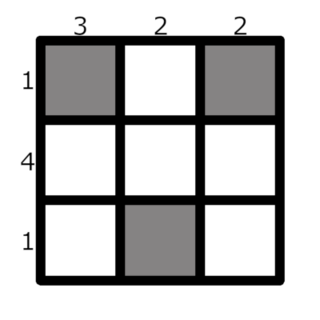 White squares are emptyThe total cost of that placement is $(1+3) + (1+2) + (1+2) = 10$ .
Calculate the minimum possible total cost of putting chips according to the rules above.
Your task is to place the chips on this board so that the following condition is satisfied for every cell $(i, j)$ :
- there exists at least one chip in the same column or in the same row as the cell $(i, j)$ . I. e. there exists a cell $(x, y)$ such that there is a chip in that cell, and either $x = i$ or $y = j$ (or both).
The cost of putting a chip in the cell $(i, j)$ is equal to $a_i + b_j$ .
For example, for $n=3$ , $a=[1, 4, 1]$ and $b=[3, 2, 2]$ . One of the possible chip placements is as follows:
 White squares are emptyThe total cost of that placement is $(1+3) + (1+2) + (1+2) = 10$ .
Calculate the minimum possible total cost of putting chips according to the rules above.
输入格式
The first line contains a single integer $t$ ( $1 \le t \le 10^4$ ) — the number of test cases.
The first line of each test case contains a single integer $n$ ( $1 \le n \le 3 \cdot 10^5$ ).
The second line contains $n$ integers $a_1, a_2, \dots, a_n$ ( $1 \le a_i \le 10^9$ ).
The third line contains $n$ integers $b_1, b_2, \dots, b_n$ ( $1 \le b_i \le 10^9$ ).
The sum of $n$ over all test cases doesn't exceed $3 \cdot 10^5$ .
The first line of each test case contains a single integer $n$ ( $1 \le n \le 3 \cdot 10^5$ ).
The second line contains $n$ integers $a_1, a_2, \dots, a_n$ ( $1 \le a_i \le 10^9$ ).
The third line contains $n$ integers $b_1, b_2, \dots, b_n$ ( $1 \le b_i \le 10^9$ ).
The sum of $n$ over all test cases doesn't exceed $3 \cdot 10^5$ .
输出格式
For each test case, print a single integer — the minimum possible total cost of putting chips according to the rules.
输入输出样例
输入 #1
4
3
1 4 1
3 2 2
1
4
5
2
4 5
2 3
5
5 2 4 5 3
3 4 2 1 5
输出 #1
10
9
13
24
说明/提示
The first test case of the example is described in the statement.