A16129. PermuTree (hard version)
编程题
普及/提高-
知识点
题目描述
This is the hard version of the problem. The differences between the two versions are the constraint on $n$ and the time limit. You can make hacks only if both versions of the problem are solved.
You are given a tree with $n$ vertices rooted at vertex $1$ .
For some permutation $^\dagger$ $a$ of length $n$ , let $f(a)$ be the number of pairs of vertices $(u, v)$ such that $a_u < a_{\operatorname{lca}(u, v)} < a_v$ . Here, $\operatorname{lca}(u,v)$ denotes the [lowest common ancestor](https://en.wikipedia.org/wiki/Lowest_common_ancestor) of vertices $u$ and $v$ .
Find the maximum possible value of $f(a)$ over all permutations $a$ of length $n$ .
$^\dagger$ A permutation of length $n$ is an array consisting of $n$ distinct integers from $1$ to $n$ in arbitrary order. For example, $[2,3,1,5,4]$ is a permutation, but $[1,2,2]$ is not a permutation ( $2$ appears twice in the array), and $[1,3,4]$ is also not a permutation ( $n=3$ but there is $4$ in the array).
You are given a tree with $n$ vertices rooted at vertex $1$ .
For some permutation $^\dagger$ $a$ of length $n$ , let $f(a)$ be the number of pairs of vertices $(u, v)$ such that $a_u < a_{\operatorname{lca}(u, v)} < a_v$ . Here, $\operatorname{lca}(u,v)$ denotes the [lowest common ancestor](https://en.wikipedia.org/wiki/Lowest_common_ancestor) of vertices $u$ and $v$ .
Find the maximum possible value of $f(a)$ over all permutations $a$ of length $n$ .
$^\dagger$ A permutation of length $n$ is an array consisting of $n$ distinct integers from $1$ to $n$ in arbitrary order. For example, $[2,3,1,5,4]$ is a permutation, but $[1,2,2]$ is not a permutation ( $2$ appears twice in the array), and $[1,3,4]$ is also not a permutation ( $n=3$ but there is $4$ in the array).
输入格式
The first line contains a single integer $n$ ( $2 \le n \le 10^6$ ).
The second line contains $n - 1$ integers $p_2,p_3,\ldots,p_n$ ( $1 \le p_i < i$ ) indicating that there is an edge between vertices $i$ and $p_i$ .
The second line contains $n - 1$ integers $p_2,p_3,\ldots,p_n$ ( $1 \le p_i < i$ ) indicating that there is an edge between vertices $i$ and $p_i$ .
输出格式
Output the maximum value of $f(a)$ .
输入输出样例
输入 #1
5
1 1 3 3
输出 #1
4
输入 #2
2
1
输出 #2
0
输入 #3
6
1 2 2 1 5
输出 #3
7
输入 #4
4
1 1 1
输出 #4
2
说明/提示
The tree in the first test:
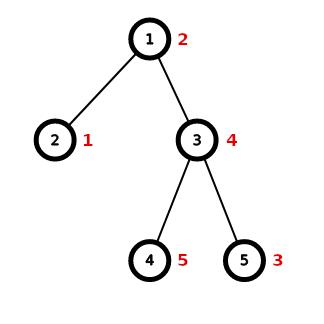One possible optimal permutation $a$ is $[2, 1, 4, 5, 3]$ with $4$ suitable pairs of vertices:
- $(2, 3)$ , since $\operatorname{lca}(2, 3) = 1$ and $1 < 2 < 4$ ,
- $(2, 4)$ , since $\operatorname{lca}(2, 4) = 1$ and $1 < 2 < 5$ ,
- $(2, 5)$ , since $\operatorname{lca}(2, 5) = 1$ and $1 < 2 < 3$ ,
- $(5, 4)$ , since $\operatorname{lca}(5, 4) = 3$ and $3 < 4 < 5$ .
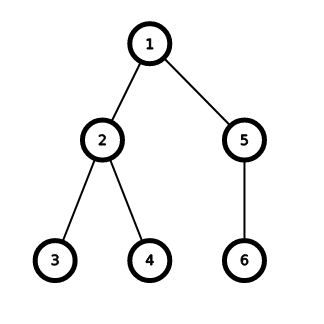
The tree in the third test:
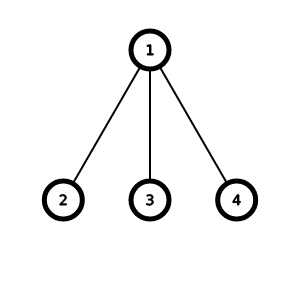
The tree in the fourth test:
One possible optimal permutation $a$ is $[2, 1, 4, 5, 3]$ with $4$ suitable pairs of vertices:
- $(2, 3)$ , since $\operatorname{lca}(2, 3) = 1$ and $1 < 2 < 4$ ,
- $(2, 4)$ , since $\operatorname{lca}(2, 4) = 1$ and $1 < 2 < 5$ ,
- $(2, 5)$ , since $\operatorname{lca}(2, 5) = 1$ and $1 < 2 < 3$ ,
- $(5, 4)$ , since $\operatorname{lca}(5, 4) = 3$ and $3 < 4 < 5$ .
The tree in the third test:
The tree in the fourth test:
