A16050 | Playoff Fixing
时间限制1s
内存限制256MB
通过 / 提交0/0
题目描述
$2^k$ teams participate in a playoff tournament. The teams are numbered from $1$ to $2^k$ , in order of decreasing strength. So, team $1$ is the strongest one, team $2^k$ is the weakest one. A team with a smaller number always defeats a team with a larger number.
First of all, the teams are arranged in some order during a procedure called seeding. Each team is assigned another unique value from $1$ to $2^k$ , called a seed, that represents its starting position in the playoff.
The tournament consists of $2^k - 1$ games. They are held as follows: the teams are split into pairs: team with seed $1$ plays against team with seed $2$ , team with seed $3$ plays against team with seed $4$ (exactly in this order), and so on (so, $2^{k-1}$ games are played in that phase). When a team loses a game, it is eliminated.
After that, only $2^{k-1}$ teams remain. If only one team remains, it is declared the champion; otherwise, $2^{k-2}$ games are played: in the first one of them, the winner of the game "seed $1$ vs seed $2$ " plays against the winner of the game "seed $3$ vs seed $4$ ", then the winner of the game "seed $5$ vs seed $6$ " plays against the winner of the game "seed $7$ vs seed $8$ ", and so on. This process repeats until only one team remains.
After the tournament ends, the teams are assigned places according to the tournament phase when they were eliminated. In particular:
- the winner of the tournament gets place $1$ ;
- the team eliminated in the finals gets place $2$ ;
- both teams eliminated in the semifinals get place $3$ ;
- all teams eliminated in the quarterfinals get place $5$ ;
- all teams eliminated in the 1/8 finals get place $9$ , and so on.
Now that we established the rules, we do a little rigging. In particular, we want:
- team $1$ (not team with seed $1$ ) to take place $1$ ;
- team $2$ to take place $2$ ;
- teams $3$ and $4$ to take place $3$ ;
- teams from $5$ to $8$ to take place $5$ , and so on.
For example, this picture describes one of the possible ways the tournament can go with $k = 3$ , and the resulting places of the teams:
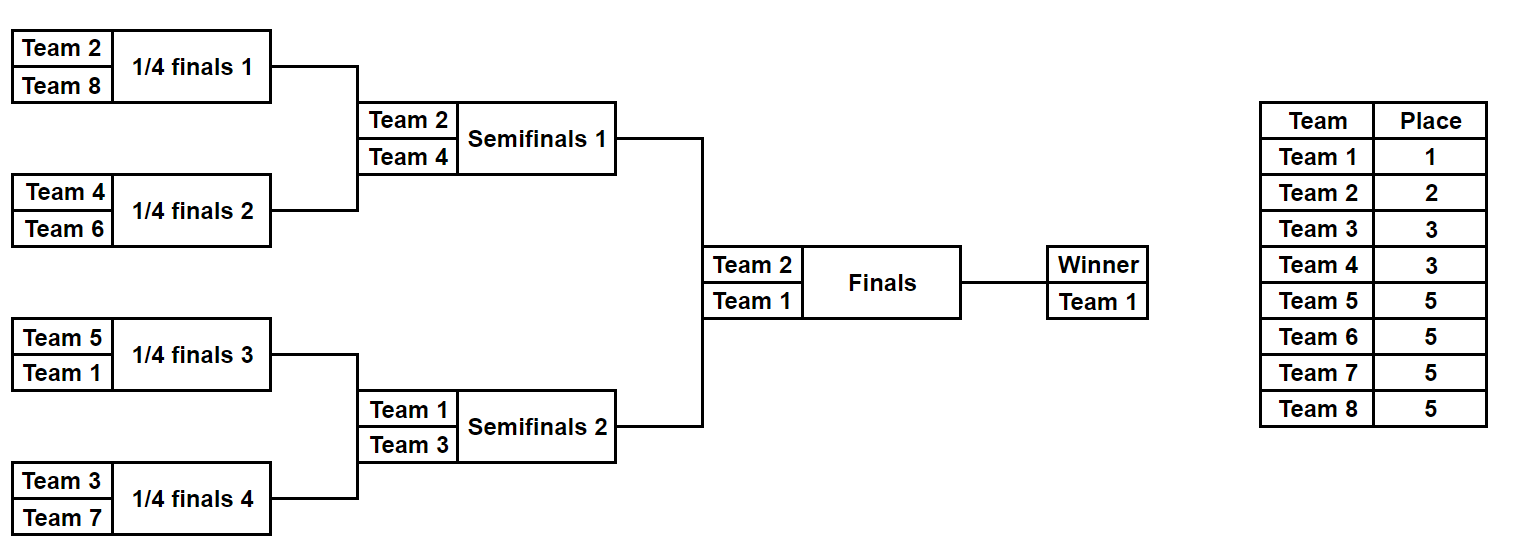Some seeds are already reserved for some teams (we are not the only ones rigging the tournament, apparently). We have to fill the rest of the seeds with the remaining teams to achieve the desired placements. How many ways are there to do that? Since that value might be large, print it modulo $998\,244\,353$ .
First of all, the teams are arranged in some order during a procedure called seeding. Each team is assigned another unique value from $1$ to $2^k$ , called a seed, that represents its starting position in the playoff.
The tournament consists of $2^k - 1$ games. They are held as follows: the teams are split into pairs: team with seed $1$ plays against team with seed $2$ , team with seed $3$ plays against team with seed $4$ (exactly in this order), and so on (so, $2^{k-1}$ games are played in that phase). When a team loses a game, it is eliminated.
After that, only $2^{k-1}$ teams remain. If only one team remains, it is declared the champion; otherwise, $2^{k-2}$ games are played: in the first one of them, the winner of the game "seed $1$ vs seed $2$ " plays against the winner of the game "seed $3$ vs seed $4$ ", then the winner of the game "seed $5$ vs seed $6$ " plays against the winner of the game "seed $7$ vs seed $8$ ", and so on. This process repeats until only one team remains.
After the tournament ends, the teams are assigned places according to the tournament phase when they were eliminated. In particular:
- the winner of the tournament gets place $1$ ;
- the team eliminated in the finals gets place $2$ ;
- both teams eliminated in the semifinals get place $3$ ;
- all teams eliminated in the quarterfinals get place $5$ ;
- all teams eliminated in the 1/8 finals get place $9$ , and so on.
Now that we established the rules, we do a little rigging. In particular, we want:
- team $1$ (not team with seed $1$ ) to take place $1$ ;
- team $2$ to take place $2$ ;
- teams $3$ and $4$ to take place $3$ ;
- teams from $5$ to $8$ to take place $5$ , and so on.
For example, this picture describes one of the possible ways the tournament can go with $k = 3$ , and the resulting places of the teams:
Some seeds are already reserved for some teams (we are not the only ones rigging the tournament, apparently). We have to fill the rest of the seeds with the remaining teams to achieve the desired placements. How many ways are there to do that? Since that value might be large, print it modulo $998\,244\,353$ .
输入格式
The first line contains a single integer $k$ ( $0 \le k \le 19$ ) — there are $2^k$ teams.
The second line contains $2^k$ integers $a_1, a_2, \dots, a_{2^k}$ ( $a_i = -1$ or $1 \le a_i \le 2^k$ ). If $a_i \ne -1$ , then team $a_i$ has seed $i$ . Otherwise, the seed $i$ is not reserved for any team.
All values, that are not $-1$ , are distinct.
The second line contains $2^k$ integers $a_1, a_2, \dots, a_{2^k}$ ( $a_i = -1$ or $1 \le a_i \le 2^k$ ). If $a_i \ne -1$ , then team $a_i$ has seed $i$ . Otherwise, the seed $i$ is not reserved for any team.
All values, that are not $-1$ , are distinct.
输出格式
Print a single integer — the number of ways to fill the non-reserved seeds so that the tournament goes as planned, modulo $998\,244\,353$ .
输入输出样例
输入 #1
2
1 2 3 4
输出 #1
0
输入 #2
2
1 3 4 2
输出 #2
1
输入 #3
1
-1 -1
输出 #3
2
输入 #4
2
-1 -1 -1 -1
输出 #4
16
输入 #5
3
-1 -1 -1 -1 2 -1 -1 -1
输出 #5
768
输入 #6
0
1
输出 #6
1
暂无题解
C++ 编辑器
输入
输出
可保存默认模板;新题优先使用已保存模板。
当前快捷键仅展示,暂不支持修改。
- 撤销
Ctrl / ⌘ + Z - 重做
Ctrl / ⌘ + Y - 查找
Ctrl / ⌘ + F - 全选
Ctrl / ⌘ + A - 复制
Ctrl / ⌘ + C - 剪切
Ctrl / ⌘ + X - 粘贴
Ctrl / ⌘ + V - 自动排版
工具栏排版按钮 - 草稿保存
编辑时自动保存到本机
历史
提交记录
状态说明时间源码
AI
作答助手
你好,我是作答助手。可以问思路、复杂度、样例含义或代码报错原因;不会直接给出完整 AC 代码。
确定要清空代码吗?
提交通过
评测结果:Accepted