A15918. LuoTianyi and XOR-Tree
编程题
普及/提高-
知识点
题目描述
LuoTianyi gives you a tree with values in its vertices, and the root of the tree is vertex $1$ .
In one operation, you can change the value in one vertex to any non-negative integer.
Now you need to find the minimum number of operations you need to perform to make each path from the root to leaf $^{\dagger}$ has a [bitwise XOR](https://en.wikipedia.org/wiki/Bitwise_operation#XOR) value of zero.
$^{\dagger}$ A leaf in a rooted tree is a vertex that has exactly one neighbor and is not a root.
In one operation, you can change the value in one vertex to any non-negative integer.
Now you need to find the minimum number of operations you need to perform to make each path from the root to leaf $^{\dagger}$ has a [bitwise XOR](https://en.wikipedia.org/wiki/Bitwise_operation#XOR) value of zero.
$^{\dagger}$ A leaf in a rooted tree is a vertex that has exactly one neighbor and is not a root.
输入格式
The first line contains a single integer $n$ ( $2 \le n \le 10^5$ ) — the number of vertices in the tree.
The second line contains $n$ integers $a_1, a_2, \ldots, a_n$ ( $1 \le a_i \le 10^9$ ), the $i$ -th number represents the value in the $i$ -th vertex.
Next $n−1$ lines describe the edges of the tree. The $i$ -th line contains two integers $u_i$ and $v_i$ ( $1 \le u_i,v_i \le n, u_i \neq v_i$ ) — the vertices connected by an edge of the tree. It's guaranteed that the given edges form a tree.
The second line contains $n$ integers $a_1, a_2, \ldots, a_n$ ( $1 \le a_i \le 10^9$ ), the $i$ -th number represents the value in the $i$ -th vertex.
Next $n−1$ lines describe the edges of the tree. The $i$ -th line contains two integers $u_i$ and $v_i$ ( $1 \le u_i,v_i \le n, u_i \neq v_i$ ) — the vertices connected by an edge of the tree. It's guaranteed that the given edges form a tree.
输出格式
Print a single integer — the minimum number of operations.
输入输出样例
输入 #1
6
3 5 7 5 8 4
1 2
1 3
1 4
3 5
4 6
输出 #1
3
输入 #2
8
7 10 7 16 19 9 16 11
1 5
4 2
6 5
5 2
7 2
2 3
3 8
输出 #2
3
输入 #3
4
1 2 1 2
1 2
2 3
4 3
输出 #3
0
输入 #4
9
4 3 6 1 5 5 5 2 7
1 2
2 3
4 1
4 5
4 6
4 7
8 1
8 9
输出 #4
2
说明/提示
The tree in the first example:
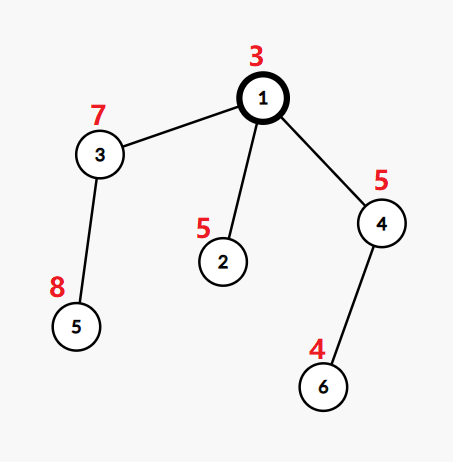 If we change the value in the vertex $2$ to $3$ , the value in the vertex $5$ to $4$ , and the value in the vertex $6$ to $6$ , then the tree will be ok.
The bitwise XOR from the root to the leaf $2$ will be $3 \oplus 3=0$ .
The bitwise XOR from the root to the leaf $5$ will be $4 \oplus 7 \oplus 3=0$ .
The bitwise XOR from the root to the leaf $6$ will be $6 \oplus 5 \oplus 3=0$ .
The tree in the second example:
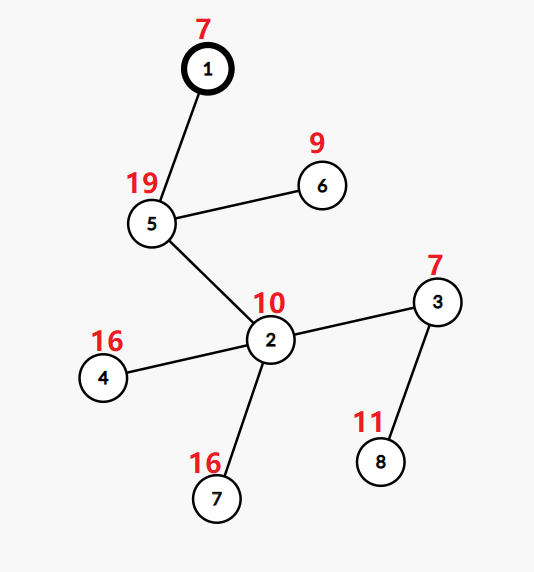 If we change the value in the vertex $2$ to $4$ , the value in the vertex $3$ to $27$ , and the value in the vertex $6$ to $20$ , then the tree will be ok.
The bitwise XOR from the root to the leaf $6$ will be $20 \oplus 19 \oplus 7=0$ .
The bitwise XOR from the root to the leaf $8$ will be $11 \oplus 27 \oplus 4 \oplus 19 \oplus 7=0$ .
The bitwise XOR from the root to the leaf $4$ will be $16 \oplus 4 \oplus 19 \oplus 7=0$ .
The bitwise XOR from the root to the leaf $7$ will be $16 \oplus 4 \oplus 19 \oplus 7=0$ .
In the third example, the only leaf is the vertex $4$ and the bitwise XOR on the path to it is $1 \oplus 2 \oplus 1 \oplus 2 = 0$ , so we don't need to change values.
In the fourth example, we can change the value in the vertex $1$ to $5$ , and the value in the vertex $4$ to $0$ .
Here $\oplus$ denotes the bitwise XOR operation.
 If we change the value in the vertex $2$ to $3$ , the value in the vertex $5$ to $4$ , and the value in the vertex $6$ to $6$ , then the tree will be ok.
The bitwise XOR from the root to the leaf $2$ will be $3 \oplus 3=0$ .
The bitwise XOR from the root to the leaf $5$ will be $4 \oplus 7 \oplus 3=0$ .
The bitwise XOR from the root to the leaf $6$ will be $6 \oplus 5 \oplus 3=0$ .
The tree in the second example:
 If we change the value in the vertex $2$ to $4$ , the value in the vertex $3$ to $27$ , and the value in the vertex $6$ to $20$ , then the tree will be ok.
The bitwise XOR from the root to the leaf $6$ will be $20 \oplus 19 \oplus 7=0$ .
The bitwise XOR from the root to the leaf $8$ will be $11 \oplus 27 \oplus 4 \oplus 19 \oplus 7=0$ .
The bitwise XOR from the root to the leaf $4$ will be $16 \oplus 4 \oplus 19 \oplus 7=0$ .
The bitwise XOR from the root to the leaf $7$ will be $16 \oplus 4 \oplus 19 \oplus 7=0$ .
In the third example, the only leaf is the vertex $4$ and the bitwise XOR on the path to it is $1 \oplus 2 \oplus 1 \oplus 2 = 0$ , so we don't need to change values.
In the fourth example, we can change the value in the vertex $1$ to $5$ , and the value in the vertex $4$ to $0$ .
Here $\oplus$ denotes the bitwise XOR operation.