A15892. Hits Different
编程题
普及/提高-
知识点
题目描述
In a carnival game, there is a huge pyramid of cans with $2023$ rows, numbered in a regular pattern as shown.
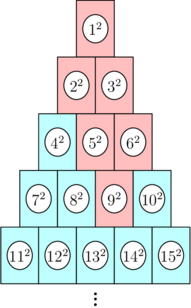If can $9^2$ is hit initially, then all cans colored red in the picture above would fall.
You throw a ball at the pyramid, and it hits a single can with number $n^2$ . This causes all cans that are stacked on top of this can to fall (that is, can $n^2$ falls, then the cans directly above $n^2$ fall, then the cans directly above those cans, and so on). For example, the picture above shows the cans that would fall if can $9^2$ is hit.
What is the sum of the numbers on all cans that fall? Recall that $n^2 = n \times n$ .
If can $9^2$ is hit initially, then all cans colored red in the picture above would fall.
You throw a ball at the pyramid, and it hits a single can with number $n^2$ . This causes all cans that are stacked on top of this can to fall (that is, can $n^2$ falls, then the cans directly above $n^2$ fall, then the cans directly above those cans, and so on). For example, the picture above shows the cans that would fall if can $9^2$ is hit.
What is the sum of the numbers on all cans that fall? Recall that $n^2 = n \times n$ .
输入格式
The first line contains an integer $t$ ( $1 \leq t \leq 1000$ ) — the number of test cases.
The only line of each test case contains a single integer $n$ ( $1 \leq n \leq 10^6$ ) — it means that the can you hit has label $n^2$ .
The only line of each test case contains a single integer $n$ ( $1 \leq n \leq 10^6$ ) — it means that the can you hit has label $n^2$ .
输出格式
For each test case, output a single integer — the sum of the numbers on all cans that fall.
Please note, that the answer for some test cases won't fit into 32-bit integer type, so you should use at least 64-bit integer type in your programming language (like long long for C++). For all valid inputs, the answer will always fit into 64-bit integer type.
Please note, that the answer for some test cases won't fit into 32-bit integer type, so you should use at least 64-bit integer type in your programming language (like long long for C++). For all valid inputs, the answer will always fit into 64-bit integer type.
输入输出样例
输入 #1
10
9
1
2
3
4
5
6
10
1434
1000000
输出 #1
156
1
5
10
21
39
46
146
63145186
58116199242129511
说明/提示
The first test case is pictured in the statement. The sum of the numbers that fall is $$$$1^2 + 2^2 + 3^2 + 5^2 + 6^2 + 9^2 = 1 + 4 + 9 + 25 + 36 + 81 = 156. $$ </p><p>In the second test case, only the can labeled $1^2$ falls, so the answer is $1^2=1$ .</p><p>In the third test case, the cans labeled $1^2$ and $2^2$ fall, so the answer is $1^2+2^2=1+4=5$ .</p><p>In the fourth test case, the cans labeled $1^2$ and $3^2$ fall, so the answer is $1^2+3^2=1+9=10$ .</p><p>In the fifth test case, the cans labeled $1^2$ , $2^2$ , and $4^2$ fall, so the answer is $1^2+2^2+4^2=1+4+16=21$$$.