A15598. Walking Boy
编程题
普及/提高-
知识点
题目描述
Each test contains multiple test cases. The first line contains an integer $t$ ( $1 \le t \le 100$ ) — the number of test cases. The descriptions of the $t$ test cases follow.
The first line of each test case contains an integer $n$ ( $1 \le n \le 100$ ) — the number of messages sent by the judge.
The second line of each test case contains $n$ integers $a_1, \, a_2, \, \dots, \, a_n$ ( $0 \le a_1 < a_2 < \cdots < a_n < 1440$ ) — the times at which the messages have been sent (in minutes elapsed from midnight).
The first line of each test case contains an integer $n$ ( $1 \le n \le 100$ ) — the number of messages sent by the judge.
The second line of each test case contains $n$ integers $a_1, \, a_2, \, \dots, \, a_n$ ( $0 \le a_1 < a_2 < \cdots < a_n < 1440$ ) — the times at which the messages have been sent (in minutes elapsed from midnight).
输入格式
For each test case, output one line containing $\texttt{YES}$ if it is possible that Boy has been walked at least twice, and $\texttt{NO}$ otherwise.
输出格式
In the **first test case**, the judge has sent a message at each time multiple of $100$ (excluding $0$). It is impossible that he has walked Boy even once.
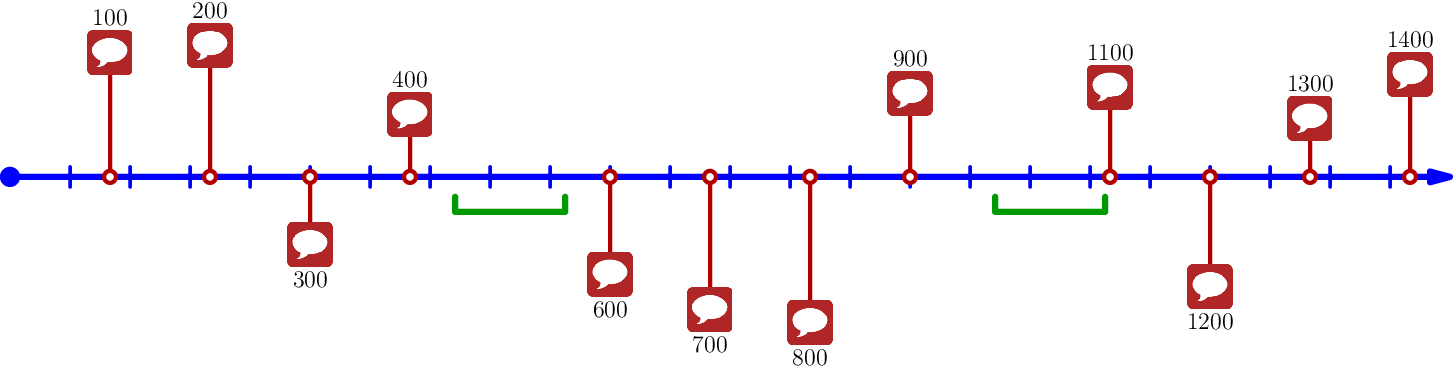
In the **second test case**, the times are the same as above, but $500$ and $1000$ are missing. The judge could have walked Boy, for instance, during the time intervals $[440, 560]$ and $[980, 1100]$. The situation is illustrated in the picture below, where the walks are represented by green intervals.
In the **third test case**, the times are the same as in the first test case, but $1000$ is missing. The judge could have walked Boy at most once.
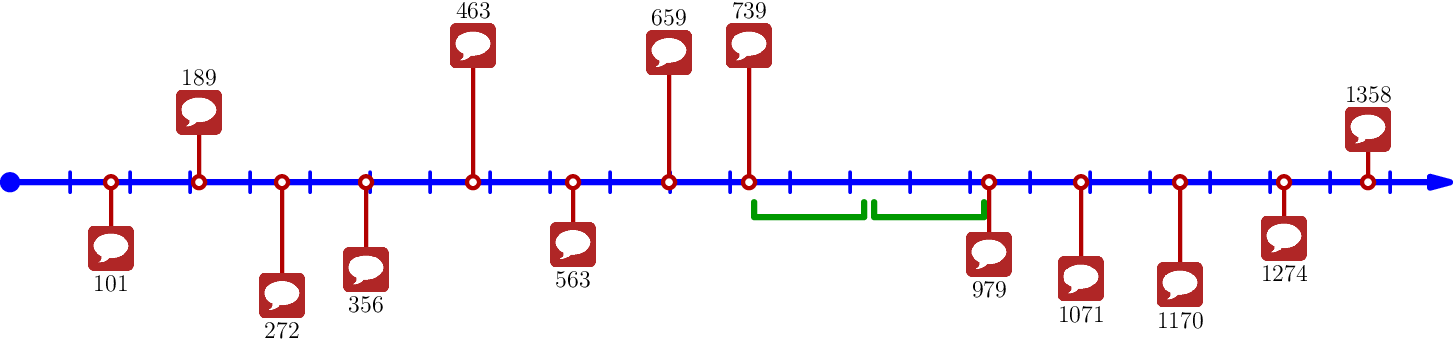
In the **fourth test case**, Boy could have been walked during the time intervals $[739, 859]$ and $[859, 979]$.
In the **second test case**, the times are the same as above, but $500$ and $1000$ are missing. The judge could have walked Boy, for instance, during the time intervals $[440, 560]$ and $[980, 1100]$. The situation is illustrated in the picture below, where the walks are represented by green intervals.

In the **third test case**, the times are the same as in the first test case, but $1000$ is missing. The judge could have walked Boy at most once.
In the **fourth test case**, Boy could have been walked during the time intervals $[739, 859]$ and $[859, 979]$.

输入输出样例
输入 #1
6
14
100 200 300 400 500 600 700 800 900 1000 1100 1200 1300 1400
12
100 200 300 400 600 700 800 900 1100 1200 1300 1400
13
100 200 300 400 500 600 700 800 900 1100 1200 1300 1400
13
101 189 272 356 463 563 659 739 979 1071 1170 1274 1358
1
42
5
0 1 2 3 4
输出 #1
NO
YES
NO
YES
YES
YES
说明/提示
In the **first test case**, the judge has sent a message at each time multiple of $100$ (excluding $0$). It is impossible that he has walked Boy even once.
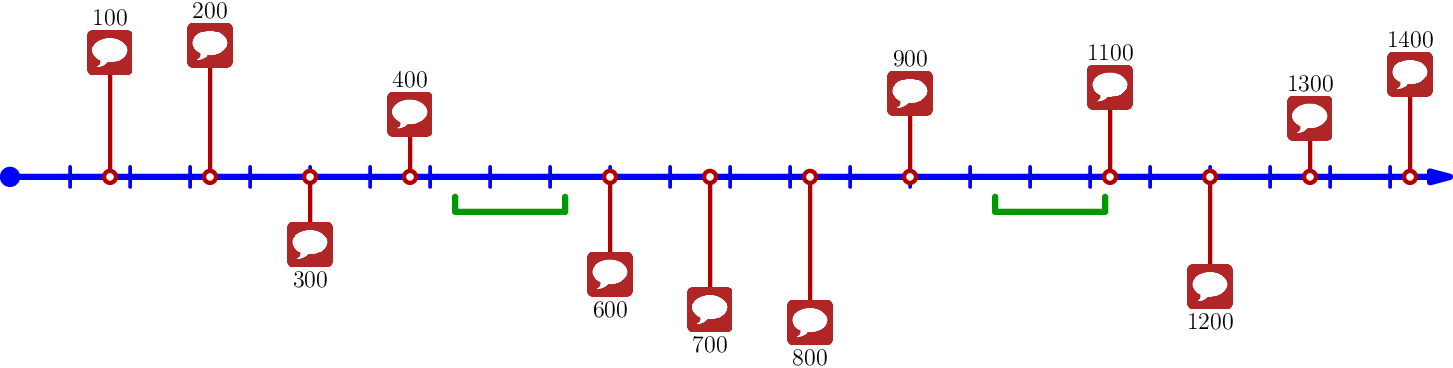
In the **second test case**, the times are the same as above, but $500$ and $1000$ are missing. The judge could have walked Boy, for instance, during the time intervals $[440, 560]$ and $[980, 1100]$. The situation is illustrated in the picture below, where the walks are represented by green intervals.
In the **third test case**, the times are the same as in the first test case, but $1000$ is missing. The judge could have walked Boy at most once.
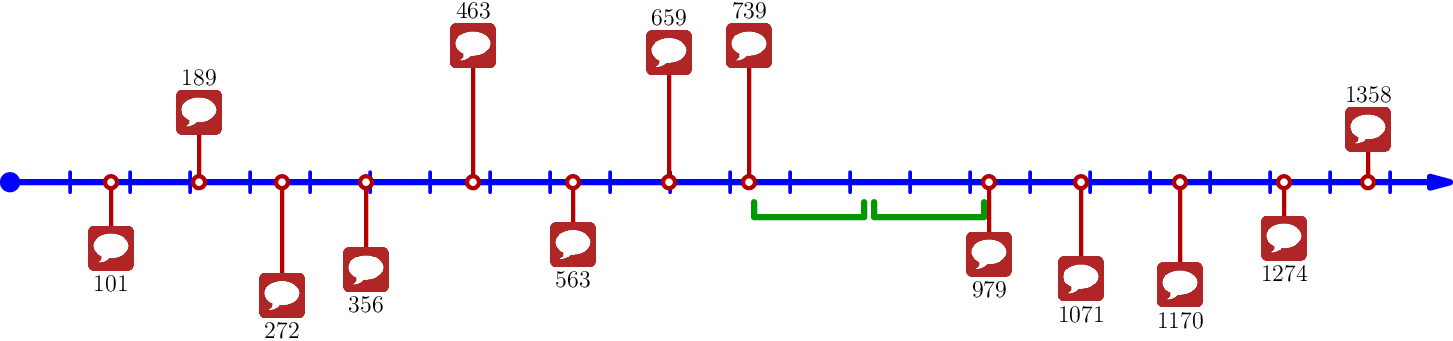
In the **fourth test case**, Boy could have been walked during the time intervals $[739, 859]$ and $[859, 979]$.
In the **second test case**, the times are the same as above, but $500$ and $1000$ are missing. The judge could have walked Boy, for instance, during the time intervals $[440, 560]$ and $[980, 1100]$. The situation is illustrated in the picture below, where the walks are represented by green intervals.

In the **third test case**, the times are the same as in the first test case, but $1000$ is missing. The judge could have walked Boy at most once.
In the **fourth test case**, Boy could have been walked during the time intervals $[739, 859]$ and $[859, 979]$.
