A15512. Challenging Valleys
编程题
普及/提高-
知识点
题目描述
You are given an array $a[0 \dots n-1]$ of $n$ integers. This array is called a "valley" if there exists exactly one subarray $a[l \dots r]$ such that:
- $0 \le l \le r \le n-1$ ,
- $a_l = a_{l+1} = a_{l+2} = \dots = a_r$ ,
- $l = 0$ or $a_{l-1} > a_{l}$ ,
- $r = n-1$ or $a_r < a_{r+1}$ .
Here are three examples:
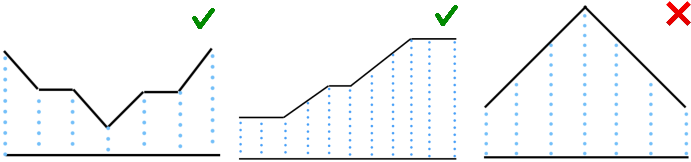The first image shows the array \[ $3, 2, 2, 1, 2, 2, 3$ \], it is a valley because only subarray with indices $l=r=3$ satisfies the condition.
The second image shows the array \[ $1, 1, 1, 2, 3, 3, 4, 5, 6, 6, 6$ \], it is a valley because only subarray with indices $l=0, r=2$ satisfies the codition.
The third image shows the array \[ $1, 2, 3, 4, 3, 2, 1$ \], it is not a valley because two subarrays $l=r=0$ and $l=r=6$ that satisfy the condition.
You are asked whether the given array is a valley or not.
Note that we consider the array to be indexed from $0$ .
- $0 \le l \le r \le n-1$ ,
- $a_l = a_{l+1} = a_{l+2} = \dots = a_r$ ,
- $l = 0$ or $a_{l-1} > a_{l}$ ,
- $r = n-1$ or $a_r < a_{r+1}$ .
Here are three examples:
The first image shows the array \[ $3, 2, 2, 1, 2, 2, 3$ \], it is a valley because only subarray with indices $l=r=3$ satisfies the condition.
The second image shows the array \[ $1, 1, 1, 2, 3, 3, 4, 5, 6, 6, 6$ \], it is a valley because only subarray with indices $l=0, r=2$ satisfies the codition.
The third image shows the array \[ $1, 2, 3, 4, 3, 2, 1$ \], it is not a valley because two subarrays $l=r=0$ and $l=r=6$ that satisfy the condition.
You are asked whether the given array is a valley or not.
Note that we consider the array to be indexed from $0$ .
输入格式
The first line contains a single integer $t$ ( $1 \leq t \leq 10^4$ ) — the number of test cases.
The first line of each test case contains a single integer $n$ ( $1 \leq n \leq 2\cdot10^5$ ) — the length of the array.
The second line of each test case contains $n$ integers $a_i$ ( $1 \leq a_i \leq 10^9$ ) — the elements of the array.
It is guaranteed that the sum of $n$ over all test cases is smaller than $2\cdot10^5$ .
The first line of each test case contains a single integer $n$ ( $1 \leq n \leq 2\cdot10^5$ ) — the length of the array.
The second line of each test case contains $n$ integers $a_i$ ( $1 \leq a_i \leq 10^9$ ) — the elements of the array.
It is guaranteed that the sum of $n$ over all test cases is smaller than $2\cdot10^5$ .
输出格式
For each test case, output "YES" (without quotes) if the array is a valley, and "NO" (without quotes) otherwise.
You can output the answer in any case (for example, the strings "yEs", "yes", "Yes" and "YES" will be recognized as a positive answer).
You can output the answer in any case (for example, the strings "yEs", "yes", "Yes" and "YES" will be recognized as a positive answer).
输入输出样例
输入 #1
6
7
3 2 2 1 2 2 3
11
1 1 1 2 3 3 4 5 6 6 6
7
1 2 3 4 3 2 1
7
9 7 4 6 9 9 10
1
1000000000
8
9 4 4 5 9 4 9 10
输出 #1
YES
YES
NO
YES
YES
NO
说明/提示
The first three test cases are explained in the statement.