A15501. Centroid Guess
编程题
普及/提高-
知识点
题目描述
This in an interactive problem.
There is an unknown tree consisting of $n$ nodes, which has exactly one centroid. You only know $n$ at first, and your task is to find the centroid of the tree.
You can ask the distance between any two vertices for at most $2\cdot10^5$ times.
Note that the interactor is not adaptive. That is, the tree is fixed in each test beforehand and does not depend on your queries.
A vertex is called a centroid if its removal splits the tree into subtrees with at most $\lfloor\frac{n}{2}\rfloor$ vertices each.
There is an unknown tree consisting of $n$ nodes, which has exactly one centroid. You only know $n$ at first, and your task is to find the centroid of the tree.
You can ask the distance between any two vertices for at most $2\cdot10^5$ times.
Note that the interactor is not adaptive. That is, the tree is fixed in each test beforehand and does not depend on your queries.
A vertex is called a centroid if its removal splits the tree into subtrees with at most $\lfloor\frac{n}{2}\rfloor$ vertices each.
输入格式
The only line of the input contains an integer $n$ ( $3\le n\le 7.5\cdot10^4$ ) — the number of nodes in the tree.
输出格式
Start interaction by reading $n$ .
To ask a query about the distance between two nodes $u, v$ ( $1 \le u, v \le n$ ), output "? u v".
If you determine that the centroid of the tree is $x$ , use "! x" to report.
After printing a query, do not forget to output the end of a line and flush the output. Otherwise, you will get Idleness limit exceeded. To do this, use:
- fflush(stdout) or cout.flush() in C++;
- System.out.flush() in Java;
- flush(output) in Pascal;
- stdout.flush() in Python;
- see documentation for other languages.
Hacks are disabled in this problem.
It's guaranteed that there are at most $500$ tests in this problem.
To ask a query about the distance between two nodes $u, v$ ( $1 \le u, v \le n$ ), output "? u v".
If you determine that the centroid of the tree is $x$ , use "! x" to report.
After printing a query, do not forget to output the end of a line and flush the output. Otherwise, you will get Idleness limit exceeded. To do this, use:
- fflush(stdout) or cout.flush() in C++;
- System.out.flush() in Java;
- flush(output) in Pascal;
- stdout.flush() in Python;
- see documentation for other languages.
Hacks are disabled in this problem.
It's guaranteed that there are at most $500$ tests in this problem.
输入输出样例
输入 #1
5

2

1

2

3

1

1

1
输出 #1
? 1 2

? 1 3

? 1 4

? 1 5

? 2 3

? 3 4

? 4 5

! 3
说明/提示
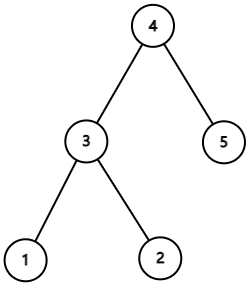
Here is an image of the tree from the sample.