A15469 | Infinite Chess
时间限制1s
内存限制256MB
通过 / 提交0/0
题目描述
The black king lives on a chess board with an infinite number of columns (files) and $8$ rows (ranks). The columns are numbered with all integer numbers (including negative). The rows are numbered from $1$ to $8$ .
Initially, the black king is located on the starting square $(x_s, y_s)$ , and he needs to reach some target square $(x_t, y_t)$ . Unfortunately, there are also white pieces on the board, and they threaten the black king. After negotiations, the white pieces agreed to let the black king pass to the target square on the following conditions:
- each turn, the black king makes a move according to the movement rules;
- the black king cannot move to a square occupied by a white piece;
- the black king cannot move to a square which is under attack by any white piece. A square is under attack if a white piece can reach it in one move according to the movement rules;
- the white pieces never move.
Help the black king find the minimum number of moves needed to reach the target square while not violating the conditions. The black king cannot leave the board at any time.
The black king moves according to the movement rules below. Even though the white pieces never move, squares which they can reach in one move are considered to be under attack, so the black king cannot move into those squares.
Below are the movement rules. Note that the pieces (except for the knight) cannot jump over other pieces.
- a king moves exactly one square horizontally, vertically, or diagonally.
- a rook moves any number of vacant squares horizontally or vertically.
- a bishop moves any number of vacant squares diagonally.
- a queen moves any number of vacant squares horizontally, vertically, or diagonally.
- a knight moves to one of the nearest squares not on the same rank, file, or diagonal (this can be thought of as moving two squares horizontally then one square vertically, or moving one square horizontally then two squares vertically — i. e. in an "L" pattern). Knights are not blocked by other pieces, they can simply jump over them.
There are no pawns on the board.
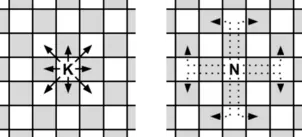 King and knight possible moves, respectively. Dotted line shows that knight can jump over other pieces. 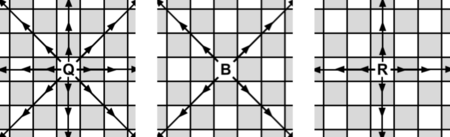 Queen, bishop, and rook possible moves, respectively.
Initially, the black king is located on the starting square $(x_s, y_s)$ , and he needs to reach some target square $(x_t, y_t)$ . Unfortunately, there are also white pieces on the board, and they threaten the black king. After negotiations, the white pieces agreed to let the black king pass to the target square on the following conditions:
- each turn, the black king makes a move according to the movement rules;
- the black king cannot move to a square occupied by a white piece;
- the black king cannot move to a square which is under attack by any white piece. A square is under attack if a white piece can reach it in one move according to the movement rules;
- the white pieces never move.
Help the black king find the minimum number of moves needed to reach the target square while not violating the conditions. The black king cannot leave the board at any time.
The black king moves according to the movement rules below. Even though the white pieces never move, squares which they can reach in one move are considered to be under attack, so the black king cannot move into those squares.
Below are the movement rules. Note that the pieces (except for the knight) cannot jump over other pieces.
- a king moves exactly one square horizontally, vertically, or diagonally.
- a rook moves any number of vacant squares horizontally or vertically.
- a bishop moves any number of vacant squares diagonally.
- a queen moves any number of vacant squares horizontally, vertically, or diagonally.
- a knight moves to one of the nearest squares not on the same rank, file, or diagonal (this can be thought of as moving two squares horizontally then one square vertically, or moving one square horizontally then two squares vertically — i. e. in an "L" pattern). Knights are not blocked by other pieces, they can simply jump over them.
There are no pawns on the board.
 King and knight possible moves, respectively. Dotted line shows that knight can jump over other pieces.  Queen, bishop, and rook possible moves, respectively.
输入格式
The first line contains two integers $x_s$ and $y_s$ ( $1 \le x_s \le 10^8$ ; $1 \le y_s \le 8$ ) — the starting coordinates of the black king.
The second line contains two integers $x_t$ and $y_t$ ( $1 \le x_t \le 10^8$ ; $1 \le y_t \le 8$ ) — the coordinates of the target square for the black king.
The third line contains one integer $n$ ( $0 \le n \le 2000$ ) — the number of white pieces on the board.
Then $n$ lines follow, the $i$ -th line contains one character $t_i$ and two integers $x_i$ and $y_i$ ( $1 \le x_i \le 10^8$ ; $1 \le y_i \le 8$ ) — the type and the coordinates of the $i$ -th white piece. The types of pieces are represented by the following uppercase Latin letters:
- K — king
- Q — queen
- R — rook
- B — bishop
- N — knight
There can be any number of white pieces of any type listed above on the board, for example, $3$ white kings or $4$ white queens. There are no pawns on the board.
Additional constrains on the input:
- no square is occupied by more than one white piece;
- the starting square for the black king is different from the square he wants to reach, and neither of these two squares is occupied or is under attack by any white piece.
The second line contains two integers $x_t$ and $y_t$ ( $1 \le x_t \le 10^8$ ; $1 \le y_t \le 8$ ) — the coordinates of the target square for the black king.
The third line contains one integer $n$ ( $0 \le n \le 2000$ ) — the number of white pieces on the board.
Then $n$ lines follow, the $i$ -th line contains one character $t_i$ and two integers $x_i$ and $y_i$ ( $1 \le x_i \le 10^8$ ; $1 \le y_i \le 8$ ) — the type and the coordinates of the $i$ -th white piece. The types of pieces are represented by the following uppercase Latin letters:
- K — king
- Q — queen
- R — rook
- B — bishop
- N — knight
There can be any number of white pieces of any type listed above on the board, for example, $3$ white kings or $4$ white queens. There are no pawns on the board.
Additional constrains on the input:
- no square is occupied by more than one white piece;
- the starting square for the black king is different from the square he wants to reach, and neither of these two squares is occupied or is under attack by any white piece.
输出格式
Print one integer — the minimum number of moves needed for the black king to reach the target square while not violating the conditions, or $-1$ if it is impossible.
输入输出样例
输入 #1
1 8
7 8
2
N 4 8
B 4 6
输出 #1
10
输入 #2
1 1
1 5
2
K 1 3
R 2 3
输出 #2
6
输入 #3
2 2
6 4
1
Q 4 3
输出 #3
-1
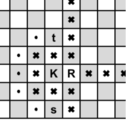
The image below demonstrates the solution for the second example. Here, the letters K, R, s, and t represent the white king, the white rook, the starting square, and the target square, respectively. Bold crosses mark the squares which are under attack by the white pieces. Bold dots show the shortest path for the black king.

C++ 编辑器
输入
输出
可保存默认模板;新题优先使用已保存模板。
当前快捷键仅展示,暂不支持修改。
- 撤销
Ctrl / ⌘ + Z - 重做
Ctrl / ⌘ + Y - 查找
Ctrl / ⌘ + F - 全选
Ctrl / ⌘ + A - 复制
Ctrl / ⌘ + C - 剪切
Ctrl / ⌘ + X - 粘贴
Ctrl / ⌘ + V - 自动排版
工具栏排版按钮 - 草稿保存
编辑时自动保存到本机
历史
提交记录
状态说明时间源码
AI
作答助手
你好,我是作答助手。可以问思路、复杂度、样例含义或代码报错原因;不会直接给出完整 AC 代码。
确定要清空代码吗?
提交通过
评测结果:Accepted