A15401 | Dangerous Laser Power
时间限制1s
内存限制256MB
通过 / 提交0/0
题目描述
Pak Chanek has an $n \times m$ grid of portals. The portal on the $i$ -th row and $j$ -th column is denoted as portal $(i,j)$ . The portals $(1,1)$ and $(n,m)$ are on the north-west and south-east corner of the grid respectively.
The portal $(i,j)$ has two settings:
- Type $t_{i,j}$ , which is either $0$ or $1$ .
- Strength $s_{i,j}$ , which is an integer between $1$ and $10^9$ inclusive.
Each portal has $4$ faces labelled with integers $0,1,2,3$ , which correspond to the north, east, south, and west direction respectively. 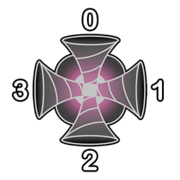When a laser enters face $k$ of portal $(i, j)$ with speed $x_\text{in}$ , it leaves the portal going out of face $(k+2+t_{i,j}) \bmod 4$ with speed $x_\text{out} = \max(x_\text{in},s_{i,j})$ . The portal also has to consume $x_\text{out} - x_\text{in}$ units of energy.
Pak Chanek is very bored today. He will shoot $4nm$ lasers with an initial speed of $1$ , one into each face of each portal. Each laser will travel throughout this grid of portals until it moves outside the grid or it has passed through $10^{100}$ portals.
At the end, Pak Chanek thinks that a portal is good if and only if the total energy consumed by that portal modulo $2$ is equal to its type. Given the strength settings of all portals, find a way to assign the type settings of each portal such that the number of good portals is maximised.
The portal $(i,j)$ has two settings:
- Type $t_{i,j}$ , which is either $0$ or $1$ .
- Strength $s_{i,j}$ , which is an integer between $1$ and $10^9$ inclusive.
Each portal has $4$ faces labelled with integers $0,1,2,3$ , which correspond to the north, east, south, and west direction respectively. When a laser enters face $k$ of portal $(i, j)$ with speed $x_\text{in}$ , it leaves the portal going out of face $(k+2+t_{i,j}) \bmod 4$ with speed $x_\text{out} = \max(x_\text{in},s_{i,j})$ . The portal also has to consume $x_\text{out} - x_\text{in}$ units of energy.
Pak Chanek is very bored today. He will shoot $4nm$ lasers with an initial speed of $1$ , one into each face of each portal. Each laser will travel throughout this grid of portals until it moves outside the grid or it has passed through $10^{100}$ portals.
At the end, Pak Chanek thinks that a portal is good if and only if the total energy consumed by that portal modulo $2$ is equal to its type. Given the strength settings of all portals, find a way to assign the type settings of each portal such that the number of good portals is maximised.
输入格式
The first line contains two integers $n$ and $m$ ( $1 \le n, m \le 1000$ ) — the number of rows and columns in the grid.
The $i$ -th of the next $n$ lines contains $m$ integers, with the $j$ -th integer being $s_{i,j}$ ( $1 \leq s_{i,j} \leq 10^9$ ) — the strength of portal $(i, j)$ .
The $i$ -th of the next $n$ lines contains $m$ integers, with the $j$ -th integer being $s_{i,j}$ ( $1 \leq s_{i,j} \leq 10^9$ ) — the strength of portal $(i, j)$ .
输出格式
Print $n$ lines with each line containing a string of length $m$ consisting of characters $0$ or $1$ representing the type settings. The $j$ -th character in the $i$ -th string is the type setting of portal $(i, j)$ .
If there are multiple solutions, you can output any of them.
If there are multiple solutions, you can output any of them.
输入输出样例
输入 #1
2 3
8 8 2
6 5 7
输出 #1
110
100
输入 #2
1 2
420 69
输出 #2
10
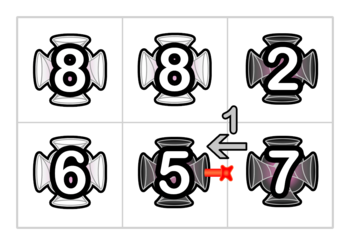
In the first example, let's consider the laser Pak Chanek shoots into face $1$ of portal $(2, 2)$ . The laser travels as follows:
1. The laser enters face $1$ of portal $(2, 2)$ with speed $1$ . It leaves the portal going out of face $3$ with speed $5$ . Portal $(2, 2)$ consumes $4$ units of energy.
2. The laser enters face $1$ of portal $(2, 1)$ with speed $5$ . It leaves the portal going out of face $0$ with speed $6$ . Portal $(2, 1)$ consumes $1$ units of energy.
3. The laser enters face $2$ of portal $(1, 1)$ with speed $6$ . It leaves the portal going out of face $1$ with speed $8$ . Portal $(1, 1)$ consumes $2$ units of energy.
4. The laser enters face $3$ of portal $(1, 2)$ with speed $8$ . It leaves the portal going out of face $2$ with speed $8$ . Portal $(1, 2)$ consumes $0$ units of energy.
5. The laser enters face $0$ of portal $(2, 2)$ with speed $8$ . It leaves the portal going out of face $2$ with speed $8$ . Portal $(2, 2)$ consumes $0$ units of energy.
The illustration of the travel of the laser above is as follows.
As an example, consider portal $(2, 3)$ . We can calculate that the total energy consumed by that portal in the end will be $32$ . Since $32 \bmod 2 = 0$ and $t_{2,3} = 0$ , then it is a good portal.
1. The laser enters face $1$ of portal $(2, 2)$ with speed $1$ . It leaves the portal going out of face $3$ with speed $5$ . Portal $(2, 2)$ consumes $4$ units of energy.
2. The laser enters face $1$ of portal $(2, 1)$ with speed $5$ . It leaves the portal going out of face $0$ with speed $6$ . Portal $(2, 1)$ consumes $1$ units of energy.
3. The laser enters face $2$ of portal $(1, 1)$ with speed $6$ . It leaves the portal going out of face $1$ with speed $8$ . Portal $(1, 1)$ consumes $2$ units of energy.
4. The laser enters face $3$ of portal $(1, 2)$ with speed $8$ . It leaves the portal going out of face $2$ with speed $8$ . Portal $(1, 2)$ consumes $0$ units of energy.
5. The laser enters face $0$ of portal $(2, 2)$ with speed $8$ . It leaves the portal going out of face $2$ with speed $8$ . Portal $(2, 2)$ consumes $0$ units of energy.
The illustration of the travel of the laser above is as follows.
As an example, consider portal $(2, 3)$ . We can calculate that the total energy consumed by that portal in the end will be $32$ . Since $32 \bmod 2 = 0$ and $t_{2,3} = 0$ , then it is a good portal.
C++ 编辑器
输入
输出
可保存默认模板;新题优先使用已保存模板。
当前快捷键仅展示,暂不支持修改。
- 撤销
Ctrl / ⌘ + Z - 重做
Ctrl / ⌘ + Y - 查找
Ctrl / ⌘ + F - 全选
Ctrl / ⌘ + A - 复制
Ctrl / ⌘ + C - 剪切
Ctrl / ⌘ + X - 粘贴
Ctrl / ⌘ + V - 自动排版
工具栏排版按钮 - 草稿保存
编辑时自动保存到本机
历史
提交记录
状态说明时间源码
AI
作答助手
你好,我是作答助手。可以问思路、复杂度、样例含义或代码报错原因;不会直接给出完整 AC 代码。
确定要清空代码吗?
提交通过
评测结果:Accepted