A15400. MEX Tree Manipulation
编程题
普及/提高-
知识点
题目描述
Given a rooted tree, define the value of vertex $u$ in the tree recursively as the MEX $^\dagger$ of the values of its children. Note that it is only the children, not all of its descendants. In particular, the value of a leaf is $0$ .
Pak Chanek has a rooted tree that initially only contains a single vertex with index $1$ , which is the root. Pak Chanek is going to do $q$ queries. In the $i$ -th query, Pak Chanek is given an integer $x_i$ . Pak Chanek needs to add a new vertex with index $i+1$ as the child of vertex $x_i$ . After adding the new vertex, Pak Chanek needs to recalculate the values of all vertices and report the sum of the values of all vertices in the current tree.
$^\dagger$ The MEX (minimum excluded) of an array is the smallest non-negative integer that does not belong to the array. For example, the MEX of $[0,1,1,2,6,7]$ is $3$ and the MEX of $[6,9]$ is $0$ .
Pak Chanek has a rooted tree that initially only contains a single vertex with index $1$ , which is the root. Pak Chanek is going to do $q$ queries. In the $i$ -th query, Pak Chanek is given an integer $x_i$ . Pak Chanek needs to add a new vertex with index $i+1$ as the child of vertex $x_i$ . After adding the new vertex, Pak Chanek needs to recalculate the values of all vertices and report the sum of the values of all vertices in the current tree.
$^\dagger$ The MEX (minimum excluded) of an array is the smallest non-negative integer that does not belong to the array. For example, the MEX of $[0,1,1,2,6,7]$ is $3$ and the MEX of $[6,9]$ is $0$ .
输入格式
The first line contains a single integer $q$ ( $1 \le q \le 3 \cdot 10^5$ ) — the number of operations.
Each of the next $q$ lines contains a single integer $x_i$ ( $1 \leq x_i \leq i$ ) — the description of the $i$ -th query.
Each of the next $q$ lines contains a single integer $x_i$ ( $1 \leq x_i \leq i$ ) — the description of the $i$ -th query.
输出格式
For each query, print a line containing an integer representing the sum of the new values of all vertices in the tree after adding the vertex.
输入输出样例
输入 #1
7
1
1
3
2
5
2
1
输出 #1
1
1
3
2
4
4
7
输入 #2
8
1
1
1
1
5
6
7
8
输出 #2
1
1
1
1
3
2
4
3
说明/提示
In the first example, the tree after the $6$ -th query will look like this.
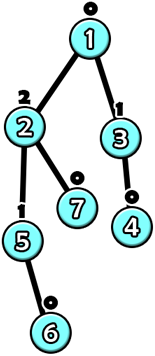
- Vertex $7$ is a leaf, so its value is $0$ .
- Vertex $6$ is a leaf, so its value is $0$ .
- Vertex $5$ only has a child with value $0$ , so its value is $1$ .
- Vertex $4$ is a leaf, so its value is $0$ .
- Vertex $3$ only has a child with value $0$ , so its value is $1$ .
- Vertex $2$ has children with values $0$ and $1$ , so its value is $2$ .
- Vertex $1$ has children with values $1$ and $2$ , so its value is $0$ .
The sum of the values of all vertices is $0+0+1+0+1+2+0=4$ .

- Vertex $7$ is a leaf, so its value is $0$ .
- Vertex $6$ is a leaf, so its value is $0$ .
- Vertex $5$ only has a child with value $0$ , so its value is $1$ .
- Vertex $4$ is a leaf, so its value is $0$ .
- Vertex $3$ only has a child with value $0$ , so its value is $1$ .
- Vertex $2$ has children with values $0$ and $1$ , so its value is $2$ .
- Vertex $1$ has children with values $1$ and $2$ , so its value is $0$ .
The sum of the values of all vertices is $0+0+1+0+1+2+0=4$ .