A15387. Scuza
编程题
普及/提高-
知识点
题目描述
Timur has a stairway with $n$ steps. The $i$ -th step is $a_i$ meters higher than its predecessor. The first step is $a_1$ meters higher than the ground, and the ground starts at $0$ meters.
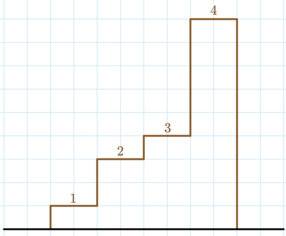The stairs for the first test case.Timur has $q$ questions, each denoted by an integer $k_1, \dots, k_q$ . For each question $k_i$ , you have to print the maximum possible height Timur can achieve by climbing the steps if his legs are of length $k_i$ . Timur can only climb the $j$ -th step if his legs are of length at least $a_j$ . In other words, $k_i \geq a_j$ for each step $j$ climbed.
Note that you should answer each question independently.
The stairs for the first test case.Timur has $q$ questions, each denoted by an integer $k_1, \dots, k_q$ . For each question $k_i$ , you have to print the maximum possible height Timur can achieve by climbing the steps if his legs are of length $k_i$ . Timur can only climb the $j$ -th step if his legs are of length at least $a_j$ . In other words, $k_i \geq a_j$ for each step $j$ climbed.
Note that you should answer each question independently.
输入格式
The first line contains a single integer $t$ ( $1 \leq t \leq 100$ ) — the number of test cases.
The first line of each test case contains two integers $n, q$ ( $1 \leq n, q \leq 2\cdot10^5$ ) — the number of steps and the number of questions, respectively.
The second line of each test case contains $n$ integers ( $1 \leq a_i \leq 10^9$ ) — the height of the steps.
The third line of each test case contains $q$ integers ( $0 \leq k_i \leq 10^9$ ) — the numbers for each question.
It is guaranteed that the sum of $n$ does not exceed $2\cdot10^5$ , and the sum of $q$ does not exceed $2\cdot10^5$ .
The first line of each test case contains two integers $n, q$ ( $1 \leq n, q \leq 2\cdot10^5$ ) — the number of steps and the number of questions, respectively.
The second line of each test case contains $n$ integers ( $1 \leq a_i \leq 10^9$ ) — the height of the steps.
The third line of each test case contains $q$ integers ( $0 \leq k_i \leq 10^9$ ) — the numbers for each question.
It is guaranteed that the sum of $n$ does not exceed $2\cdot10^5$ , and the sum of $q$ does not exceed $2\cdot10^5$ .
输出格式
For each test case, output a single line containing $q$ integers, the answer for each question.
Please note, that the answer for some questions won't fit into 32-bit integer type, so you should use at least 64-bit integer type in your programming language (like long long for C++).
Please note, that the answer for some questions won't fit into 32-bit integer type, so you should use at least 64-bit integer type in your programming language (like long long for C++).
输入输出样例
输入 #1
3
4 5
1 2 1 5
1 2 4 9 10
2 2
1 1
0 1
3 1
1000000000 1000000000 1000000000
1000000000
输出 #1
1 4 4 9 9
0 2
3000000000
说明/提示
Consider the first test case, pictured in the statement.
- If Timur's legs have length $1$ , then he can only climb stair $1$ , so the highest he can reach is $1$ meter.
- If Timur's legs have length $2$ or $4$ , then he can only climb stairs $1$ , $2$ , and $3$ , so the highest he can reach is $1+2+1=4$ meters.
- If Timur's legs have length $9$ or $10$ , then he can climb the whole staircase, so the highest he can reach is $1+2+1+5=9$ meters.
In the first question of the second test case, Timur has no legs, so he cannot go up even a single step. :(
- If Timur's legs have length $1$ , then he can only climb stair $1$ , so the highest he can reach is $1$ meter.
- If Timur's legs have length $2$ or $4$ , then he can only climb stairs $1$ , $2$ , and $3$ , so the highest he can reach is $1+2+1=4$ meters.
- If Timur's legs have length $9$ or $10$ , then he can climb the whole staircase, so the highest he can reach is $1+2+1+5=9$ meters.
In the first question of the second test case, Timur has no legs, so he cannot go up even a single step. :(