A15364. Triameter
编程题
普及/提高-
知识点
题目描述
— What is my mission?
— To count graph diameters.
You and Your Submission
A tree is a connected undirected graph without cycles. A weighted tree has a weight assigned to each edge. The degree of a vertex is the number of edges connected to this vertex.
You are given a weighted tree with $n$ vertices, each edge has a weight of $1$ . Let $L$ be the set of vertices with degree equal to $1$ .
You have to answer $q$ independent queries. In the $i$ -th query:
1. You are given a positive integer $x_i$ .
2. For all $u,v \in L$ such that $u < v$ , add edge $(u, v)$ with weight $x_i$ to the graph (initially the given tree).
3. Find the diameter of the resulting graph.
The diameter of a graph is equal to $\max\limits_{1 \le u < v \le n}{\operatorname{d}(u, v)}$ , where $\operatorname{d}(u, v)$ is the length of the shortest path between vertex $u$ and vertex $v$ .
— To count graph diameters.
You and Your Submission
A tree is a connected undirected graph without cycles. A weighted tree has a weight assigned to each edge. The degree of a vertex is the number of edges connected to this vertex.
You are given a weighted tree with $n$ vertices, each edge has a weight of $1$ . Let $L$ be the set of vertices with degree equal to $1$ .
You have to answer $q$ independent queries. In the $i$ -th query:
1. You are given a positive integer $x_i$ .
2. For all $u,v \in L$ such that $u < v$ , add edge $(u, v)$ with weight $x_i$ to the graph (initially the given tree).
3. Find the diameter of the resulting graph.
The diameter of a graph is equal to $\max\limits_{1 \le u < v \le n}{\operatorname{d}(u, v)}$ , where $\operatorname{d}(u, v)$ is the length of the shortest path between vertex $u$ and vertex $v$ .
输入格式
The first line contains a single integer $n$ ( $3 \le n \le 10^6$ ).
The second line contains $n - 1$ integers $p_2,p_3,\ldots,p_n$ ( $1 \le p_i < i$ ) indicating that there is an edge between vertices $i$ and $p_i$ . It is guaranteed that the given edges form a tree.
The third line contains a single integer $q$ ( $1 \le q \le 10$ ).
The fourth line contains $q$ integers $x_1,x_2,\ldots,x_q$ ( $1 \le x_i \le n$ ). All $x_i$ are distinct.
The second line contains $n - 1$ integers $p_2,p_3,\ldots,p_n$ ( $1 \le p_i < i$ ) indicating that there is an edge between vertices $i$ and $p_i$ . It is guaranteed that the given edges form a tree.
The third line contains a single integer $q$ ( $1 \le q \le 10$ ).
The fourth line contains $q$ integers $x_1,x_2,\ldots,x_q$ ( $1 \le x_i \le n$ ). All $x_i$ are distinct.
输出格式
Print $q$ integers in a single line — the answers to the queries.
输入输出样例
输入 #1
4
1 2 2
4
1 2 3 4
输出 #1
1 2 2 2
输入 #2
7
1 2 3 4 2 1
7
2 1 3 7 5 6 4
输出 #2
3 3 4 5 5 5 4
输入 #3
3
1 2
1
1
输出 #3
1
说明/提示
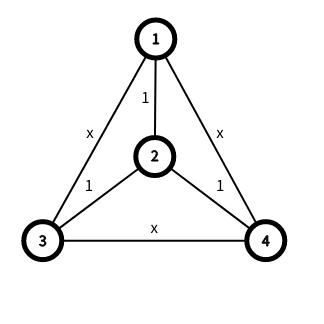
The graph in the first test after adding the edges: