A15351. Path Prefixes
编程题
普及/提高-
知识点
题目描述
You are given a rooted tree. It contains $n$ vertices, which are numbered from $1$ to $n$ . The root is the vertex $1$ .
Each edge has two positive integer values. Thus, two positive integers $a_j$ and $b_j$ are given for each edge.
Output $n-1$ numbers $r_2, r_3, \dots, r_n$ , where $r_i$ is defined as follows.
Consider the path from the root (vertex $1$ ) to $i$ ( $2 \le i \le n$ ). Let the sum of the costs of $a_j$ along this path be $A_i$ . Then $r_i$ is equal to the length of the maximum prefix of this path such that the sum of $b_j$ along this prefix does not exceed $A_i$ .
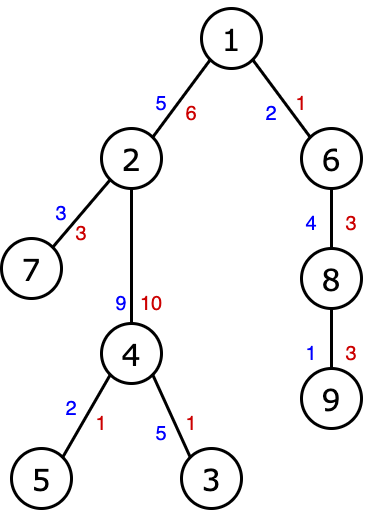Example for $n=9$ . The blue color shows the costs of $a_j$ , and the red color shows the costs of $b_j$ .Consider an example. In this case:
- $r_2=0$ , since the path to $2$ has an amount of $a_j$ equal to $5$ , only the prefix of this path of length $0$ has a smaller or equal amount of $b_j$ ;
- $r_3=3$ , since the path to $3$ has an amount of $a_j$ equal to $5+9+5=19$ , the prefix of length $3$ of this path has a sum of $b_j$ equal to $6+10+1=17$ ( the number is $17 \le 19$ );
- $r_4=1$ , since the path to $4$ has an amount of $a_j$ equal to $5+9=14$ , the prefix of length $1$ of this path has an amount of $b_j$ equal to $6$ (this is the longest suitable prefix, since the prefix of length $2$ already has an amount of $b_j$ equal to $6+10=16$ , which is more than $14$ );
- $r_5=2$ , since the path to $5$ has an amount of $a_j$ equal to $5+9+2=16$ , the prefix of length $2$ of this path has a sum of $b_j$ equal to $6+10=16$ (this is the longest suitable prefix, since the prefix of length $3$ already has an amount of $b_j$ equal to $6+10+1=17$ , what is more than $16$ );
- $r_6=1$ , since the path up to $6$ has an amount of $a_j$ equal to $2$ , the prefix of length $1$ of this path has an amount of $b_j$ equal to $1$ ;
- $r_7=1$ , since the path to $7$ has an amount of $a_j$ equal to $5+3=8$ , the prefix of length $1$ of this path has an amount of $b_j$ equal to $6$ (this is the longest suitable prefix, since the prefix of length $2$ already has an amount of $b_j$ equal to $6+3=9$ , which is more than $8$ );
- $r_8=2$ , since the path up to $8$ has an amount of $a_j$ equal to $2+4=6$ , the prefix of length $2$ of this path has an amount of $b_j$ equal to $1+3=4$ ;
- $r_9=3$ , since the path to $9$ has an amount of $a_j$ equal to $2+4+1=7$ , the prefix of length $3$ of this path has a sum of $b_j$ equal to $1+3+3=7$ .
Each edge has two positive integer values. Thus, two positive integers $a_j$ and $b_j$ are given for each edge.
Output $n-1$ numbers $r_2, r_3, \dots, r_n$ , where $r_i$ is defined as follows.
Consider the path from the root (vertex $1$ ) to $i$ ( $2 \le i \le n$ ). Let the sum of the costs of $a_j$ along this path be $A_i$ . Then $r_i$ is equal to the length of the maximum prefix of this path such that the sum of $b_j$ along this prefix does not exceed $A_i$ .
Example for $n=9$ . The blue color shows the costs of $a_j$ , and the red color shows the costs of $b_j$ .Consider an example. In this case:
- $r_2=0$ , since the path to $2$ has an amount of $a_j$ equal to $5$ , only the prefix of this path of length $0$ has a smaller or equal amount of $b_j$ ;
- $r_3=3$ , since the path to $3$ has an amount of $a_j$ equal to $5+9+5=19$ , the prefix of length $3$ of this path has a sum of $b_j$ equal to $6+10+1=17$ ( the number is $17 \le 19$ );
- $r_4=1$ , since the path to $4$ has an amount of $a_j$ equal to $5+9=14$ , the prefix of length $1$ of this path has an amount of $b_j$ equal to $6$ (this is the longest suitable prefix, since the prefix of length $2$ already has an amount of $b_j$ equal to $6+10=16$ , which is more than $14$ );
- $r_5=2$ , since the path to $5$ has an amount of $a_j$ equal to $5+9+2=16$ , the prefix of length $2$ of this path has a sum of $b_j$ equal to $6+10=16$ (this is the longest suitable prefix, since the prefix of length $3$ already has an amount of $b_j$ equal to $6+10+1=17$ , what is more than $16$ );
- $r_6=1$ , since the path up to $6$ has an amount of $a_j$ equal to $2$ , the prefix of length $1$ of this path has an amount of $b_j$ equal to $1$ ;
- $r_7=1$ , since the path to $7$ has an amount of $a_j$ equal to $5+3=8$ , the prefix of length $1$ of this path has an amount of $b_j$ equal to $6$ (this is the longest suitable prefix, since the prefix of length $2$ already has an amount of $b_j$ equal to $6+3=9$ , which is more than $8$ );
- $r_8=2$ , since the path up to $8$ has an amount of $a_j$ equal to $2+4=6$ , the prefix of length $2$ of this path has an amount of $b_j$ equal to $1+3=4$ ;
- $r_9=3$ , since the path to $9$ has an amount of $a_j$ equal to $2+4+1=7$ , the prefix of length $3$ of this path has a sum of $b_j$ equal to $1+3+3=7$ .
输入格式
The first line contains an integer $t$ ( $1 \le t \le 10^4$ ) — the number of test cases in the test.
The descriptions of test cases follow.
Each description begins with a line that contains an integer $n$ ( $2 \le n \le 2\cdot10^5$ ) — the number of vertices in the tree.
This is followed by $n-1$ string, each of which contains three numbers $p_j, a_j, b_j$ ( $1 \le p_j \le n$ ; $1 \le a_j,b_j \le 10^9$ ) — the ancestor of the vertex $j$ , the first and second values an edge that leads from $p_j$ to $j$ . The value of $j$ runs through all values from $2$ to $n$ inclusive. It is guaranteed that each set of input data has a correct hanged tree with a root at the vertex $1$ .
It is guaranteed that the sum of $n$ over all input test cases does not exceed $2\cdot10^5$ .
The descriptions of test cases follow.
Each description begins with a line that contains an integer $n$ ( $2 \le n \le 2\cdot10^5$ ) — the number of vertices in the tree.
This is followed by $n-1$ string, each of which contains three numbers $p_j, a_j, b_j$ ( $1 \le p_j \le n$ ; $1 \le a_j,b_j \le 10^9$ ) — the ancestor of the vertex $j$ , the first and second values an edge that leads from $p_j$ to $j$ . The value of $j$ runs through all values from $2$ to $n$ inclusive. It is guaranteed that each set of input data has a correct hanged tree with a root at the vertex $1$ .
It is guaranteed that the sum of $n$ over all input test cases does not exceed $2\cdot10^5$ .
输出格式
For each test case, output $n-1$ integer in one line: $r_2, r_3, \dots, r_n$ .
输入输出样例
输入 #1
4
9
1 5 6
4 5 1
2 9 10
4 2 1
1 2 1
2 3 3
6 4 3
8 1 3
4
1 1 100
2 1 1
3 101 1
4
1 100 1
2 1 1
3 1 101
10
1 1 4
2 3 5
2 5 1
3 4 3
3 1 5
5 3 5
5 2 1
1 3 2
6 2 1
输出 #1
0 3 1 2 1 1 2 3
0 0 3
1 2 2
0 1 2 1 1 2 2 1 1
说明/提示
The first example is clarified in the statement.
In the second example:
- $r_2=0$ , since the path to $2$ has an amount of $a_j$ equal to $1$ , only the prefix of this path of length $0$ has a smaller or equal amount of $b_j$ ;
- $r_3=0$ , since the path to $3$ has an amount of $a_j$ equal to $1+1=2$ , the prefix of length $1$ of this path has an amount of $b_j$ equal to $100$ ( $100 > 2$ );
- $r_4=3$ , since the path to $4$ has an amount of $a_j$ equal to $1+1+101=103$ , the prefix of length $3$ of this path has an amount of $b_j$ equal to $102$ , .
In the second example:
- $r_2=0$ , since the path to $2$ has an amount of $a_j$ equal to $1$ , only the prefix of this path of length $0$ has a smaller or equal amount of $b_j$ ;
- $r_3=0$ , since the path to $3$ has an amount of $a_j$ equal to $1+1=2$ , the prefix of length $1$ of this path has an amount of $b_j$ equal to $100$ ( $100 > 2$ );
- $r_4=3$ , since the path to $4$ has an amount of $a_j$ equal to $1+1+101=103$ , the prefix of length $3$ of this path has an amount of $b_j$ equal to $102$ , .