A15298 | Field Photography
时间限制1s
内存限制256MB
通过 / 提交0/0
题目描述
Pak Chanek is traveling to Manado. It turns out that OSN (Indonesian National Scientific Olympiad) 2019 is being held. The contestants of OSN 2019 are currently lining up in a field to be photographed. The field is shaped like a grid of size $N \times 10^{100}$ with $N$ rows and $10^{100}$ columns. The rows are numbered from $1$ to $N$ from north to south, the columns are numbered from $1$ to $10^{100}$ from west to east. The tile in row $r$ and column $c$ is denoted as $(r,c)$ .
There are $N$ provinces that participate in OSN 2019. Initially, each contestant who represents province $i$ stands in tile $(i, p)$ for each $p$ satisfying $L_i \leq p \leq R_i$ . So, we can see that there are $R_i-L_i+1$ contestants who represent province $i$ .
Pak Chanek has a variable $Z$ that is initially equal to $0$ . In one operation, Pak Chanek can choose a row $i$ and a positive integer $k$ . Then, Pak Chanek will do one of the two following possibilities:
- Move all contestants in row $i$ exactly $k$ tiles to the west. In other words, a contestant who is in $(i, p)$ is moved to $(i, p-k)$ .
- Move all contestants in row $i$ exactly $k$ tiles to the east. In other words, a contestant who is in $(i, p)$ is moved to $(i, p+k)$ .
After each operation, the value of $Z$ will change into $Z \text{ OR } k$ , with $\text{OR}$ being the [bitwise OR operation](https://en.wikipedia.org/wiki/Bitwise_operation#OR). Note that Pak Chanek can do operations to the same row more than once. Also note that Pak Chanek is not allowed to move contestants out of the grid.
There are $Q$ questions. For the $j$ -th question, you are given a positive integer $W_j$ , Pak Chanek must do zero or more operations so that the final value of $Z$ is exactly $W_j$ . Define $M$ as the biggest number such that after all operations, there is at least one column that contains exactly $M$ contestants. For each question, you must find the biggest possible $M$ for all sequences of operations that can be done by Pak Chanek. Note that the operations done by Pak Chanek for one question do not carry over to other questions.
There are $N$ provinces that participate in OSN 2019. Initially, each contestant who represents province $i$ stands in tile $(i, p)$ for each $p$ satisfying $L_i \leq p \leq R_i$ . So, we can see that there are $R_i-L_i+1$ contestants who represent province $i$ .
Pak Chanek has a variable $Z$ that is initially equal to $0$ . In one operation, Pak Chanek can choose a row $i$ and a positive integer $k$ . Then, Pak Chanek will do one of the two following possibilities:
- Move all contestants in row $i$ exactly $k$ tiles to the west. In other words, a contestant who is in $(i, p)$ is moved to $(i, p-k)$ .
- Move all contestants in row $i$ exactly $k$ tiles to the east. In other words, a contestant who is in $(i, p)$ is moved to $(i, p+k)$ .
After each operation, the value of $Z$ will change into $Z \text{ OR } k$ , with $\text{OR}$ being the [bitwise OR operation](https://en.wikipedia.org/wiki/Bitwise_operation#OR). Note that Pak Chanek can do operations to the same row more than once. Also note that Pak Chanek is not allowed to move contestants out of the grid.
There are $Q$ questions. For the $j$ -th question, you are given a positive integer $W_j$ , Pak Chanek must do zero or more operations so that the final value of $Z$ is exactly $W_j$ . Define $M$ as the biggest number such that after all operations, there is at least one column that contains exactly $M$ contestants. For each question, you must find the biggest possible $M$ for all sequences of operations that can be done by Pak Chanek. Note that the operations done by Pak Chanek for one question do not carry over to other questions.
输入格式
The first line contains a single integer $N$ ( $1 \leq N \leq 10^5$ ) — the number of rows in the grid and also the number of provinces that participate in OSN 2019.
The $i$ -th of the next $N$ lines contains two integers $L_i$ and $R_i$ ( $1 \leq L_i \leq R_i \leq 10^9$ ) describing the positions of the contestants who represent province $i$ .
The next line contains a single integer $Q$ ( $1 \leq Q \leq 10^5$ ) — the number of questions.
The $j$ -th of the next $Q$ lines contains a single integer $W_j$ ( $1 \leq W_j \leq 10^9$ ) — the required final value of $Z$ for the $j$ -th question.
The $i$ -th of the next $N$ lines contains two integers $L_i$ and $R_i$ ( $1 \leq L_i \leq R_i \leq 10^9$ ) describing the positions of the contestants who represent province $i$ .
The next line contains a single integer $Q$ ( $1 \leq Q \leq 10^5$ ) — the number of questions.
The $j$ -th of the next $Q$ lines contains a single integer $W_j$ ( $1 \leq W_j \leq 10^9$ ) — the required final value of $Z$ for the $j$ -th question.
输出格式
Output $Q$ lines, with the $j$ -th line containing an integer that is the answer to the $j$ -th question.
输入输出样例
输入 #1
3
1 5
10 11
8 8
2
12
5
输出 #1
2
3
For the $1$ -st question, Pak Chanek can do the following operations to get $M=2$ :
- Move all contestants in row $2$ to the east by $4$ tiles. $Z$ changes into $0 \text{ OR } 4 = 4$ .
- Move all contestants in row $1$ to the east by $12$ tiles. $Z$ changes into $4 \text{ OR } 12 = 12$ .
Now, columns $14$ and $15$ each contains exactly $2$ contestants.
For the $2$ -nd question, Pak Chanek can do the following operations to get $M=3$ :
- Move all contestants in row $3$ to the east by $4$ tiles. $Z$ changes into $0 \text{ OR } 4 = 4$ .
- Move all contestants in row $3$ to the west by $1$ tiles. $Z$ changes into $4 \text{ OR } 1 = 5$ .
- Move all contestants in row $1$ to the east by $5$ tiles. $Z$ changes into $5 \text{ OR } 5 = 5$ .
- Move all contestants in row $1$ to the east by $5$ tiles. $Z$ changes into $5 \text{ OR } 5 = 5$ .
Now, column $11$ contains exactly $3$ contestants.
The following is an illustration of the example operations for the $2$ -nd question.
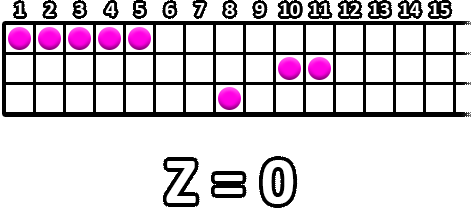
- Move all contestants in row $2$ to the east by $4$ tiles. $Z$ changes into $0 \text{ OR } 4 = 4$ .
- Move all contestants in row $1$ to the east by $12$ tiles. $Z$ changes into $4 \text{ OR } 12 = 12$ .
Now, columns $14$ and $15$ each contains exactly $2$ contestants.
For the $2$ -nd question, Pak Chanek can do the following operations to get $M=3$ :
- Move all contestants in row $3$ to the east by $4$ tiles. $Z$ changes into $0 \text{ OR } 4 = 4$ .
- Move all contestants in row $3$ to the west by $1$ tiles. $Z$ changes into $4 \text{ OR } 1 = 5$ .
- Move all contestants in row $1$ to the east by $5$ tiles. $Z$ changes into $5 \text{ OR } 5 = 5$ .
- Move all contestants in row $1$ to the east by $5$ tiles. $Z$ changes into $5 \text{ OR } 5 = 5$ .
Now, column $11$ contains exactly $3$ contestants.
The following is an illustration of the example operations for the $2$ -nd question.

C++ 编辑器
输入
输出
可保存默认模板;新题优先使用已保存模板。
当前快捷键仅展示,暂不支持修改。
- 撤销
Ctrl / ⌘ + Z - 重做
Ctrl / ⌘ + Y - 查找
Ctrl / ⌘ + F - 全选
Ctrl / ⌘ + A - 复制
Ctrl / ⌘ + C - 剪切
Ctrl / ⌘ + X - 粘贴
Ctrl / ⌘ + V - 自动排版
工具栏排版按钮 - 草稿保存
编辑时自动保存到本机
历史
提交记录
状态说明时间源码
AI
作答助手
你好,我是作答助手。可以问思路、复杂度、样例含义或代码报错原因;不会直接给出完整 AC 代码。
确定要清空代码吗?
提交通过
评测结果:Accepted