A15274 | Guess the Cycle Size
时间限制1s
内存限制256MB
通过 / 提交0/0
题目描述
This is an interactive problem.
I want to play a game with you...
We hid from you a cyclic graph of $n$ vertices ( $3 \le n \le 10^{18}$ ). A cyclic graph is an undirected graph of $n$ vertices that form one cycle. Each vertex belongs to the cycle, i.e. the length of the cycle (the number of edges in it) is exactly $n$ . The order of the vertices in the cycle is arbitrary.
You can make queries in the following way:
- "? a b" where $1 \le a, b \le 10^{18}$ and $a \neq b$ . In response to the query, the interactor outputs on a separate line the length of random of two paths from vertex $a$ to vertex $b$ , or -1 if $\max(a, b) > n$ . The interactor chooses one of the two paths with equal probability. The length of the path —is the number of edges in it.
You win if you guess the number of vertices in the hidden graph (number $n$ ) by making no more than $50$ queries.
Note that the interactor is implemented in such a way that for any ordered pair $(a, b)$ , it always returns the same value for query "? a b", no matter how many such queries. Note that the "? b a" query may be answered differently by the interactor.
The vertices in the graph are randomly placed, and their positions are fixed in advance.
Hacks are forbidden in this problem. The number of tests the jury has is $50$ .
I want to play a game with you...
We hid from you a cyclic graph of $n$ vertices ( $3 \le n \le 10^{18}$ ). A cyclic graph is an undirected graph of $n$ vertices that form one cycle. Each vertex belongs to the cycle, i.e. the length of the cycle (the number of edges in it) is exactly $n$ . The order of the vertices in the cycle is arbitrary.
You can make queries in the following way:
- "? a b" where $1 \le a, b \le 10^{18}$ and $a \neq b$ . In response to the query, the interactor outputs on a separate line the length of random of two paths from vertex $a$ to vertex $b$ , or -1 if $\max(a, b) > n$ . The interactor chooses one of the two paths with equal probability. The length of the path —is the number of edges in it.
You win if you guess the number of vertices in the hidden graph (number $n$ ) by making no more than $50$ queries.
Note that the interactor is implemented in such a way that for any ordered pair $(a, b)$ , it always returns the same value for query "? a b", no matter how many such queries. Note that the "? b a" query may be answered differently by the interactor.
The vertices in the graph are randomly placed, and their positions are fixed in advance.
Hacks are forbidden in this problem. The number of tests the jury has is $50$ .
输入格式
无
输出格式
You can make no more than $50$ of queries. To make a query, output on a separate line:
- "? a b", where $1 \le a, b \le 10^{18}$ and $a \neq b$ . In response to the query, the interactor will output on a separate line the length of a random simple path from vertex $a$ to vertex $b$ (not to be confused with the path from $b$ to $a$ ), or $-1$ if $\max(a, b) > n$ . The interactor chooses one of the two paths with equal probability.
If your program gets a number 0 as a result of a query, it means that the verdict for your solution is already defined as "wrong answer" (for example, you made more than $50$ queries or made an invalid query). In this case, your program should terminate immediately. Otherwise, in this scenario you may get a random verdict "Execution error", "Exceeded time limit" or some other verdict instead of "Wrong answer".
The answer, like queries, print on a separate line. The output of the answer is not counted as a query when counting them. To print it, use the following format:
- "! n": the expected size of the hidden graph ( $3 \le n \le 10^{18}$ ).
After that, your program should terminate.
After the output of the next query, be sure to use stream cleaning functions so that some of your output is not left in some buffer. For example, in C++ you should use function flush(stdout), in Java call System.out.flush(), in Pascal flush(output) and stdout.flush() for Python.
Note that the interactor is implemented in such a way that for any ordered pair $(a, b)$ , it always returns the same value for query "? a b", no matter how many such queries. Note that the "? b a" query may be answered differently by the interactor.
The vertices in the graph are randomly placed, and their positions are fixed in advance.
Hacks are forbidden in this problem. The number of tests the jury has is $50$ .
- "? a b", where $1 \le a, b \le 10^{18}$ and $a \neq b$ . In response to the query, the interactor will output on a separate line the length of a random simple path from vertex $a$ to vertex $b$ (not to be confused with the path from $b$ to $a$ ), or $-1$ if $\max(a, b) > n$ . The interactor chooses one of the two paths with equal probability.
If your program gets a number 0 as a result of a query, it means that the verdict for your solution is already defined as "wrong answer" (for example, you made more than $50$ queries or made an invalid query). In this case, your program should terminate immediately. Otherwise, in this scenario you may get a random verdict "Execution error", "Exceeded time limit" or some other verdict instead of "Wrong answer".
The answer, like queries, print on a separate line. The output of the answer is not counted as a query when counting them. To print it, use the following format:
- "! n": the expected size of the hidden graph ( $3 \le n \le 10^{18}$ ).
After that, your program should terminate.
After the output of the next query, be sure to use stream cleaning functions so that some of your output is not left in some buffer. For example, in C++ you should use function flush(stdout), in Java call System.out.flush(), in Pascal flush(output) and stdout.flush() for Python.
Note that the interactor is implemented in such a way that for any ordered pair $(a, b)$ , it always returns the same value for query "? a b", no matter how many such queries. Note that the "? b a" query may be answered differently by the interactor.
The vertices in the graph are randomly placed, and their positions are fixed in advance.
Hacks are forbidden in this problem. The number of tests the jury has is $50$ .
输入输出样例
输入 #1
1

2

-1
输出 #1
? 1 2

? 1 3

? 1 4

! 3
In the first example, the graph could look like this
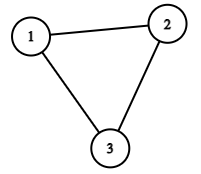The lengths of the simple paths between all pairs of vertices in this case are $1$ or $2$ .
- The first query finds out that one of the simple paths from vertex $1$ to vertex $2$ has a length of $1$ .
- With the second query, we find out that one of the simple paths from vertex $1$ to vertex $3$ has length $2$ .
- In the third query, we find out that vertex $4$ is not in the graph. Consequently, the size of the graph is $3$ .
The lengths of the simple paths between all pairs of vertices in this case are $1$ or $2$ .
- The first query finds out that one of the simple paths from vertex $1$ to vertex $2$ has a length of $1$ .
- With the second query, we find out that one of the simple paths from vertex $1$ to vertex $3$ has length $2$ .
- In the third query, we find out that vertex $4$ is not in the graph. Consequently, the size of the graph is $3$ .
C++ 编辑器
输入
输出
可保存默认模板;新题优先使用已保存模板。
当前快捷键仅展示,暂不支持修改。
- 撤销
Ctrl / ⌘ + Z - 重做
Ctrl / ⌘ + Y - 查找
Ctrl / ⌘ + F - 全选
Ctrl / ⌘ + A - 复制
Ctrl / ⌘ + C - 剪切
Ctrl / ⌘ + X - 粘贴
Ctrl / ⌘ + V - 自动排版
工具栏排版按钮 - 草稿保存
编辑时自动保存到本机
历史
提交记录
状态说明时间源码
AI
作答助手
你好,我是作答助手。可以问思路、复杂度、样例含义或代码报错原因;不会直接给出完整 AC 代码。
确定要清空代码吗?
提交通过
评测结果:Accepted