A15161. Tokitsukaze and Two Colorful Tapes
编程题
普及/提高-
知识点
题目描述
Tokitsukaze has two colorful tapes. There are $n$ distinct colors, numbered $1$ through $n$ , and each color appears exactly once on each of the two tapes. Denote the color of the $i$ -th position of the first tape as $ca_i$ , and the color of the $i$ -th position of the second tape as $cb_i$ .
Now Tokitsukaze wants to select each color an integer value from $1$ to $n$ , distinct for all the colors. After that she will put down the color values in each colored position on the tapes. Denote the number of the $i$ -th position of the first tape as $numa_i$ , and the number of the $i$ -th position of the second tape as $numb_i$ .
For example, for the above picture, assuming that the color red has value $x$ ( $1 \leq x \leq n$ ), it appears at the $1$ -st position of the first tape and the $3$ -rd position of the second tape, so $numa_1=numb_3=x$ .
Note that each color $i$ from $1$ to $n$ should have a distinct value, and the same color which appears in both tapes has the same value.
After labeling each color, the beauty of the two tapes is calculated as $$$$\sum_{i=1}^{n}|numa_i-numb_i|. $$$$
Please help Tokitsukaze to find the highest possible beauty.
Now Tokitsukaze wants to select each color an integer value from $1$ to $n$ , distinct for all the colors. After that she will put down the color values in each colored position on the tapes. Denote the number of the $i$ -th position of the first tape as $numa_i$ , and the number of the $i$ -th position of the second tape as $numb_i$ .
For example, for the above picture, assuming that the color red has value $x$ ( $1 \leq x \leq n$ ), it appears at the $1$ -st position of the first tape and the $3$ -rd position of the second tape, so $numa_1=numb_3=x$ .
Note that each color $i$ from $1$ to $n$ should have a distinct value, and the same color which appears in both tapes has the same value.
After labeling each color, the beauty of the two tapes is calculated as $$$$\sum_{i=1}^{n}|numa_i-numb_i|. $$$$
Please help Tokitsukaze to find the highest possible beauty.
输入格式
The first contains a single positive integer $t$ ( $1 \leq t \leq 10^4$ ) — the number of test cases.
For each test case, the first line contains a single integer $n$ ( $1\leq n \leq 10^5$ ) — the number of colors.
The second line contains $n$ integers $ca_1, ca_2, \ldots, ca_n$ ( $1 \leq ca_i \leq n$ ) — the color of each position of the first tape. It is guaranteed that $ca$ is a permutation.
The third line contains $n$ integers $cb_1, cb_2, \ldots, cb_n$ ( $1 \leq cb_i \leq n$ ) — the color of each position of the second tape. It is guaranteed that $cb$ is a permutation.
It is guaranteed that the sum of $n$ over all test cases does not exceed $2 \cdot 10^{5}$ .
For each test case, the first line contains a single integer $n$ ( $1\leq n \leq 10^5$ ) — the number of colors.
The second line contains $n$ integers $ca_1, ca_2, \ldots, ca_n$ ( $1 \leq ca_i \leq n$ ) — the color of each position of the first tape. It is guaranteed that $ca$ is a permutation.
The third line contains $n$ integers $cb_1, cb_2, \ldots, cb_n$ ( $1 \leq cb_i \leq n$ ) — the color of each position of the second tape. It is guaranteed that $cb$ is a permutation.
It is guaranteed that the sum of $n$ over all test cases does not exceed $2 \cdot 10^{5}$ .
输出格式
For each test case, print a single integer — the highest possible beauty.
输入输出样例
输入 #1
3
6
1 5 4 3 2 6
5 3 1 4 6 2
6
3 5 4 6 2 1
3 6 4 5 2 1
1
1
1
输出 #1
18
10
0
说明/提示
An optimal solution for the first test case is shown in the following figure:
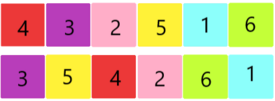The beauty is $\left|4-3 \right|+\left|3-5 \right|+\left|2-4 \right|+\left|5-2 \right|+\left|1-6 \right|+\left|6-1 \right|=18$ .
An optimal solution for the second test case is shown in the following figure:
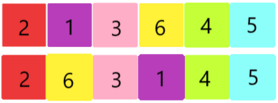The beauty is $\left|2-2 \right|+\left|1-6 \right|+\left|3-3 \right|+\left|6-1 \right|+\left|4-4 \right|+\left|5-5 \right|=10$ .
The beauty is $\left|4-3 \right|+\left|3-5 \right|+\left|2-4 \right|+\left|5-2 \right|+\left|1-6 \right|+\left|6-1 \right|=18$ .
An optimal solution for the second test case is shown in the following figure:
The beauty is $\left|2-2 \right|+\left|1-6 \right|+\left|3-3 \right|+\left|6-1 \right|+\left|4-4 \right|+\left|5-5 \right|=10$ .