A15069 | Zero Path
时间限制1s
内存限制256MB
通过 / 提交0/0
题目描述
You are given a grid with $n$ rows and $m$ columns. We denote the square on the $i$ -th ( $1\le i\le n$ ) row and $j$ -th ( $1\le j\le m$ ) column by $(i, j)$ and the number there by $a_{ij}$ . All numbers are equal to $1$ or to $-1$ .
You start from the square $(1, 1)$ and can move one square down or one square to the right at a time. In the end, you want to end up at the square $(n, m)$ .
Is it possible to move in such a way so that the sum of the values written in all the visited cells (including $a_{11}$ and $a_{nm}$ ) is $0$ ?
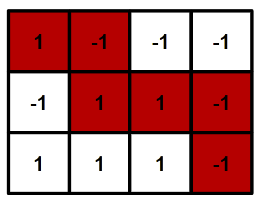
You start from the square $(1, 1)$ and can move one square down or one square to the right at a time. In the end, you want to end up at the square $(n, m)$ .
Is it possible to move in such a way so that the sum of the values written in all the visited cells (including $a_{11}$ and $a_{nm}$ ) is $0$ ?

输入格式
Each test contains multiple test cases. The first line contains the number of test cases $t$ ( $1 \leq t \leq 10^4$ ). Description of the test cases follows.
The first line of each test case contains two integers $n$ and $m$ ( $1 \le n, m \le 1000$ ) — the size of the grid.
Each of the following $n$ lines contains $m$ integers. The $j$ -th integer on the $i$ -th line is $a_{ij}$ ( $a_{ij} = 1$ or $-1$ ) — the element in the cell $(i, j)$ .
It is guaranteed that the sum of $n\cdot m$ over all test cases does not exceed $10^6$ .
The first line of each test case contains two integers $n$ and $m$ ( $1 \le n, m \le 1000$ ) — the size of the grid.
Each of the following $n$ lines contains $m$ integers. The $j$ -th integer on the $i$ -th line is $a_{ij}$ ( $a_{ij} = 1$ or $-1$ ) — the element in the cell $(i, j)$ .
It is guaranteed that the sum of $n\cdot m$ over all test cases does not exceed $10^6$ .
输出格式
For each test case, print "YES" if there exists a path from the top left to the bottom right that adds up to $0$ , and "NO" otherwise. You can output each letter in any case.
输入输出样例
输入 #1
5
1 1
1
1 2
1 -1
1 4
1 -1 1 -1
3 4
1 -1 -1 -1
-1 1 1 -1
1 1 1 -1
3 4
1 -1 1 1
-1 1 -1 1
1 -1 1 1
输出 #1
NO
YES
YES
YES
NO
One possible path for the fourth test case is given in the picture in the statement.
C++ 编辑器
输入
输出
可保存默认模板;新题优先使用已保存模板。
当前快捷键仅展示,暂不支持修改。
- 撤销
Ctrl / ⌘ + Z - 重做
Ctrl / ⌘ + Y - 查找
Ctrl / ⌘ + F - 全选
Ctrl / ⌘ + A - 复制
Ctrl / ⌘ + C - 剪切
Ctrl / ⌘ + X - 粘贴
Ctrl / ⌘ + V - 自动排版
工具栏排版按钮 - 草稿保存
编辑时自动保存到本机
历史
提交记录
状态说明时间源码
AI
作答助手
你好,我是作答助手。可以问思路、复杂度、样例含义或代码报错原因;不会直接给出完整 AC 代码。
确定要清空代码吗?
提交通过
评测结果:Accepted