A14955. Big Brush
编程题
普及/提高-
知识点
题目描述
You found a painting on a canvas of size $n \times m$ . The canvas can be represented as a grid with $n$ rows and $m$ columns. Each cell has some color. Cell $(i, j)$ has color $c_{i,j}$ .
Near the painting you also found a brush in the shape of a $2 \times 2$ square, so the canvas was surely painted in the following way: initially, no cell was painted. Then, the following painting operation has been performed some number of times:
- Choose two integers $i$ and $j$ ( $1 \le i < n$ , $1 \le j < m$ ) and some color $k$ ( $1 \le k \le nm$ ).
- Paint cells $(i, j)$ , $(i + 1, j)$ , $(i, j + 1)$ , $(i + 1, j + 1)$ in color $k$ .
All cells must be painted at least once. A cell can be painted multiple times. In this case, its final color will be the last one.
Find any sequence of at most $nm$ operations that could have led to the painting you found or state that it's impossible.
Near the painting you also found a brush in the shape of a $2 \times 2$ square, so the canvas was surely painted in the following way: initially, no cell was painted. Then, the following painting operation has been performed some number of times:
- Choose two integers $i$ and $j$ ( $1 \le i < n$ , $1 \le j < m$ ) and some color $k$ ( $1 \le k \le nm$ ).
- Paint cells $(i, j)$ , $(i + 1, j)$ , $(i, j + 1)$ , $(i + 1, j + 1)$ in color $k$ .
All cells must be painted at least once. A cell can be painted multiple times. In this case, its final color will be the last one.
Find any sequence of at most $nm$ operations that could have led to the painting you found or state that it's impossible.
输入格式
The first line of input contains two integers $n$ and $m$ ( $2 \le n, m \le 1000$ ) — the dimensions of the canvas.
On the $i$ -th of the next $n$ lines of input, there will be $m$ integers. The $j$ -th of them is $a_{i,j}$ ( $1 \le a_{i,j} \le nm$ ) — the color of cell $(i, j)$ .
On the $i$ -th of the next $n$ lines of input, there will be $m$ integers. The $j$ -th of them is $a_{i,j}$ ( $1 \le a_{i,j} \le nm$ ) — the color of cell $(i, j)$ .
输出格式
If there is no solution, print a single integer $-1$ .
Otherwise, on the first line, print one integer $q$ ( $1 \le q \le nm$ ) — the number of operations.
Next, print the operations in order. On the $k$ -th of the next $q$ lines, print three integers $i$ , $j$ , $c$ ( $1 \le i < n$ , $1 \le j < m$ , $1 \le c \le nm$ ) — the description of the $k$ -th operation.
If there are multiple solutions, print any.
Otherwise, on the first line, print one integer $q$ ( $1 \le q \le nm$ ) — the number of operations.
Next, print the operations in order. On the $k$ -th of the next $q$ lines, print three integers $i$ , $j$ , $c$ ( $1 \le i < n$ , $1 \le j < m$ , $1 \le c \le nm$ ) — the description of the $k$ -th operation.
If there are multiple solutions, print any.
输入输出样例
输入 #1
4 4
5 5 3 3
1 1 5 3
2 2 5 4
2 2 4 4
输出 #1
6
1 3 3
3 3 4
2 2 5
1 1 5
2 1 1
3 1 2
输入 #2
3 4
1 1 1 1
2 2 3 1
2 2 1 1
输出 #2
-1
说明/提示
In the first test case, the solution is not unique. Here's one of them:
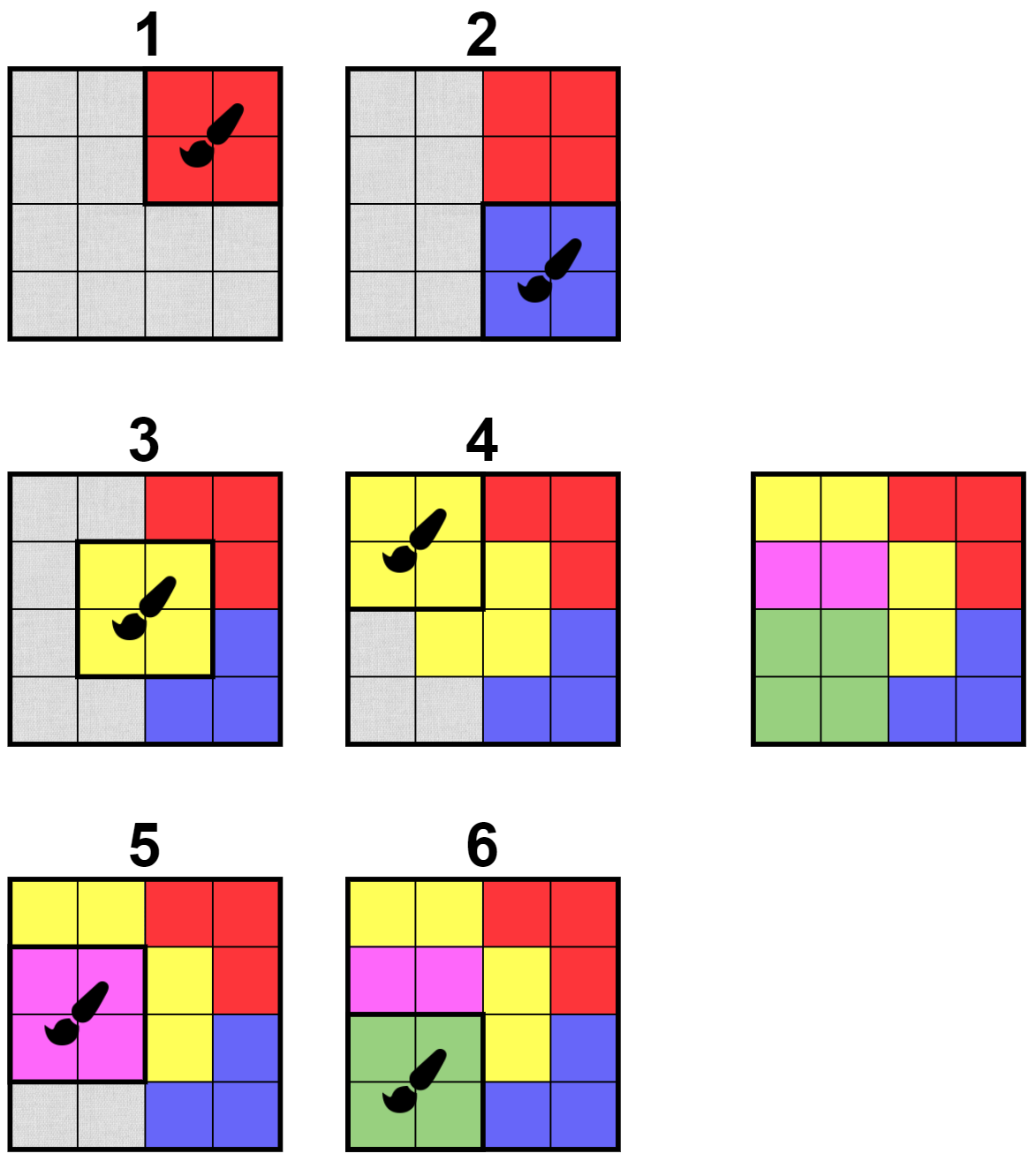In the second test case, there is no way one could obtain the given painting, thus the answer is $-1$ .
In the second test case, there is no way one could obtain the given painting, thus the answer is $-1$ .