A14809 | Not Escaping
时间限制1s
内存限制256MB
通过 / 提交0/0
题目描述
Major Ram is being chased by his arch enemy Raghav. Ram must reach the top of the building to escape via helicopter. The building, however, is on fire. Ram must choose the optimal path to reach the top of the building to lose the minimum amount of health.
The building consists of $n$ floors, each with $m$ rooms each. Let $(i, j)$ represent the $j$ -th room on the $i$ -th floor. Additionally, there are $k$ ladders installed. The $i$ -th ladder allows Ram to travel from $(a_i, b_i)$ to $(c_i, d_i)$ , but not in the other direction. Ram also gains $h_i$ health points if he uses the ladder $i$ . It is guaranteed $a_i < c_i$ for all ladders.
If Ram is on the $i$ -th floor, he can move either left or right. Travelling across floors, however, is treacherous. If Ram travels from $(i, j)$ to $(i, k)$ , he loses $|j-k| \cdot x_i$ health points.
Ram enters the building at $(1, 1)$ while his helicopter is waiting at $(n, m)$ . What is the minimum amount of health Ram loses if he takes the most optimal path? Note this answer may be negative (in which case he gains health). Output "NO ESCAPE" if no matter what path Ram takes, he cannot escape the clutches of Raghav.
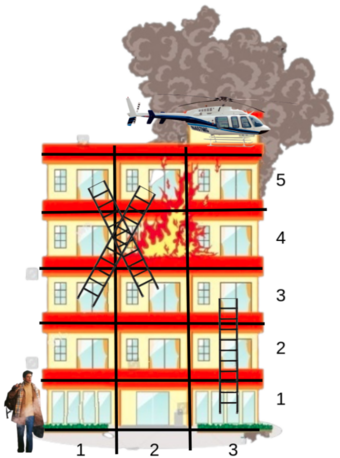
The building consists of $n$ floors, each with $m$ rooms each. Let $(i, j)$ represent the $j$ -th room on the $i$ -th floor. Additionally, there are $k$ ladders installed. The $i$ -th ladder allows Ram to travel from $(a_i, b_i)$ to $(c_i, d_i)$ , but not in the other direction. Ram also gains $h_i$ health points if he uses the ladder $i$ . It is guaranteed $a_i < c_i$ for all ladders.
If Ram is on the $i$ -th floor, he can move either left or right. Travelling across floors, however, is treacherous. If Ram travels from $(i, j)$ to $(i, k)$ , he loses $|j-k| \cdot x_i$ health points.
Ram enters the building at $(1, 1)$ while his helicopter is waiting at $(n, m)$ . What is the minimum amount of health Ram loses if he takes the most optimal path? Note this answer may be negative (in which case he gains health). Output "NO ESCAPE" if no matter what path Ram takes, he cannot escape the clutches of Raghav.

输入格式
The first line of input contains $t$ ( $1 \leq t \leq 5 \cdot 10^4$ ) — the number of test cases.
The first line of each test case consists of $3$ integers $n, m, k$ ( $2 \leq n, m \leq 10^5$ ; $1 \leq k \leq 10^5$ ) — the number of floors, the number of rooms on each floor and the number of ladders respectively.
The second line of a test case consists of $n$ integers $x_1, x_2, \dots, x_n$ ( $1 \leq x_i \leq 10^6$ ).
The next $k$ lines describe the ladders. Ladder $i$ is denoted by $a_i, b_i, c_i, d_i, h_i$ ( $1 \leq a_i < c_i \leq n$ ; $1 \leq b_i, d_i \leq m$ ; $1 \leq h_i \leq 10^6$ ) — the rooms it connects and the health points gained from using it.
It is guaranteed $a_i < c_i$ for all ladders and there is at most one ladder between any 2 rooms in the building.
The sum of $n$ , the sum of $m$ , and the sum of $k$ over all test cases do not exceed $10^5$ .
The first line of each test case consists of $3$ integers $n, m, k$ ( $2 \leq n, m \leq 10^5$ ; $1 \leq k \leq 10^5$ ) — the number of floors, the number of rooms on each floor and the number of ladders respectively.
The second line of a test case consists of $n$ integers $x_1, x_2, \dots, x_n$ ( $1 \leq x_i \leq 10^6$ ).
The next $k$ lines describe the ladders. Ladder $i$ is denoted by $a_i, b_i, c_i, d_i, h_i$ ( $1 \leq a_i < c_i \leq n$ ; $1 \leq b_i, d_i \leq m$ ; $1 \leq h_i \leq 10^6$ ) — the rooms it connects and the health points gained from using it.
It is guaranteed $a_i < c_i$ for all ladders and there is at most one ladder between any 2 rooms in the building.
The sum of $n$ , the sum of $m$ , and the sum of $k$ over all test cases do not exceed $10^5$ .
输出格式
Output the minimum health Ram loses on the optimal path from $(1, 1)$ to $(n, m)$ . If Ram cannot escape the clutches of Raghav regardless of the path he takes, output "NO ESCAPE" (all uppercase, without quotes).
输入输出样例
输入 #1
4
5 3 3
5 17 8 1 4
1 3 3 3 4
3 1 5 2 5
3 2 5 1 6
6 3 3
5 17 8 1 4 2
1 3 3 3 4
3 1 5 2 5
3 2 5 1 6
5 3 1
5 17 8 1 4
1 3 5 3 100
5 5 5
3 2 3 7 5
3 5 4 2 1
2 2 5 4 5
4 4 5 2 3
1 2 4 2 2
3 3 5 2 4
输出 #1
16
NO ESCAPE
-90
27
The figure for the first test case is in the statement. There are only $2$ possible paths to $(n, m)$ :
- Ram travels to $(1, 3)$ , takes the ladder to $(3, 3)$ , travels to $(3, 2)$ , takes the ladder to $(5, 1)$ , travels to $(5, 3)$ where he finally escapes via helicopter. The health lost would be $$$$ \begin{align*} &\mathrel{\phantom{=}} x_1 \cdot |1-3| - h_1 + x_3 \cdot |3-2| - h_3 + x_5 \cdot |1-3| \\ &= 5 \cdot 2 - 4 + 8 \cdot 1 - 6 + 4 \cdot 2 \\ &= 16. \end{align*} $$ </li><li> Ram travels to $(1, 3)$ , takes the ladder to $(3, 3)$ , travels to $(3, 1)$ , takes the ladder to $(5, 2)$ , travels to $(5, 3)$ where he finally escapes via helicopter. The health lost would be $$ \begin{align*} &\mathrel{\phantom{=}} x_1 \cdot |1-3| - h_1 + x_3 \cdot |3-1| - h_2 + a_5 \cdot |2-3| \\ &= 5 \cdot 2 - 4 + 8 \cdot 2 - 5 + 4 \cdot 1 \\ &= 21. \end{align*} $$ </li></ul> Therefore, the minimum health lost would be $16$ .<p>In the second test case, there is no path to $(n, m)$ .</p><p>In the third case case, Ram travels to $(1, 3)$ and takes the only ladder to $(5, 3)$ . He loses $5 \\cdot 2$ health points and gains $h\_1 = 100$ health points. Therefore the total loss is $10-100=-90$$$ (negative implies he gains health after the path).
- Ram travels to $(1, 3)$ , takes the ladder to $(3, 3)$ , travels to $(3, 2)$ , takes the ladder to $(5, 1)$ , travels to $(5, 3)$ where he finally escapes via helicopter. The health lost would be $$$$ \begin{align*} &\mathrel{\phantom{=}} x_1 \cdot |1-3| - h_1 + x_3 \cdot |3-2| - h_3 + x_5 \cdot |1-3| \\ &= 5 \cdot 2 - 4 + 8 \cdot 1 - 6 + 4 \cdot 2 \\ &= 16. \end{align*} $$ </li><li> Ram travels to $(1, 3)$ , takes the ladder to $(3, 3)$ , travels to $(3, 1)$ , takes the ladder to $(5, 2)$ , travels to $(5, 3)$ where he finally escapes via helicopter. The health lost would be $$ \begin{align*} &\mathrel{\phantom{=}} x_1 \cdot |1-3| - h_1 + x_3 \cdot |3-1| - h_2 + a_5 \cdot |2-3| \\ &= 5 \cdot 2 - 4 + 8 \cdot 2 - 5 + 4 \cdot 1 \\ &= 21. \end{align*} $$ </li></ul> Therefore, the minimum health lost would be $16$ .<p>In the second test case, there is no path to $(n, m)$ .</p><p>In the third case case, Ram travels to $(1, 3)$ and takes the only ladder to $(5, 3)$ . He loses $5 \\cdot 2$ health points and gains $h\_1 = 100$ health points. Therefore the total loss is $10-100=-90$$$ (negative implies he gains health after the path).
C++ 编辑器
输入
输出
可保存默认模板;新题优先使用已保存模板。
当前快捷键仅展示,暂不支持修改。
- 撤销
Ctrl / ⌘ + Z - 重做
Ctrl / ⌘ + Y - 查找
Ctrl / ⌘ + F - 全选
Ctrl / ⌘ + A - 复制
Ctrl / ⌘ + C - 剪切
Ctrl / ⌘ + X - 粘贴
Ctrl / ⌘ + V - 自动排版
工具栏排版按钮 - 草稿保存
编辑时自动保存到本机
历史
提交记录
状态说明时间源码
AI
作答助手
你好,我是作答助手。可以问思路、复杂度、样例含义或代码报错原因;不会直接给出完整 AC 代码。
确定要清空代码吗?
提交通过
评测结果:Accepted